Wednesday, July 8, 2026

STATE NEWS

Dairy Plus Now Accepting Applications

By Paul Sousa, Director of Regulatory & Environmental Affairs


The California Department of Food and Agriculture (CDFA) and the California Dairy Research Foundation recently announced that $34 million from the Dairy Plus program is now available, with completed applications due September 14. Dairy Plus is the result of a successful application submitted by the California Dairy Research Foundation (CDRF) to USDA. CDRF was awarded $85 million, with $75 million going directly to dairy farmers for on-farm projects. CDFA was selected to administer the farmer funding because it already had staff managing the Digester and Alternative Manure Management Program (AMMP). Two rounds of Dairy Plus funding have already been completed, making this the final funding round under the $85 million award.


Dairy Plus funds advanced solid manure separation projects that address both methane emissions and water quality. This is especially timely now that we have a clearer picture of where water quality regulations are headed with the adoption of the Modesto Management Zone Implementation Plan (MZIP) and the release of the State Water Board's Dairy Remand Order. Dairy Plus may be a good fit for dairies working to achieve a whole-farm nitrogen balance to better protect groundwater quality. These projects significantly reduce nutrients in the liquid manure stream and make them available for exporting or composting.


Dairy Plus was designed to fund advanced solid-liquid separation systems, so the standard separation systems commonly found on dairies are not eligible. Those systems had previously been funded through AMMP, but with no current state funding, there is no AMMP funding available for these types of projects. AMMP projects not eligible under Dairy Plus include standard sloped screen separators, compost bedded pack barns, and pasture-based projects.


Projects eligible for Dairy Plus funding include:

  • Vermifiltration
  • Weeping wall separation
  • Flocculant- or bead-assisted separation
  • Centrifuge separation


These technologies must be implemented after primary separation to achieve additional solid manure removal and may be installed with or without a digester.


Once one of these projects has been selected, subsurface drip irrigation using liquid manure or composting may be included as an additional project component.

The right project for your dairy depends on your operation and the challenges you are trying to solve. Selecting a project that best fits your dairy is important, and I am happy to discuss how each of these technologies may help meet your operation's needs.


Funded projects are eligible for up to $1.25 million in federal funding with no matching funds required, subject to a maximum of $750 per cow. This article provides only a general overview of the Dairy Plus program. For complete program requirements and application information, please review the Dairy Plus Request for Grant Applications and other materials available on the CDFA Dairy Plus website: https://www.cdfa.ca.gov/oars/dairyplus. If you have any questions on how it might work for your dairy please contact me at 209-556-2490 or paul@wudairies.com.


Dairy Industry Shaken up on June 3

By Dr. Deanne Meyer, Ph.D., Livestock Waste Management Specialist, UC Davis & UC ANR | Originally Published in CDQAP's June Newsletter


It wasn’t an earthquake. However, it may result in the largest change in dairy

management since the adoption of the bulk tank.


On June 3, 2026, the Central Valley Regional Water Quality Control Board

(RB5) adopted the Modesto Nitrate Management Zone Implementation Plan

(MZIP for short). For dairies, this Plan starts a 35-year timeclock. Between

now and then, dairy producers and the Central Valley Dairy Representative

Monitoring Program (CVDRMP) have much work to accomplish. The goal at

the end of the 35 years is to achieve no further degradation of the groundwater

from nitrate.


The 35-year window provides time to identify and implement improvements

needed to manage surplus nitrogen at each farm and then appropriately manage

the remaining nitrogen. Specific deliverables must be accomplished over time

and require accountability. The MZIP area will continue to test drinking water

and provide safe water to residents with impacted wells when tests show water

is above the safe drinking water standard for nitrate concentration. Within

three years, examples include use of a new Data Management System for

Annual Reports (web-based portal) and data collection to allow analyses of

data at different scales, development of site-specific Irrigation and Nutrient

Management Plans, and reporting of compliance with Irrigation and Nutrient

Management Plan annually thereafter. At 10 years, each dairy must document

it is on track to achieve 0 nitrogen surplus by the 35-year mark. This becomes

increasingly more difficult for facilities that may have intermittent fallowing of

land due to Sustainable Ground Water Management Act restrictions.


For now, the focus is on meeting the no further degradation goal in 35 years.

The local management zone board of directors will review nitrate loading

information and identify if there is a different approach regarding collection

of funds to pay for water quality testing, safe drinking water and any needed

research. Maintaining seats at the table is essential for representation. Dairy

producers contribute to management zone costs through CVDRMP.


CDQAP held workshops June 10 (allied industry), and June 11 and 19

(dairy producers) to highlight requirements and timeline milestones. More

information will follow as additional management zones prepare to adopt

similar Orders.


And there’s more. Additional requirements for all Central Valley dairies will occur

when the State Water Resources Control Board adopts an order anticipated this

fall. The State Board released its draft order on June 15 and says it is scheduled to

be adopted at a public hearing in September. RB5 will be required to address the

additional requirements as it modifies its Dairy General Order.


Be sure you consider implications of both the MZIP and Dairy General Order

regulatory changes while you consider facility modifications and long-term

contractual obligations.


MARKET UPDATE

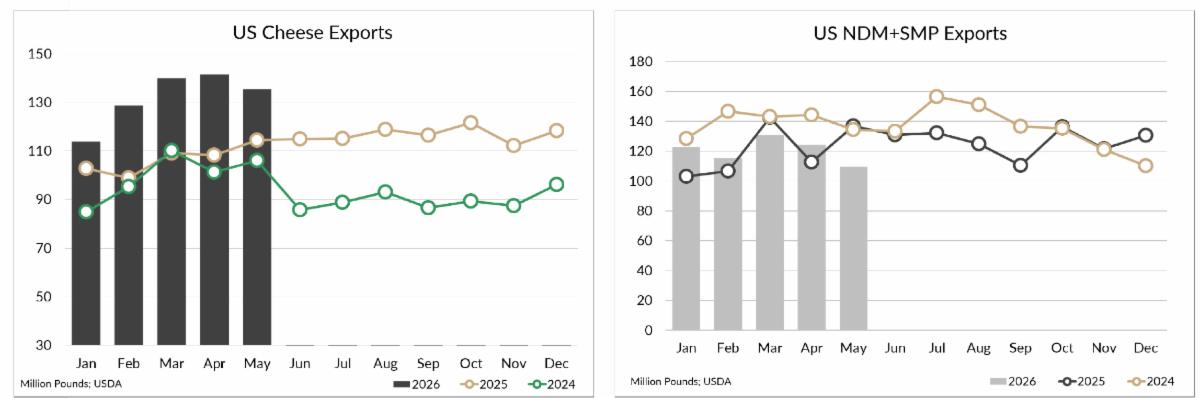
The international marketplace continues to favor most US dairy products. In May, US cheese exports jumped 18%, while butter leapt 89% and whey surged 112% versus 2025. But outbound milk powder volume declined, down 20% as historically high prices hurt competitiveness.

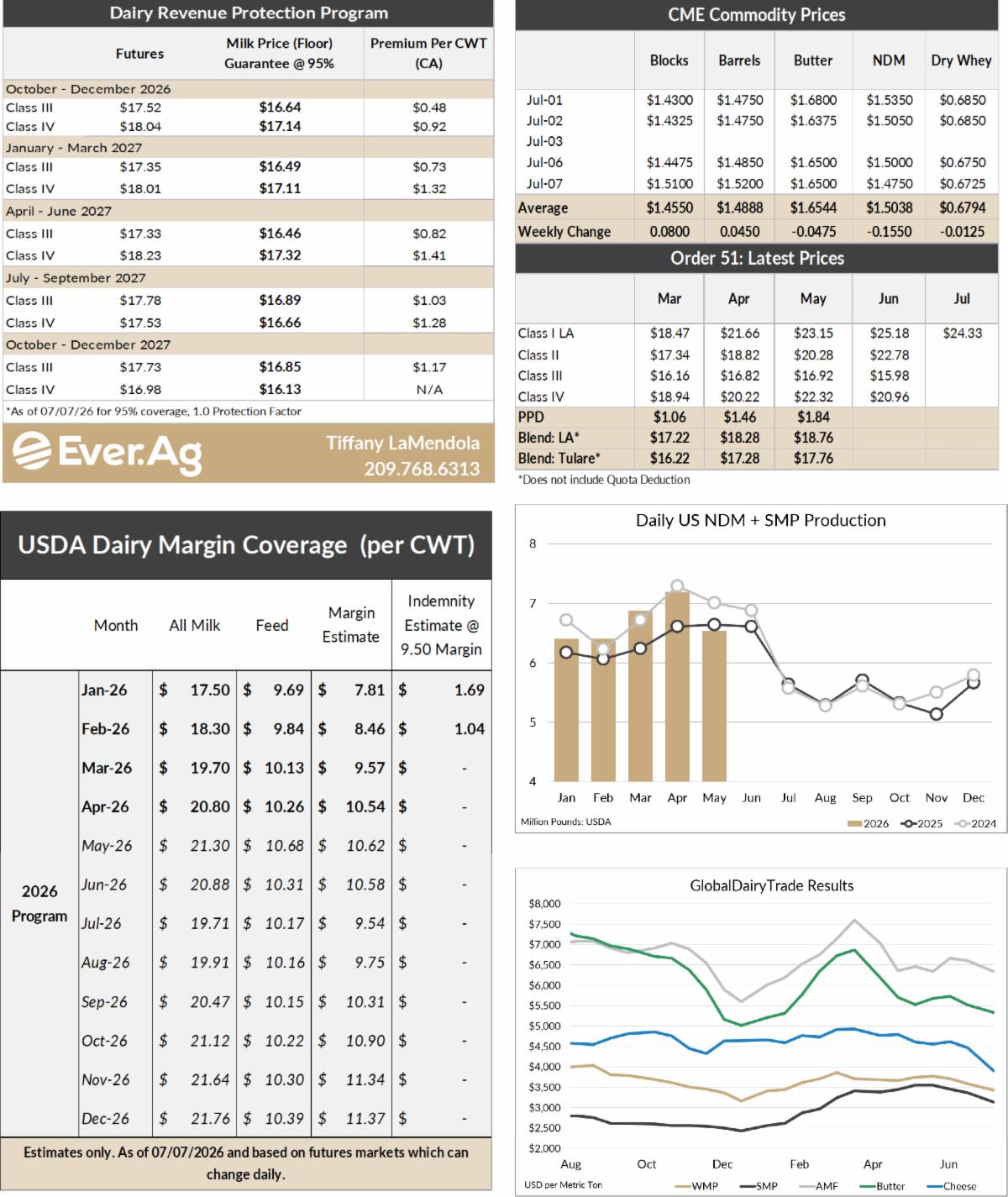
  • Spot nonfat dry milk continued to fall from its historic highs, dropping to the $1.40s for the first time since early February. Reports suggest supplies have improved. Global prices are also on the decline, adding more pressure to the US market.


  • The CME butter market still appears comfortable in the mid-$1.60s. Domestic demand is strong and US prices are globally competitive. But there’s also still plenty of cream and churns are still making enough butter to meet that demand.


  • After remaining rangebound in the $1.40s, spot blocks jumped to the $1.50s for the first time since May. Another month of strong export sales likely helped give the market a bump.
  • According to USDA’s May Dairy Products report, nonfat dry milk production was high-er but skim milk powder output lower (makes sense as manufactures make less SMP for export). Stocks remain slightly lower versus 2025 but above 2024. Total cheese and butter outputs were up year-over-year.


  • Milk powder prices took a tumble at this week’s Global Dairy Trade auction, with SMP down 6.9% to $1.42 per pound and whole milk powder down 4.6% to $1.55. Cheddar fell 12.8% to $1.77 per pound, while butter slipped 3.3% to $2.42.


  • Forecasts for continued hot and dry weather helped drive nearby corn and soybean futures sharply higher. USDA’s July World Agricultural Supply and Demand Estimates report, due Friday, usually cools these traditional mid-Summer rallies.


THANK YOU TO OUR CURRENT SPONSORS


Facebook  Instagram  LinkedIn  Web