Weekly Digest Number 29 - July 19th, 2022 |
|
Welcome to the RWU Rail & Labor News! This news bulletin is produced and emailed out each Tuesday morning. We hope you find each week's news and information useful. If so, please share with co-workers, friends, and colleagues. If you like, you can sign them up to get all the news from RWU HERE. Or forward them the link. Note: If you read over this news bulletin each week, you will be sure to never miss the important news of what is going on in the railroad world from a worker's perspective!
|
|
(Editor's Note: This overwhelming support for a strike comes as no surprise to rail workers of all crafts who are fed up and disgusted with the Class One freight carriers. If and when other rail unions poll their members, the results will no doubt be similar. Since rail workers are ready for the fight, the rail union leadership must now prepare the workers for the looming showdown. It is high time we mobilize!) |
|
BLET Members Vote in Favor of Strike Authorization |
|
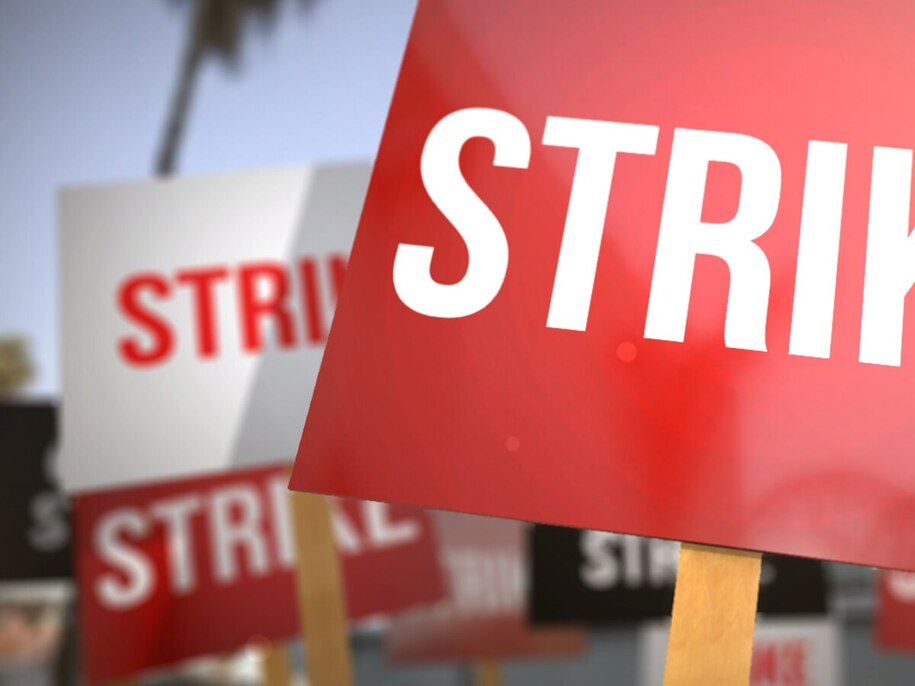
About 99.5% of the participating membership authorized the strike, should such action become legal in the coming days, and become necessary to secure a contract with the rail carriers, BLET National President Dennis Pierce said in a prepared statement.
The action was the first nationwide strike vote over national rail contract negotiations since 2011. BLET represents more than 57,000 locomotive engineers, conductors, brakemen, firemen, switchmen, hostlers and other train-service employees.
Pierce said the railroads' operating plans and subsequent actions taken during the pandemic have contributed to a "toxic" work culture for railroad employees. He accused he railroads of stonewalling at the bargaining table.
"The question of whether or not any of the rail industry’s union-represented employees want to legally strike is secondary to what they truly want," said Pierce. "They want a contract with meaningful wage increases and good benefits. They want jobs that give them the ability to have a life outside of work. To be clear, there would be no need for a strike vote if any of that had happened in these negotiations."
To read Pierce's full statement, click here.
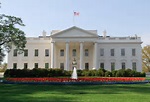
Meanwhile, both sides of the bargaining table — as well as rail shippers — are waiting for President Joe Biden to set up a Presidential Emergency Board to help break the contract stalemate. Biden faces a deadline of July 18 to establish the board.
|
|
VIDEO: "Why Railroad Workers May Soon Strike" |
|
The BLET has produced this commercial video to inform people concerned about anything rail related why there maybe a possible strike from rail unions.
Watch this 4 minute video now available on You Tube to learn more about the background and the issues that have led us to where we are now, with the nation's railroad workers poised to strike if necessary.
The video was produced by the BLET. But all of the nation's rail unions are in Coalition and ready to strike as well.
|
|
(Editor's Note: As expected, the White House announced a few days before the deadline the appointment of a PEB on 7/15/22. Now that this business is finally out of the way, we can get on with the next order of business - preparing for a strike in the event that rank & file vote against the recommendation of the PEB. We may still get a kick at the carriers in September!) |
|
Biden Signs Order to Create PEB in Rail Labor Dispute |
|
Biden's deadline for establishing the board is July 18. His action today impacts the railroads represented in contract negotiations by the National Carriers' Conference Committee of the National Railway Labor Conference, and their employers represented by certain labor unions.
Establishing the board delays a strike or lockout for 60 days. The board — which will consist of a chair and two members — has 30 days to investigate the differences between the parties and report recommendations for settling the dispute to the president. The recommendations are nonbinding. After the PEB reports to the president, the railroads and unions have a 30-day cooling-off period to consider the recommendations and reach a settlement.
|
|
(Editor's Note: RWU General Secretary Jason Doering was interviewed as part of this article in Freightwaves.)
|
|
America’s Freight Railroads are Incredibly Chaotic Right Now |
|
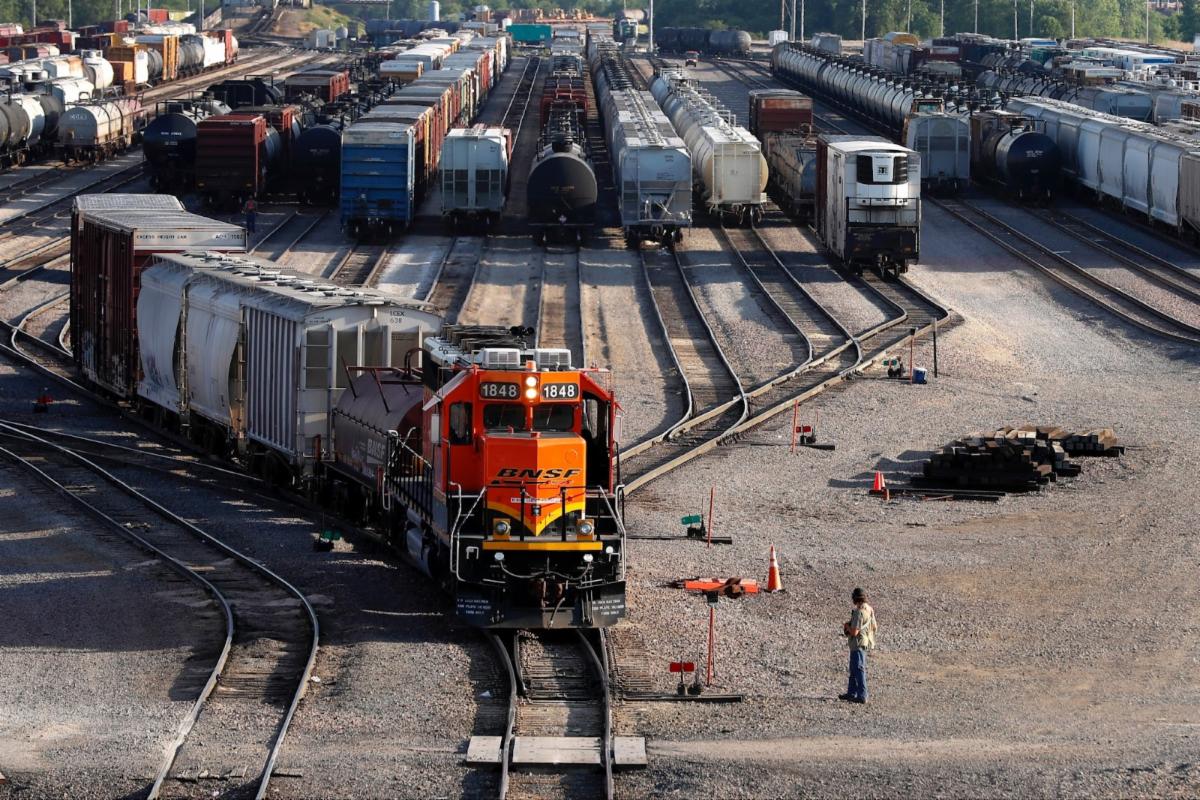
Jason Doering has seen a lot during his 18 years at Union Pacific Railroad. But what’s happening with the current hiring class at UP is unprecedented. “They’re dropping like flies,” Doering said. “I mean, I’ve never seen it.”
A railroad engineer or conductor typically earns a six-figure salary, retires with a pension and enjoys union benefits. They don’t need a college degree; the monthslong training is provided on the job. It’s the kind of career that ought to be popular — but Doering said trainees and longtimers alike are getting burned out. It used to be a job with eight- or nine-hour shifts and plenty of time at home. Now, Doering says railroading demands too much time away from one’s family and workdays that last up to 19 hours, combining 12-hour shifts with hours of waiting around for transportation or relief crews.
Union Pacific is struggling to find railroad crews after years of slashing headcounts. The $22 billion railroader had 30,100 employees during the first three months of 2022, according to its latest earnings report. Five years prior, the company had nearly 12,000 more workers. (A representative from Union Pacific declined to provide a comment for this article, as the company is reporting its second-quarter earnings later this month. The rep did share a company blog on the importance of supply chain fluidity and cooperation.)
This employment issue isn’t unique to Union Pacific. America’s railways are in an unusually chaotic state as Class I lines struggle to find employees. That’s led to congestion that analysts say is even worse than 2021, which saw some of the biggest rail traffic in history. Now, a strike of 115,000 rail workers could happen as soon as next week.
|
|
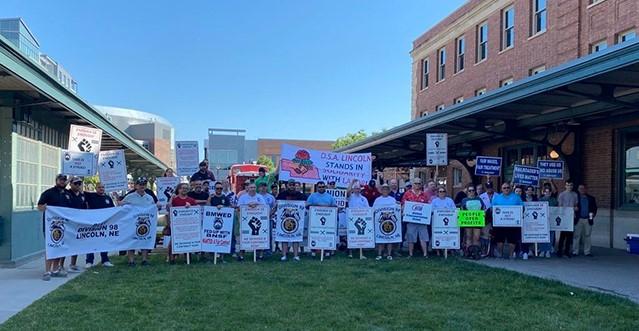
(Editor's Note: Rallies are being organized in many other towns and cities across the country in the coming weeks, including Galesburg, IL, Toledo, OH and Marquette, MI. Watch for more info soon.) |
|
Rail Union Workers Rally in Lincoln, NE for a Fair Contract |
|
As you’ve likely seen or heard by now, yesterday’s Rally for Rail Labor in downtown Lincoln, Neb. was a great success, drawing over 100 members, their families, and other Union supporters and affording us an opportunity to reach the public with our demands that the railroad carriers agree to a fair and equitable contract this round.
The press was in attendance. Politicians from both sides of the aisle. Members from an assortment of Rail and other Labor Unions. Spouses and children. Supporters who just want to see working men and women get a fair shake for the hard work they put in. It was a tremendous day in Nebraska’s capital city.
Our message is true. We’re not being greedy. We’re asking to be treated and compensated fairly. We’re demanding that the railroads afford us respect. Morale is low, workers are leaving the industry in record numbers, yet the suits in company headquarters can’t get off Wall Street’s Kool-Aid long enough to make anything remotely close to a fair offer this bargaining round. But, people see this. The public sees it. Many politicians see it. Sentiment is on our side.
So, to those who joined us yesterday in Lincoln, thank you. To those planning similar events of your own, keep up the momentum! We are on the right side, and we will win if we stay united!
|
|
(Editor's Note: When the workers actually are posed to strike and the hour draws near, the rail carriers can be backed down and suddenly find themselves ready to meet our demands. Curious how power works ...) |
|
VIA Rail Canada Strike Averted
Unifor, passenger operator announce tentative agreement to run through end of 2024
|
|
MONTREAL — Averting a strike, VIA Rail Canada and the Unifor union reached a tentative agreement just ahead of the latest in a series of deadlines on Monday.
VIA said the agreement will be retroactive to Jan. 1, 2022 and runs through Dec. 31, 2024. Both sides said details would be released only upon ratification by union members.
“VIA Rail is pleased to have negotiated these agreements and recognizes the hard work of both parties during this process,” VIA CEO Martin Landry said in a press release. “We sympathize with the passengers and communities whose plans have been impacted in the past couple of days due to the uncertainty caused by this potential strike.”
VIA, which offered passengers the ability to change plans without service fees as the strike loomed, said it will continue that offer through July 31.
The union represents more than 2,400 VIA employees in on-board, station, customer center, maintenance, and administrative office positions. The agreement came after Unifor extended the strike deadline four times from Monday’s original 12:01 a.m. EDT walkout time — the last to 11:59 p.m. Monday — as negotiations continued to make progress.
|
|
(Editor's Note: News is starting to trickle out to local and regional news outlets. Here the national Daily Koss has picked it up and does some favorable coverage. All rail workers and family members are encouraged to contact the news media you have access to. Let them know what is happening and why. We all have our story to tell.) |
|
(EXCERPT) So how did we end up on the verge of a national rail strike?
The rail industry in America is a case study in everything that is wrong with the way corporations, labor policy, and government regulation interact — late-stage capitalism in other words. Pierce’s message above details what it looks like for the rail work force.
As supply chain issues have demonstrated, transportation is critical. Rail could be a huge positive asset in dealing with climate change — but the industry could care less and government has not been paying attention as the industry guts itself in the name of greater shareholder value. Expanding Amtrak is a good thing, and HSR (High Speed Rail) is something America could really use — but the real issue is we are simply not making the best use of the rail assets we already have and are not investing in the rail assets we need.
It’s an arbitrary metric metric that seeks to optimize the Operating Ratio. That is, seeking efficiencies to spend as little money as possible for each dollar of revenue generated. PSR is supposed to provide better service for customers while increasing rail profits — and to a certain extent it can, IF done with care and not taken to extremes.
In practice it can become a death spiral as shareholders and investors demand continuing payouts and cutting fat turns into cutting muscle and bone. Instead of operating in a way that prioritizes customer service, it becomes more a matter of serving customers at the railroad’s convenience, and only serving customers where the cost to the railroad falls within their revenue targets.
|
|
(Editor's Note: LA-Long Beach is the largest port on the U.S. If it continues to become more and more backed up, then one can expect the entire rail network to melt down.) |
|
Los Angeles Port Boss: Fix Rail Service or Risk ‘Nationwide Logjam’ |
|
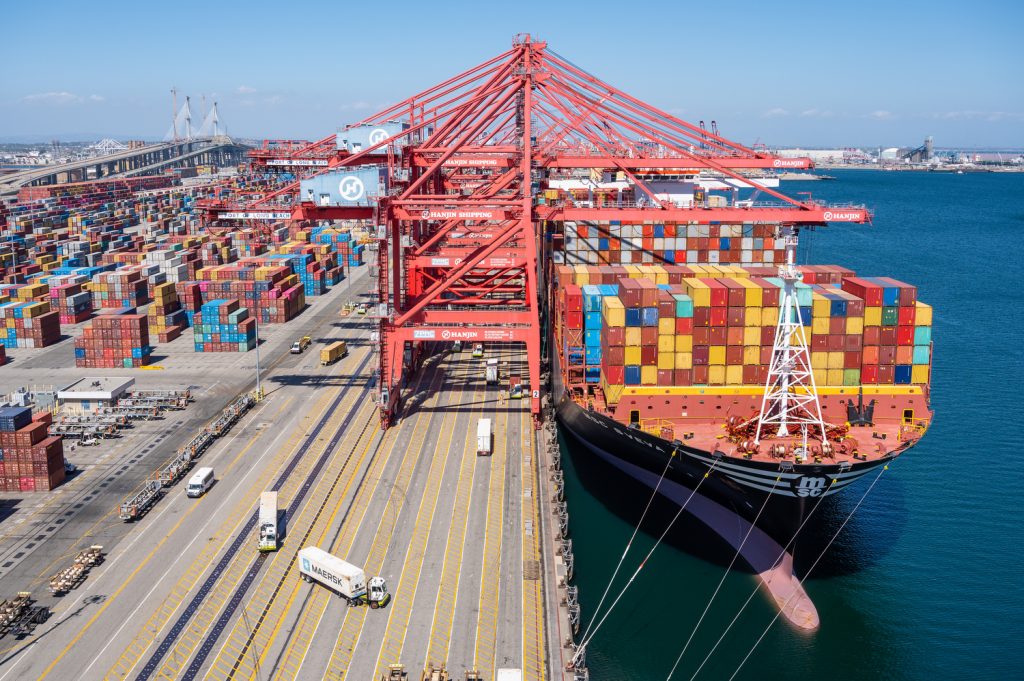
Gene Seroka, the executive director of the Port of Los Angeles, also highlighted a major risk to the country’s supply chain if rail service is not improved. The shortfall of rail service to handle import cargo — which is causing more containers to pile up at terminals for longer — is front and center, he said during a press conference.
“All eyes are focused on improving the rail product. Full stop. The bottom line is that we must take action on this issue immediately to avoid a nationwide logjam,” he warned.
Best June ever for Los Angeles throughput
The Port of Los Angeles handled 876,611 twenty-foot equivalent units of total throughput for last month, making it the highest-performing June ever. Total throughput was up less than 1% year on year (y/y) but up 15% versus the prior five-year average for that month. Exports came in at 93,890 TEUs, down 2% y/y, with 338,041 empty containers shipped, up 8% y/y.
There were 444,680 TEUs of imports, down 5% y/y but up 12% from the trailing five-year average. It was the second-best June on record for Los Angeles imports.
|
|
(Editor's Note: Yet another example that the old railroad slogan, "Safety First" is just so much drivel. In its statement, the carrier claims, "CSX is committed to ensuring the health and safety of our employees and neighboring communities." Ask the workers and communities about the extent of that commitment ....)
|
|
OSHA Proposes Fines for CSX Over Baltimore Coal Terminal Explosion |
|
The Occupational Safety and Health Administration is proposing CSX be fined $121,200 over citations related to a December 2021 explosion at the company’s coal terminal in Baltimore.
The explosion, which occurred at CSX’s Curtis Bay Coal Terminal, was felt from several miles away, according to local media reports and tweets from nearby residents. Following the blast, CSX said all employees were accounted for and there were no injuries.
The penalties CSX faces include nine serious and two other-than serious citations following an OSHA-initiated inspection on Jan. 4, 2022.
According to OSHA’s June 29 letter to CSX (NASDAQ: CSX), the citations range from employees not using appropriate respirators or emergency protective equipment, per federal regulations, when checking on the North Tunnel and Northwest Escape Tunnel; failure to provide documentation designating which areas within the coal terminal are designated as hazardous locations; and failure to ensure a properly equipped designated person tested the atmosphere prior to employees entering.
Once CSX receives all the citations and the proposed penalties, it has 15 days to comply or request an informal conference with OSHA.
|
|
(Editor's Note: Another video that has been making the rounds, popular with rail workers. The backdrop to the first video below is an American classic: Tennessee Ernie Ford's "Sixteen Tons") |
|
VIDEO: Railroaders are Quitting - Part 2 |
|
Railroaders are quitting everywhere. Even with 20 years of service and multiple generations of railroad family. The time has come to simply walk away. Reason 2: Oppressive attendance policies. The industry cut a third of its workforce to implement "Precision Scheduled Railroading." Time off has become a thing of the past. 365 days per year. The expectation is to be available. PERIOD. Weekends, holidays, birthdays, funerals, Sickness. Death. Life is a point system. Employees and family are both expendable. Discipline awaits a sick day even after working 80 hours the past 6 months If you don't have enough arbitrary points left. And the contract is expired and the workers have not received a raise in almost 3 years. But Wall Street got its cut.... |
|
(Editor's Note: In fact, the rail industry could be a boon for small town America. Instead, rail's presence in rural areas has diminished greatly in recent times. For an alternative vision of what rail could be for rural and small town America, check out Solutionary Rail, a group that RWU is closely aligned to.)
|
|
Filling Class I Railroad Jobs in Rural Locations Will Help Customers Everywhere |
|
CHICAGO — Class I railroads appreciate moving large volumes of traffic across long routes. There’s efficiency and carload profitability gains by running fewer trains for longer distances on relatively consistent schedules. When this is successful, customers see their shipments make great strides across chunks of a Class I railroad’s network. But some customers’ locations aren’t conveniently placed parallel to a high-density superhighway of a mainline, and thus must rely on lower density feeder lines, and local service, to connect them with the mainline, similar to a regional puddle jumper providing access to a hub airport.
Customers’ supply chains must consider the travel time from when a railcar is pulled from its siding to when it arrives at a rail yard and is blocked into a long-haul manifest. Depending on local service frequency, railcars may only travel a few miles each day, or may have to travel a greater distance on a feeder line at a slower pace. Many of these locations and intermediate crew change points are in rural communities.
As railroads navigate labor shortages, they desperately need workers in small towns to help ensure local service and intermediate crew change points are staffed to provide reliable, punctual service. Attracting workers to these small communities is challenging, especially when a otherf employment sectors are hiring workers with work-life balances that do not require railroading’s on-call environment.
|
|
(Editor's Note: Two derailments in two days on NS. See the button below for a more serious wreck in South Carolina.) |
|
Norfolk Southern Train Derails in Georgia |
|
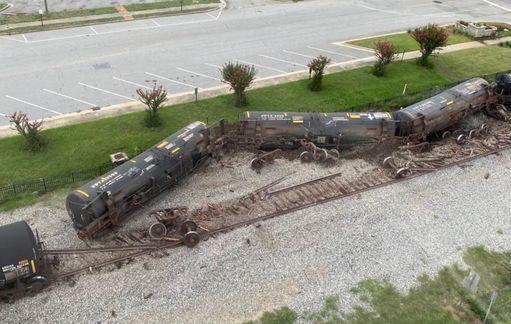
WARNER ROBINS, Ga. — No injuries are reported and no hazardous materials are said to be involved after a Norfolk Southern train derailed Tuesday afternoon, closing a highway and an entrance to Robins Air Force Base.
About 20 railcars are involved, Houston County Fire Chief Chris Stoner told WMAZ-TV. At least some of those are tank cars, but the Houston County Emergency Management Agency says in a Facebook post that none of the cars are leaking.
|
|
(Editor's Note: Not to be outdone by Norfolk Southern - see article above - Canadian Pacific weighs in with two derailments on the SAME DAY.) |
|
Two Canadian Pacific Trains Derail in Canada
Grain trains involved in incidents in Alberta and British Columbia
|
|
BASSANO, Alberta — About a dozen cars of a Canadian Pacific grain train derailed Wednesday afternoon in Bassano, about 85 miles southeast of Calgary, the CBC reports.
It was one of two derailments involving CP grain trains on Wednesday. The other occurred in Kamloops, British Columbia.
An eyewitness told the CBC about a dozen cars were involved in the incident in Alberta. A railroad representative said there were no injuries and the cause was under investigation.
No immediate count was available on the cars in the Kamloops derailment, but photos in a CBC report appear to show more than 10 were involved. As in the other incident, no one was injured and the cause is under investigation.
|
|
U.S. Freight-Rail Volume Decline Continued in Week 27 |
|
U.S. freight railroads’ carload and intermodal volumes fell a combined 3.1% to 437,600 units for the week ending July 9 compared with the same period last year, according to Association of American Railroads data.
Railroads moved a total of 207,450 carloads, down 1.3%, during the week that included the July 4th national holiday. The railroads moved 230,150 containers and trailers, down 4.7%.
|
|
|
|
|
|
|