Greetings
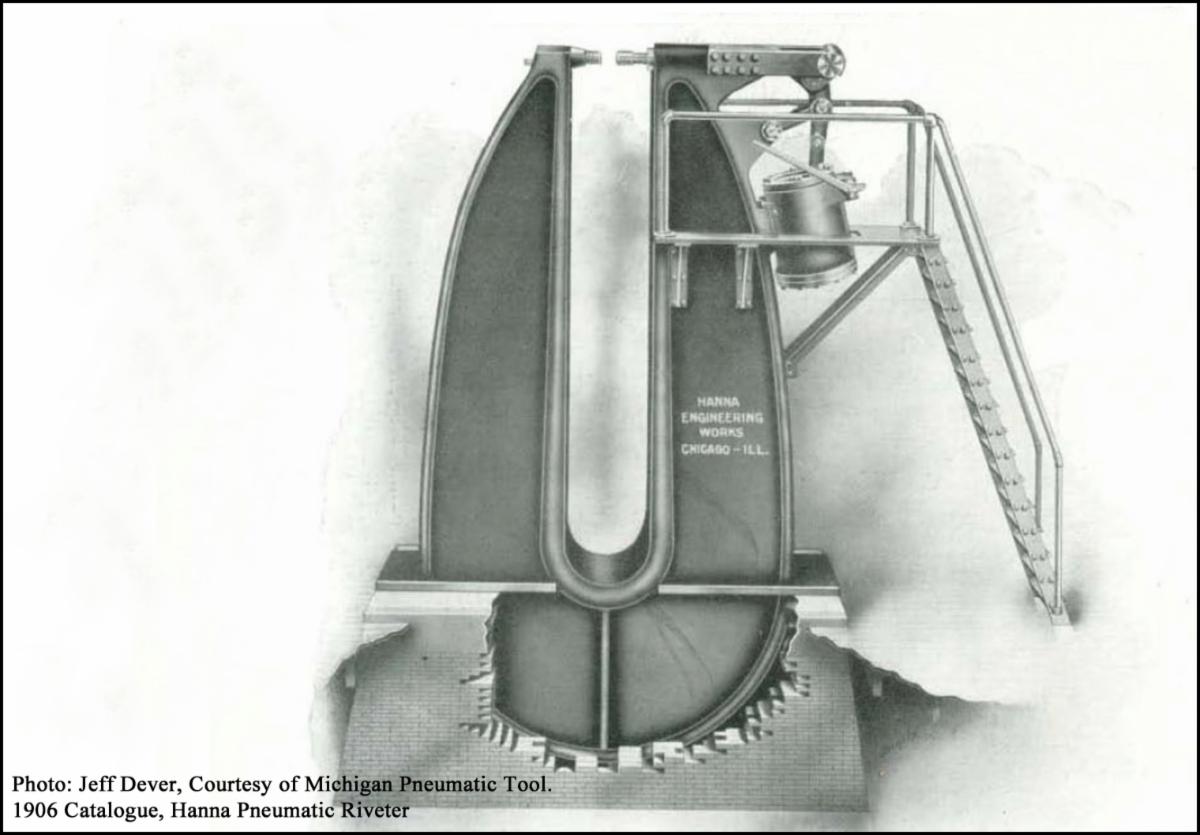
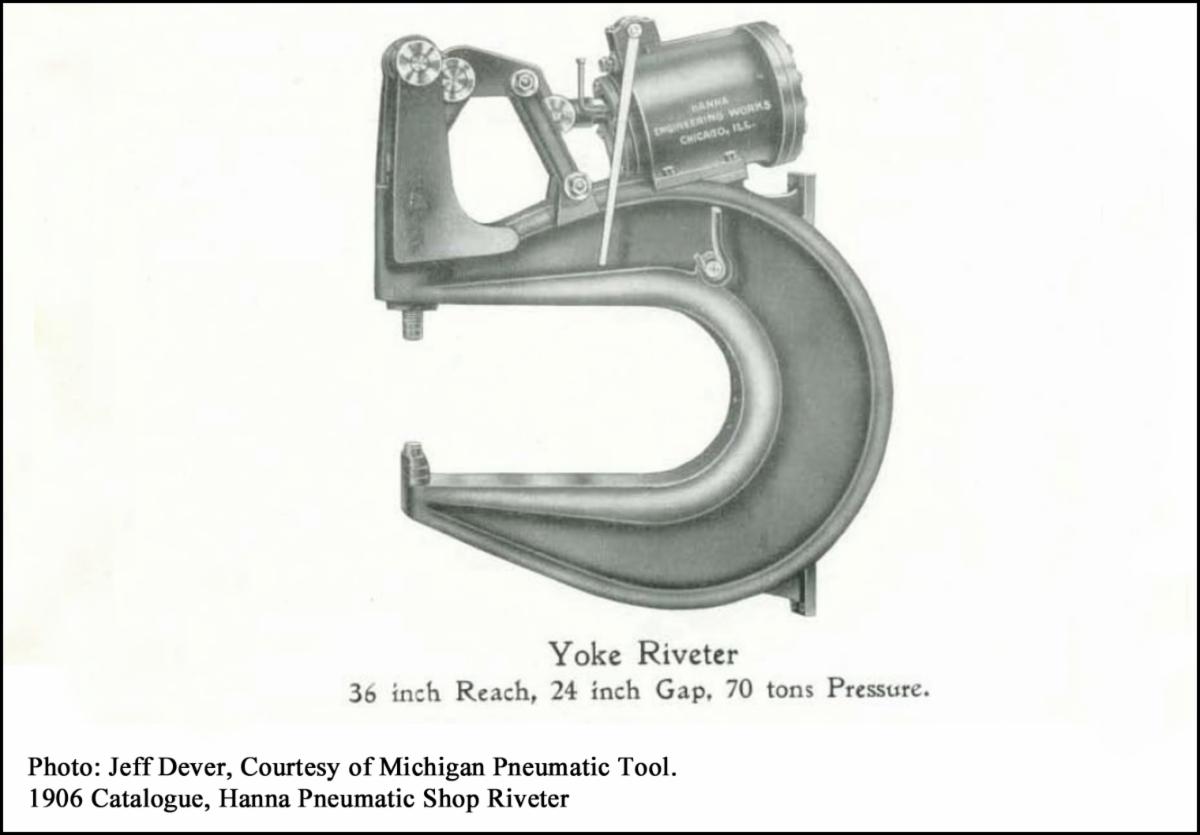
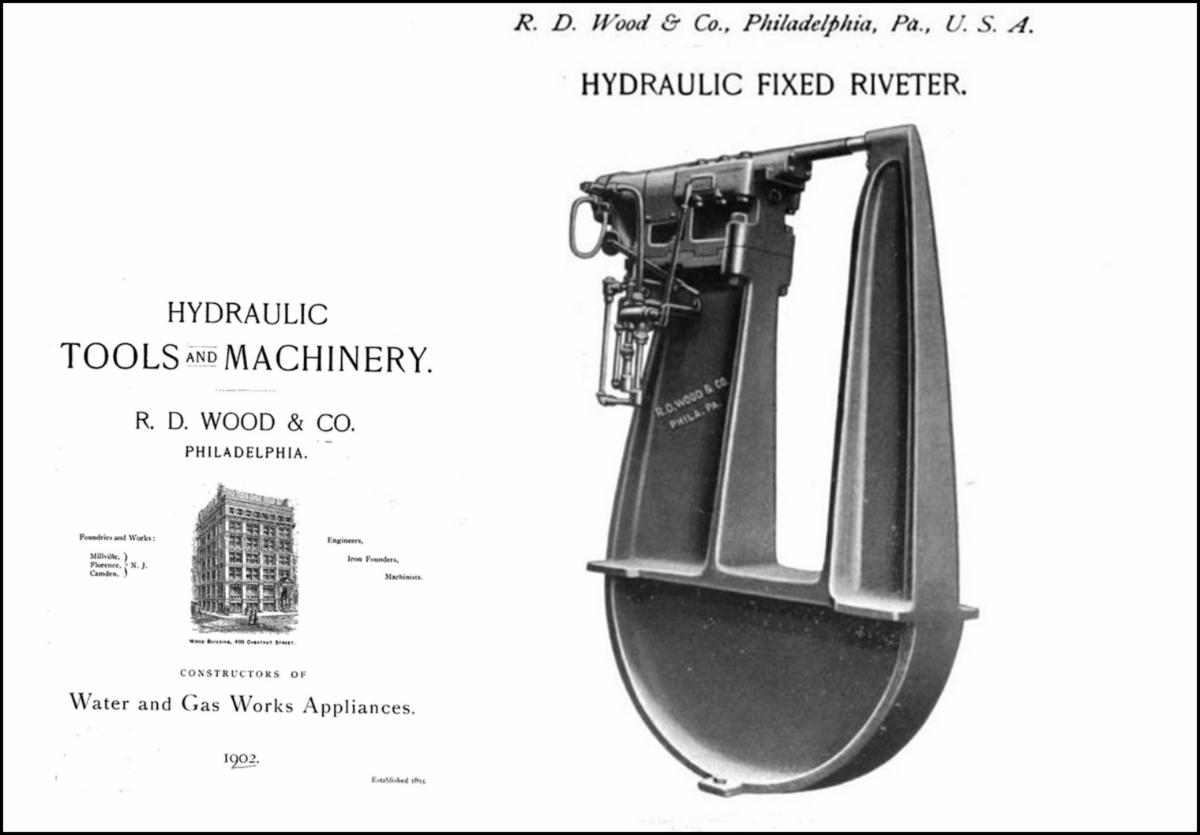
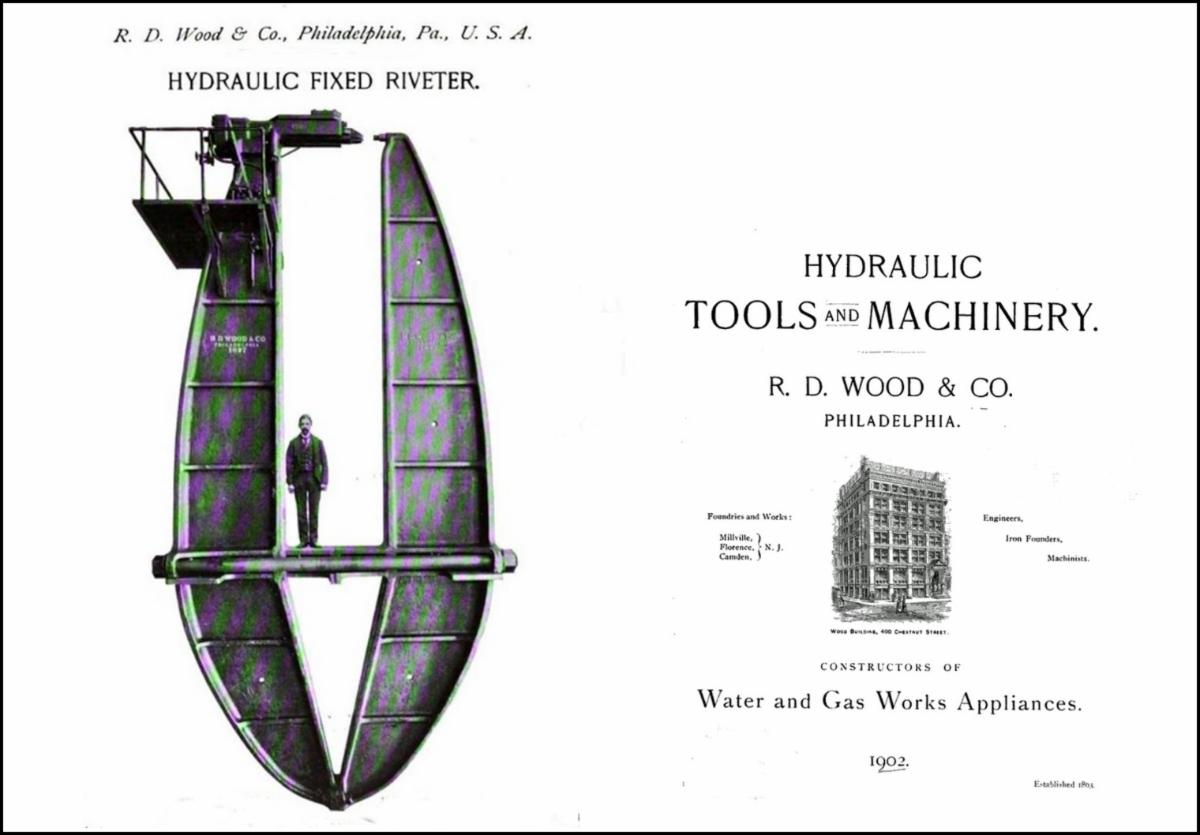
Lost in the fog of industrial time: an industrial process used in the prefabrication of large shop-riveted assemblies riveted with pneumatic and hydraulic riveters designed to drive substantial quantities of rivets in massive structural sections. There is a history here that is not being told, the history of the craftsmen who operated this rivet equipment in large industrial plants to fabricate the legendary riveted structures of the USA.
I often write about craftsmen, but out there in the industrial history are women who were pioneers during the early chapters of the development of industrial processes. Kate Gleason, the "Madame Curie of Machine Tools" (1865 – 1933), a title given to Gleason by Fred H. Colvin in his autobiography “60 Years with Men and Machines,” was one such woman. To learn more about Kate Gleason: “The Life and Letters of Kate Gleason” can be ordered directly from the publisher, Rochester Institute of Technology (home of the Kate Gleason College of Engineering).
Vern Mesler 2022
|
|
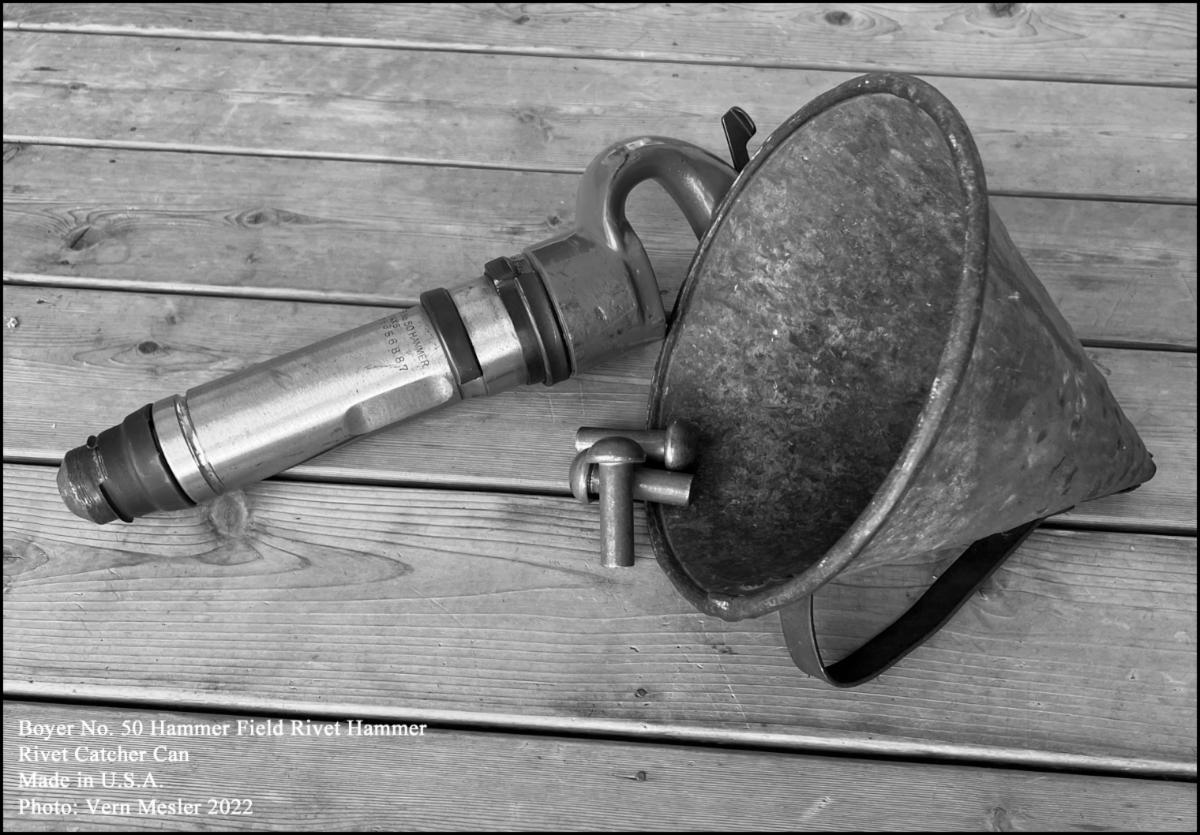
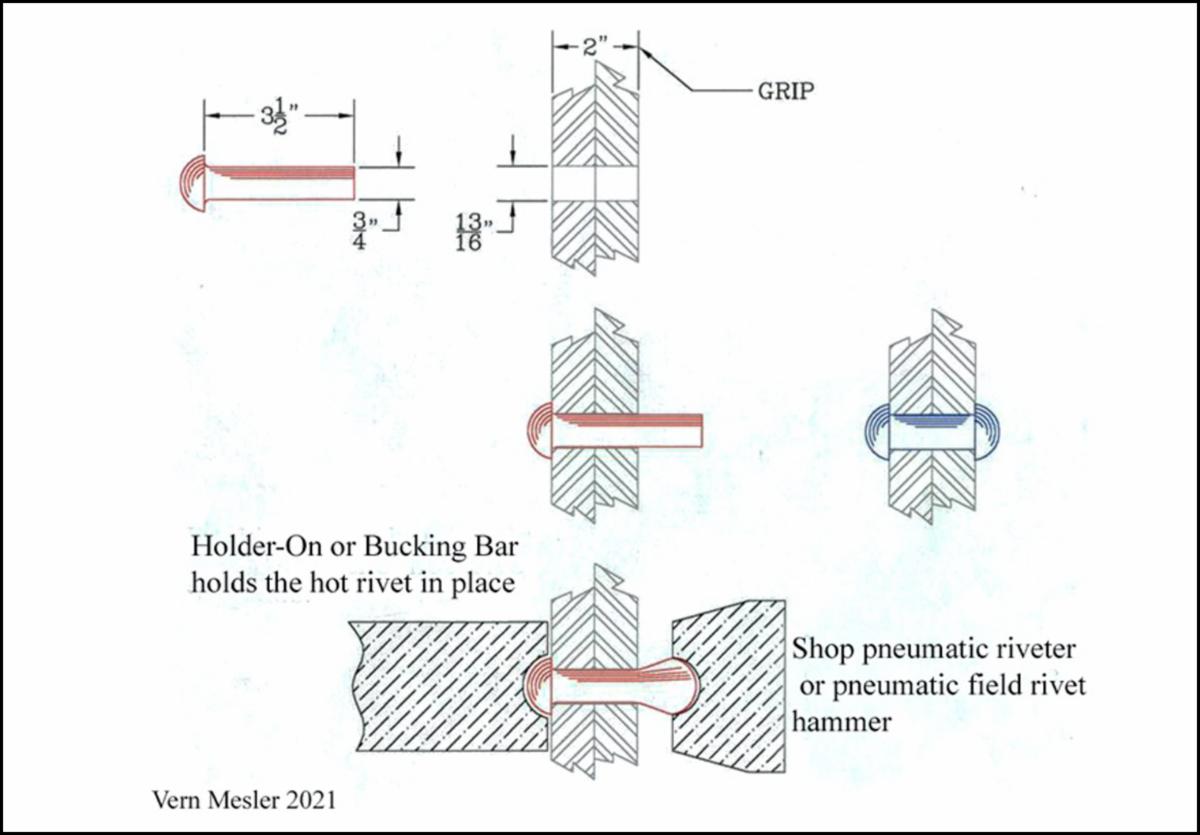
A hot metal rivet is pulled from a bed of burning coals, thrown in a high arc, and caught in a conical metal catcher’s can. It rattles against the can, hot mill scale popping off the rivet. Then the rivet is grasped with a set of tongs and inserted into a hole in a set of connection plates. A bucking bar or pneumatic holder-on slams against the manufactured button head of the rivet, holding it in place as the pneumatic field rivet hammer repeatedly strikes the protruding rivet shank, forming it into a convex shaped head. |
|
While this is the most popular portrayal of the hot rivet process in the media (and could lead many to believe the millions of rivets required in the fabrication of famous riveted bridges were driven in this way), it is not accurate. This process is a field riveting process used to connect the larger shop-riveted sections together at the erection site, and it represents only a modest percentage of the driven rivets in a riveted structure. Moreover, many of the famous riveted suspension bridges used a series of tubes to deliver hot rivets to a field riveting crew instead of tossing them to a catcher. “Rain ten!” someone in the rivet gang would shout up at the forge tender and he would pull ten heated rivets from the hot coals and send them in a timed sequence down the tube to the rivet gang. |
|
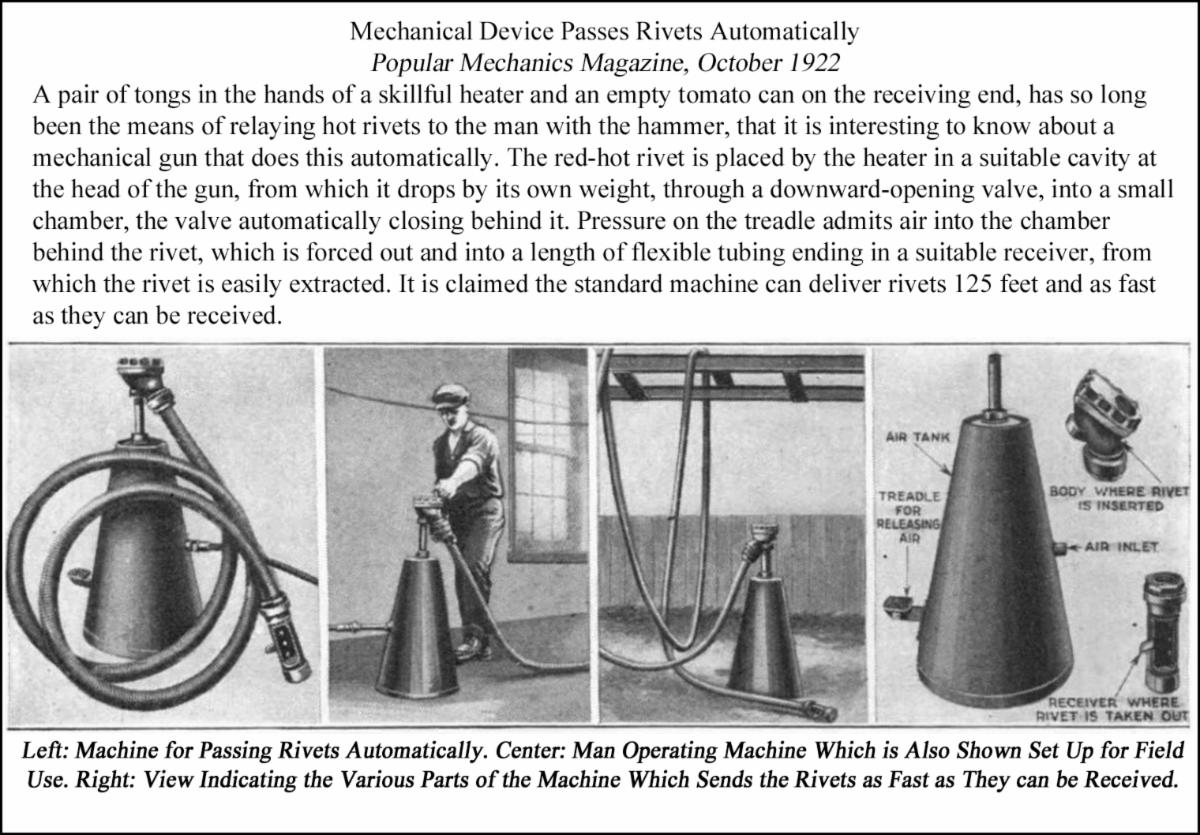
"Mechanical Device Passes Rivets Automatically"
Popular Mechanics Magazine, October 1922
|
|
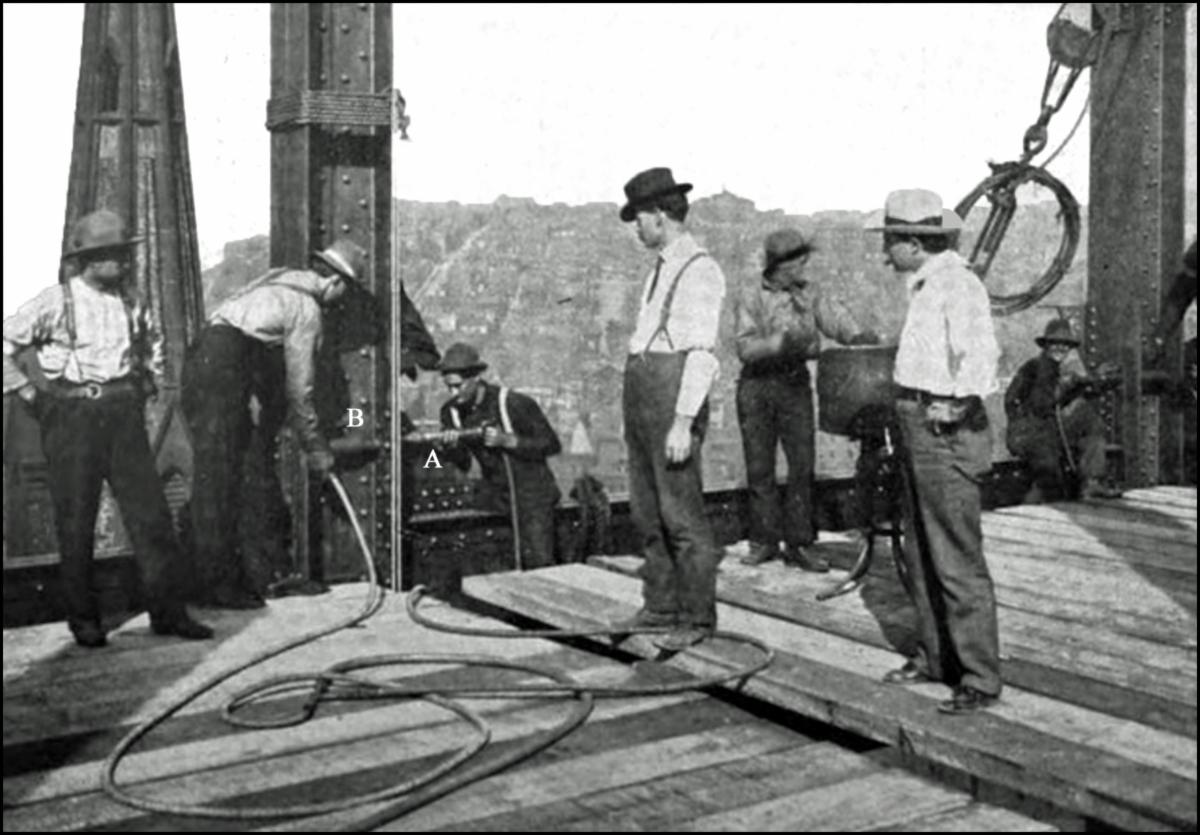
No.9 Boyer long stroke pneumatic field rivet hammer (A) and Boyer pneumatic holder-on (B) in use on the Frick building, Pittsburgh, PA |
|
A popular media program described a marvelous industrial process, the electric arc welding process, in a well-documented program that accurately described the history and current advances in the electric arc welding processes. However, when they described the rivet process it replaced, they chose to focus only on the field riveting, showing the high-flying hot rivet. What was left out of this narrative was more than a hundred years of industrial history and the skilled shop craftsmen who operated the shop-driven pneumatic and hydraulic riveters. These craftsmen also played an important role in the development of steel fabrication practices. Welding replaced rivets but not the advances made in steel fabrication that led the way to the fabrication of spectacular steel structures.
|
|
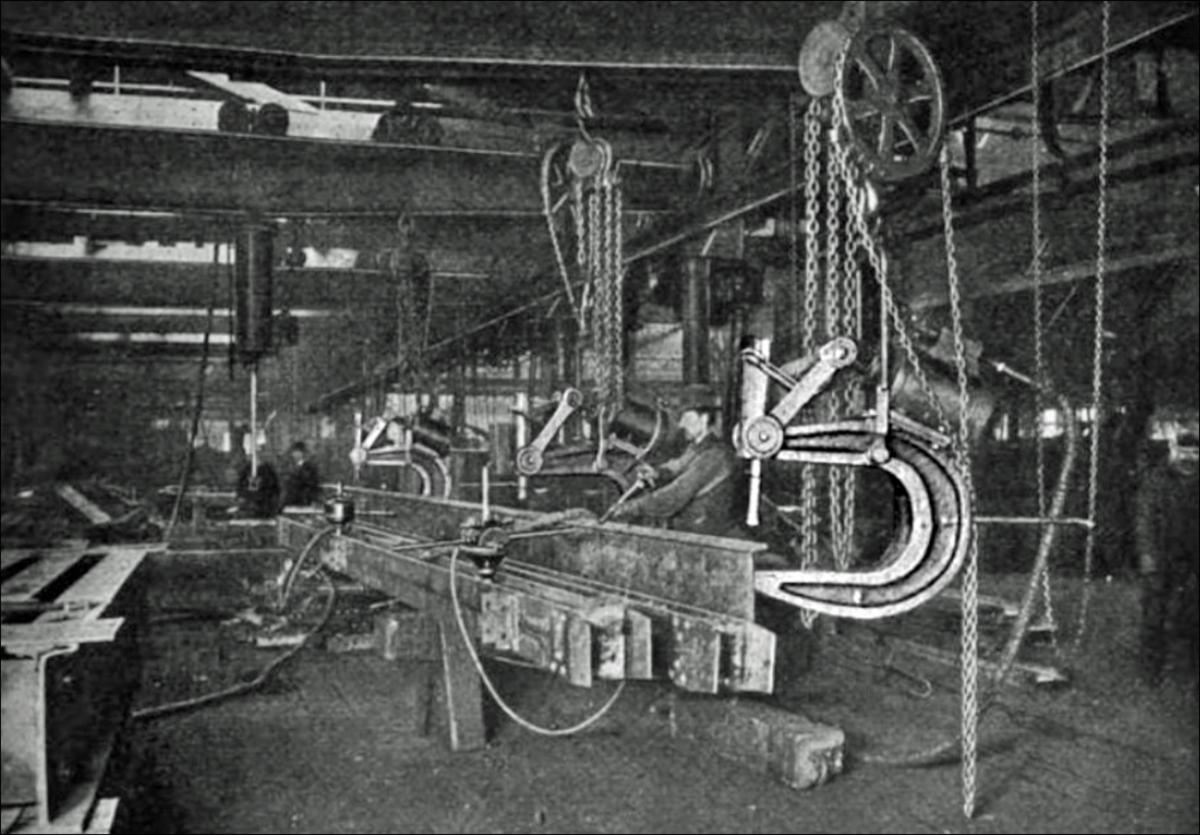
Three pneumatic shop riveters, Passaic Rolling Mill Co. Patterson, New Jersey Bridge Shop.
|
|
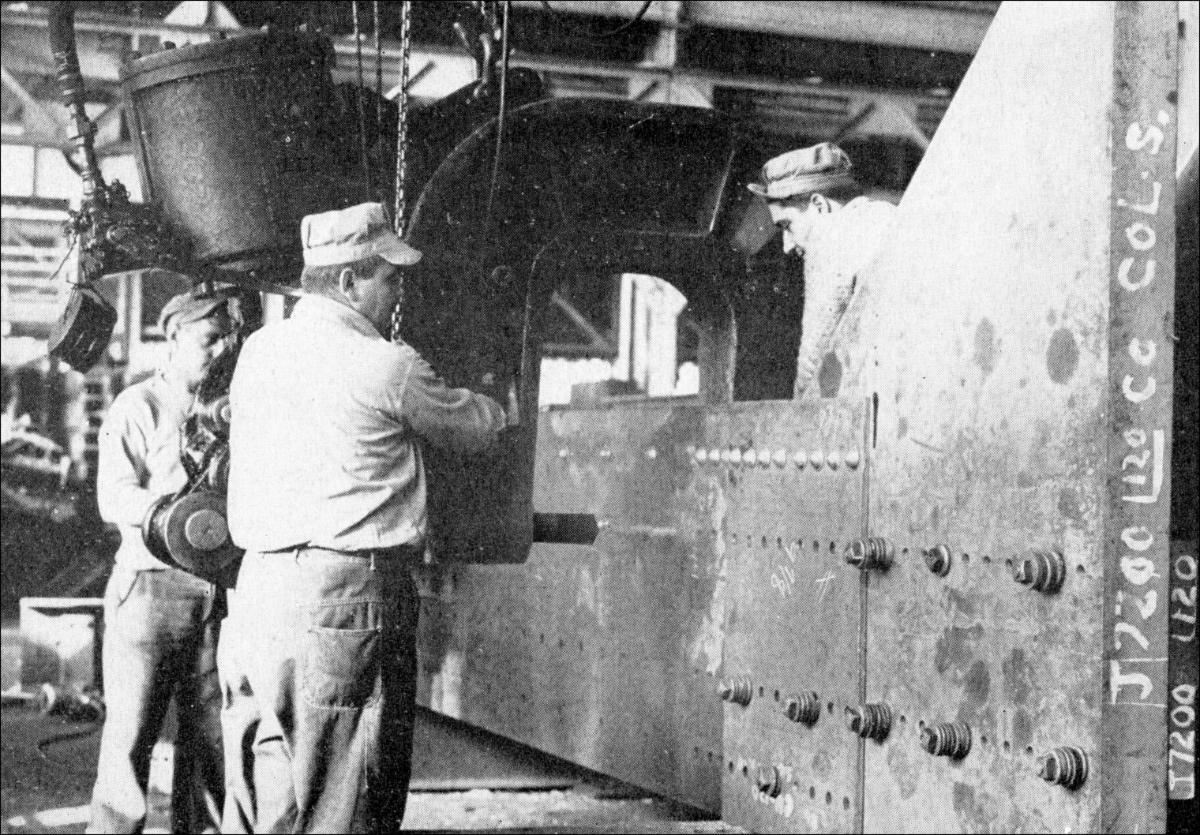
Shop riveting a cover plate to a fabricated steel column with a suspended pneumatic (bull) riveter at Bethlehem Steel Co. PA. (Photo: AISC Textbook of Structural Shop Drafting, vol 1, 1953) |
|
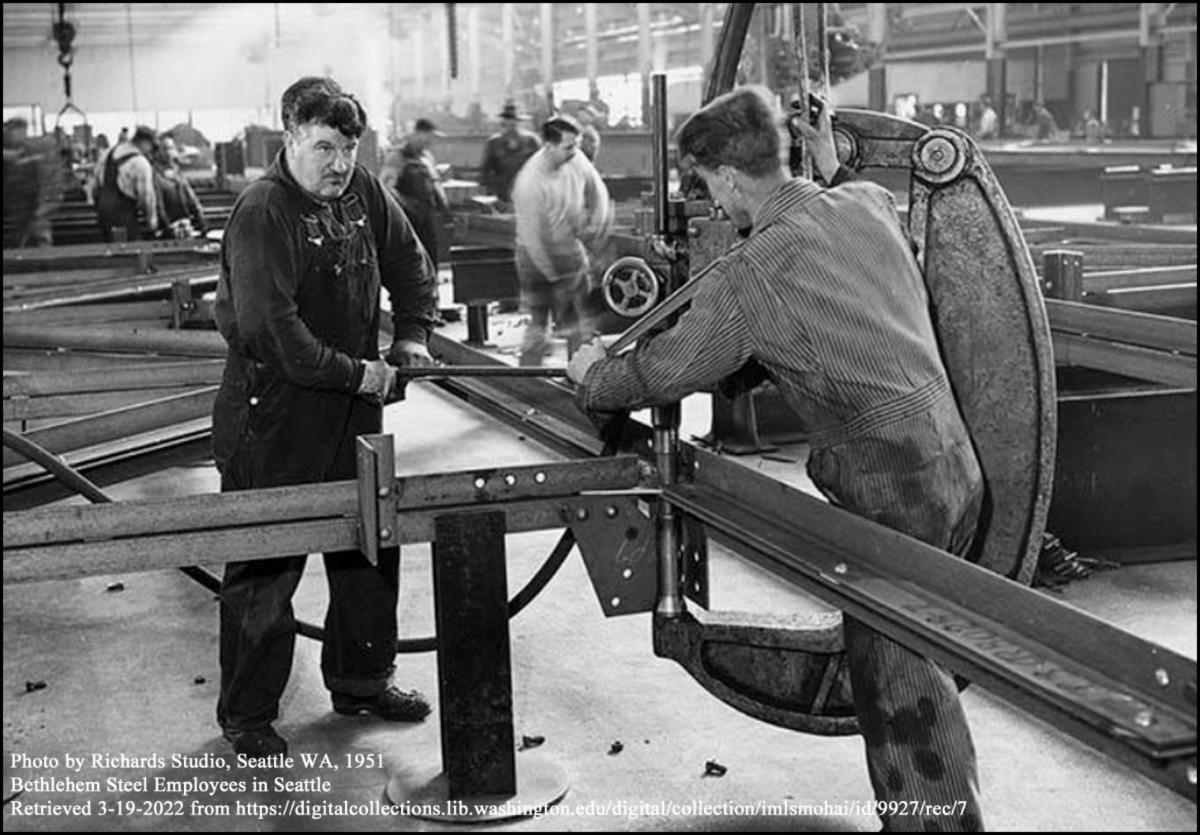
“Bethlehem Steel employees Tash Cooper, left, and Edward Barber operate a bull riveter to complete the fabrication of a steel truss to be used in a new warehouse for Associated Grocers.” (Museum of History and Industry, Seattle) |
|
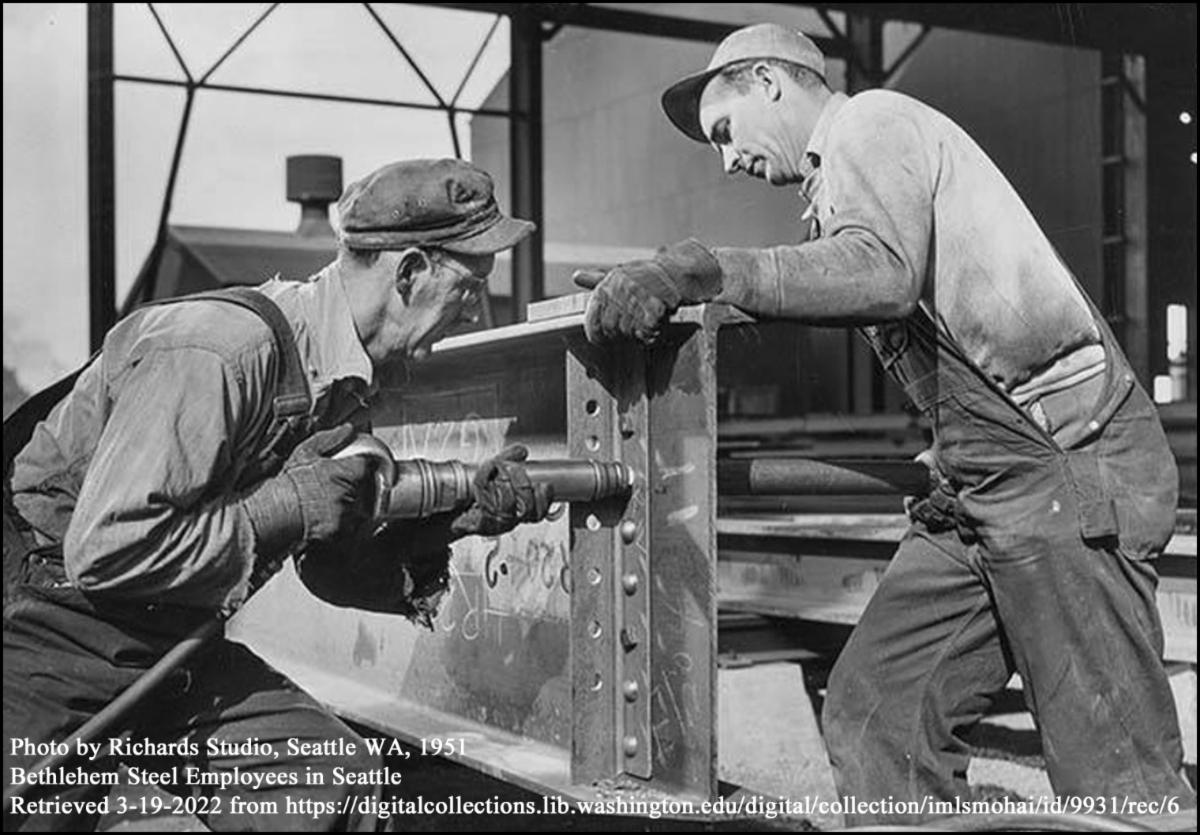
“Bethlehem Steel employees Pete Ross, left, and Bert Marshall rivet a girder beam for a new bridge to be built in Montana.” (Museum of History and Industry, Seattle) |
|
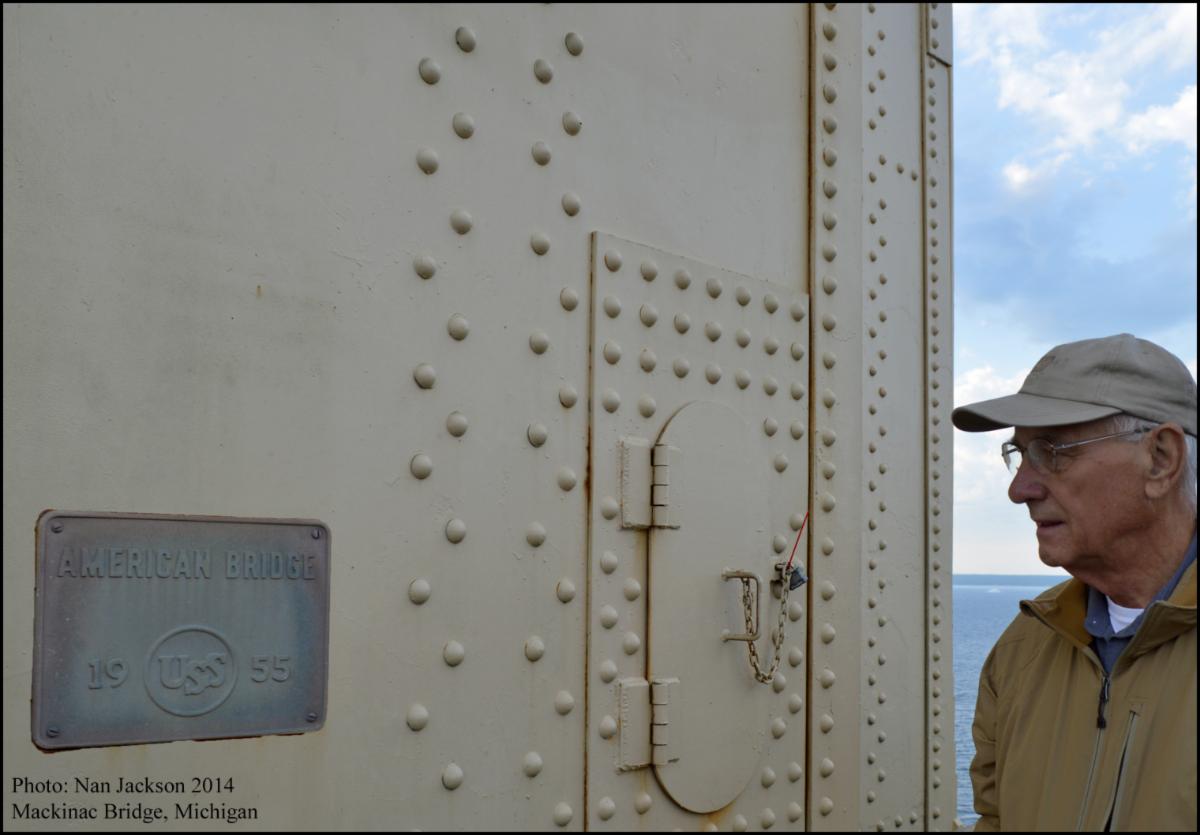
Michigan’s Mackinac Bridge, with an estimated five million (5,000,000) shop- and field-driven rivets.
Shop riveting was done at American Bridge plant in Ambridge PA.
|
|
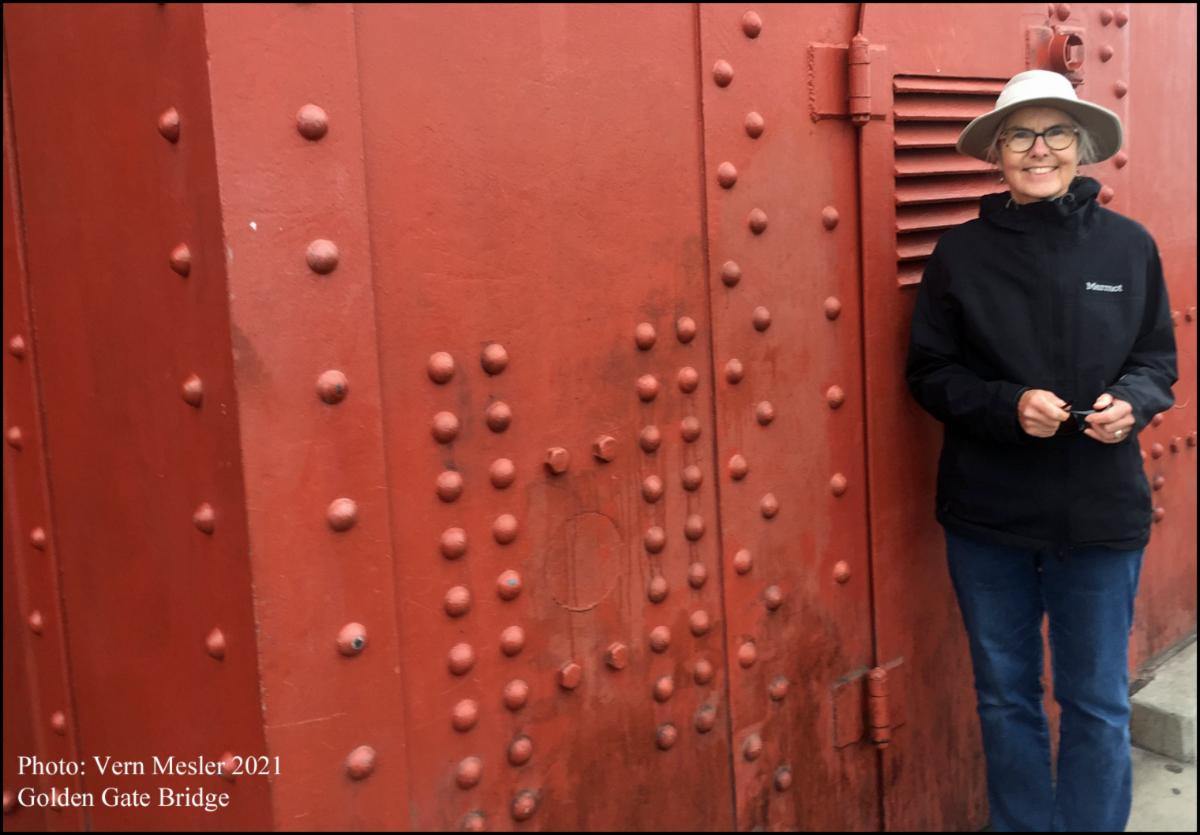
San Francisco Golden Gate Bridge, with millions of shop- and field-driven rivets. Shop riveting was done at McClintic-Marshall, an affiliate of Bethlehem Steel, in Pottstown, PA. (See "Name Change" article below.) |
|
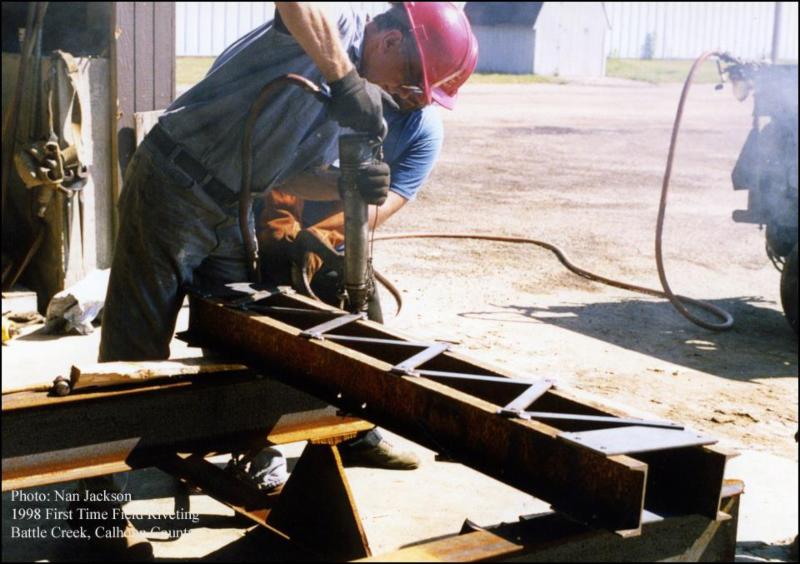
I’m an industrial welder who labored for many years in steel fabrication as a welder, fitter, and foreman, and worked as many years as an adjunct welding instructor training a younger generation of men and women in the art of electric arc welding at Lansing Community College. I have experience with many of the major industrial welding processes, and I’m impressed with the advances made today in the electric arc welding processes. I had an opportunity to use these skills as Project Manager for Historic Bridge Restoration for the restoration of five historic riveted truss bridges for Michigan’s Calhoun County Historic Bridge Park. It was there I learned about the riveting process and developed an appreciation for the processes, tools, and craftsmen who operated the field rivet hammers and the large shop pneumatic and hydraulic riveters. |
|
Industrial riveting will never achieve the level of use it did during the nineteenth and early twentieth century, but many of the riveted structures fabricated during that time continue to play a vital role in the daily activity of cities and their inhabitants. They have stood the test of time.
Shop and field riveting is part of an industrial history that led to the fabrication of many renowned buildings and bridges nationwide. Yet no major industrial museum in the United States has any exhibits on the industrial rivet processes used in the construction of these legendary buildings and bridges. Many industrial museums are housed in spectacular riveted structures, yet nothing is on display to tell the story of their fabrication. No shop equipment or field riveting equipment is part of an exhibit.
A forge filled with burning coal, a hot rivet sailing through the air and rattling in a catcher can, hot mill scale popping off the rivet. What is missing in this dramatic Hollywood narrative is more than one hundred years of industrial history and the skilled craftsmen who operated the pneumatic and hydraulic shop riveters. This industrial history deserves a permanent exhibit.
|
|
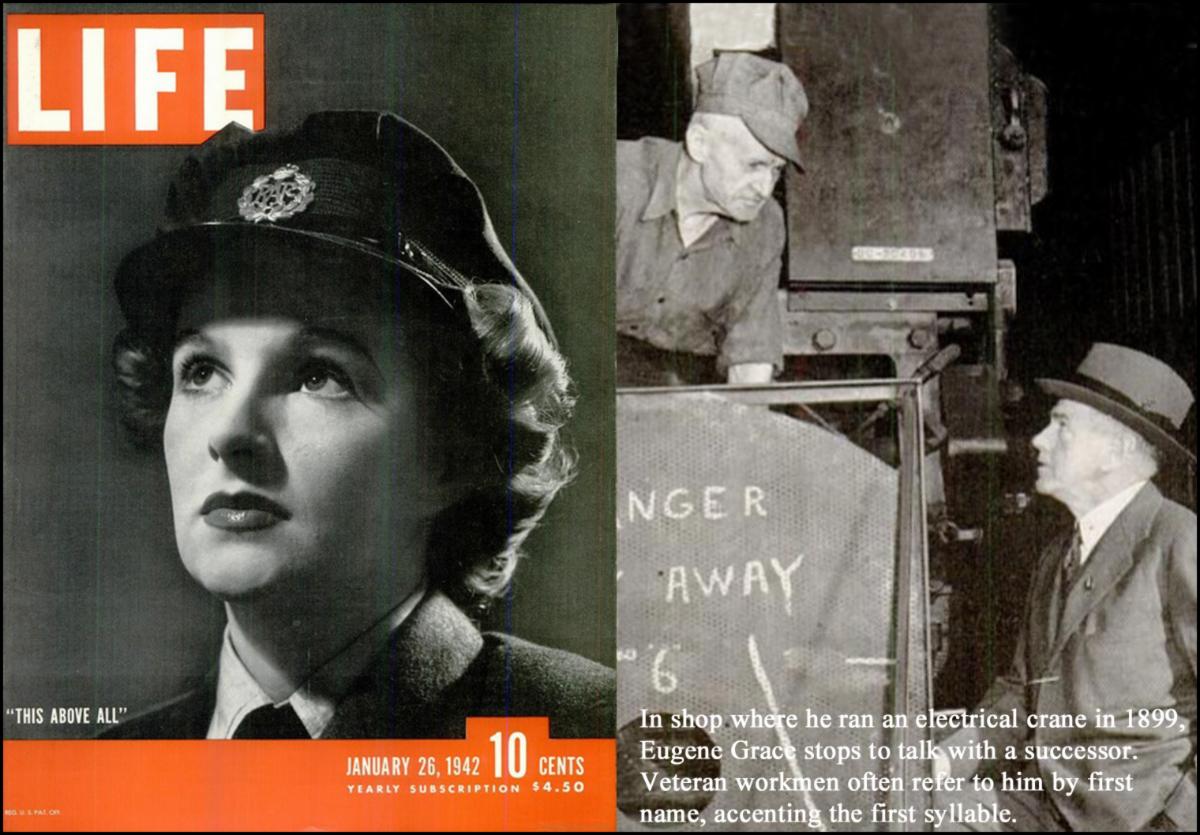
While searching for shop rivet pictures and information on the fabrication of the Golden Gate Bridge, I discovered an interesting article in a 1942 Life magazine that featured Eugene Gifford Grace, president of Bethlehem Steel Corporation at that time.
"Bethlehem [refused] to become involved with numerous subsidiaries which, in paying profits to each other, raise over-all costs. Grace’s distaste for such procedures was expressed in typically forthright style a few years ago when he paid a visit to the Golden Gate Bridge in San Francisco which had been put up by Bethlehem affiliate McClintic-Marshall Corp. To a local foreman Grace remarked that Bethlehem had apparently done a good construction job. “Bethlehem?” said the foreman, “Bethlehem had nothing to do with it. McClintic-Marshall built this bridge.” Grace changed McClintic-Marshall’s name the next day. It is now Bethlehem's 'fabricated steel construction division.'”
|
|
“There were about 600,000 field driven rivets in each tower. The rivets were heated in coal-burning forges located on scaffolds outside the tower and passed to crews within the tower by pneumatic rivet-passers through holes 6-1/2 inches in diameter and left in the tower webs for that purpose.” (The Golden Gate Bridge: Report of the Chief Engineer to the Board of Directors of the Golden Gate Bridge and Highway District – California, September 1937, pp. 148-9.)
Over the years, the focus of the written history of the Golden Gate Bridge was on the spectacular erection of the 70,000-ton towers and the spinning of wires across the Golden Gate. The words “field driven” were soon dropped from the phrase “field driven rivets” in the written record. Each 70,000-ton tower is now commonly recorded as being held together with 600,000 rivets. Actually, if the towers only had 600,000 rivets, they probably would fall down. New York’s George Washington Bridge has an estimated ten million (10,000,000) shop- and field-driven rivets, Michigan’s Mackinac Bridge an estimated five million (5,000,000) shop- and field-driven rivets. Vast walls of rivets can be seen inside and outside the Golden Gate Bridge towers in rare fabrication shop photographs, rivets driven in nearly every square foot of these massive steel towers. Shop rivets were driven with large riveters operated by shop craftsmen, their history rarely recorded, their story and industrial tools rarely exhibited in museums.
Vern Mesler 2022
|
|
Please consider contributing to the Iron and Steel Preservation Program Fund. This fund was established to support projects, research, conferences and scholarships related to the repair, rehabilitation, and restoration of metals. The Lansing Community College Foundation is a nonprofit 501(c)(3) corporation.
Select “Other” under “Designation” and type in “Iron and Steel Preservation.”
|
|
Copyright © 2022. All Rights Reserved |
|
|
|
|
|
|