March 15, 2022
Top stories
■ Fox News cameraman Pierre Zakrzewski, Ukrainian journalist Oleksandra Kuvshynova killed near Kyiv (Washington Post) / ‘Fox News memo on the death of its cameraman, Pierre Zakrzewski, in Ukraine. Pierre was with Ben Hall when their vehicle was struck by incoming fire. Hall remains hospitalized.’ (Michael M. Grynbaum) / ‘Fox News’ Ukrainian producer Oleksandra Kuvshynova was also killed. Do not forget her. Without our Ukrainian colleagues so many stories would go untold. Ukrainian journalists are doing brave, incredible work on top of personally dealing with Russia’s war against their country.’ (Christopher Miller) / 'Fox's memo about Oleksandra Kuvshynova's death in yesterday's attack: "Sasha was just 24 years old and was serving as a consultant for us in Ukraine…”’ (Brian Stelter) / ‘This is how I want to remember Pierre Zakrzewski. Big smiles. Fantastic human being. Kind, generous & radiates an upbeat can-do energy. From Kabul to Kyiv, he never stopped wanting to help. He was found dead alongside Ukrainian journalist Oleksandra Kuvshynova. RIP. Miss you.’ (Marcus Yam) / 'Sasha was killed alongside Pierre. She was talented, well-sourced and witty. She liked photography, poetry and music. We became fast friends over a shared love of coffee. She was 24 years old.’ (Trey Yingst) / 'We have been in close touch with Fox News, we have been in touch with the highest executives at Fox News, we have been in touch with the bureau here in D.C. to offer any and all support we can' (State Department Spokesperson via Brian Stelter) / New Yorker writer draws backlash for comment about Fox cameraman’s death (Mediaite) 


Press Freedom


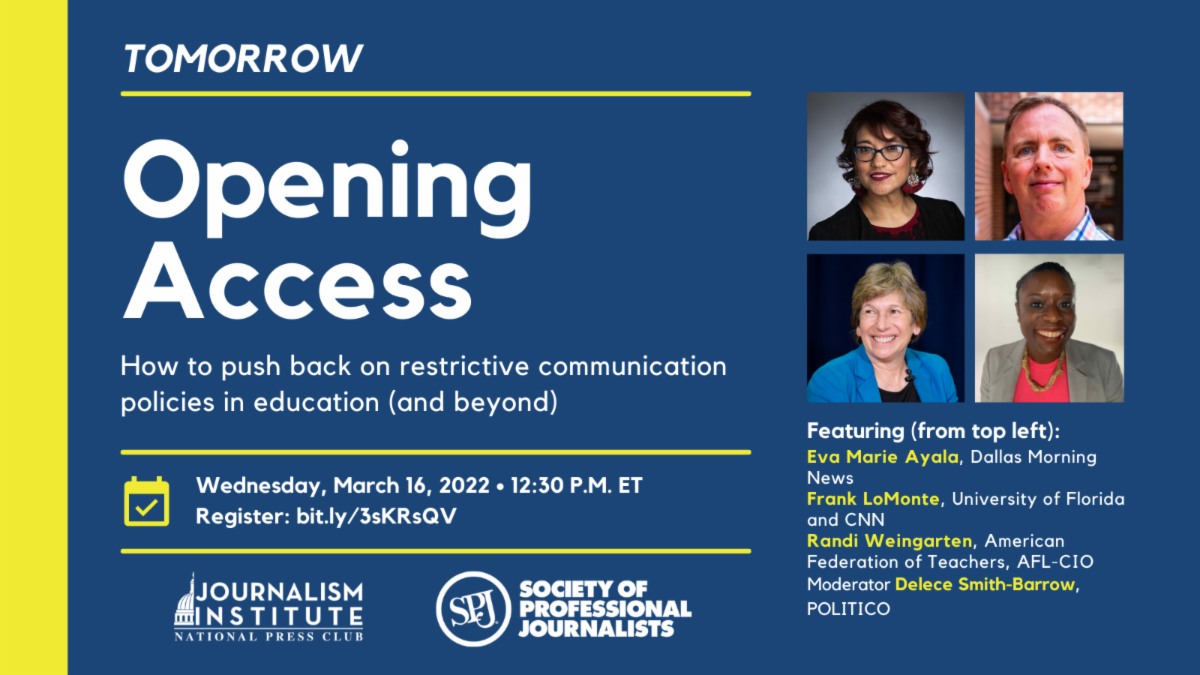
In honor of Sunshine Week, expert panelists will explore the impact of government restrictions on press coverage of public schools and how to work around them. Produced by the Society of Professional Journalists and the National Press Club Journalism Institute, the discussion will offer strategies and tools to overcome these barriers.

Registration is open for this program, which will take place tomorrow, March 16 at 12:30 p.m. ET.
Open records requests are essential to journalists and open a window to the public about their government’s inner workings. Here are a few tips from Institute programs, to assist in gaining access: 

The work starts before you file
  • Call the agency to see if you can get the data without filing a request.
  • Ask if search fees can be waived because your reporting is in the public interest.
  • Ask about regular reports the agency is required to make to the state or federal government.
  • Ask about financial documents, contracts, bond documents — anything that backs up payments to vendors, employees, or elected officials.

Know and understand the gatekeeper
  • Get to know the official who is the records gatekeeper.
  • Always put yourself in that FOIA officer’s shoes. Be as clear and concise as possible. 
  • Ask the official what is generally available, how they retain the records, and how long records are available.

Invest time in formulating your request 
  • FOIA and records requests apply to existing documents; do not ask in a request whether certain documents or records exist. 
  • The request must “reasonably describe” the records. 
  • Be specific: Include keywords, custodians, date ranges, domains, etc. 
  • Find and use the exact names for forms or documents you are seeking.
  • Avoid ambiguity (words like “related to”).

Strategize timing for the agency’s response
  • Seek expedited processing - make a strong case for the public’s right to know.
  • In principle, the agency must make a “determination” within 20 business days.
  • In “unusual circumstances,” the agency may extend that deadline, usually by no more than 10 additional business days.
  • The agency doesn’t necessarily have to give you records then, but it has to tell you when it will do so.
  • Ask for an estimated date of completion.

Tips curated from “Keeping Public Records Public: Strategies for getting access during the pandemic.” Watch here.

Press freedom is core to our mission to power journalism in the public interest. We need your help to continue this important work. Show your support for a free press and its role in a healthy democracy with a donation in any amount to the National Press Club Journalism Institute today.
Jill Geisler, Bill Plante Chair in Leadership & Media Integrity at Loyola University Chicago and Freedom Forum Fellow in Women’s Leadership, on what to do if employees are loyal to their supervisors but critical of their organizations.

Aspiring journalists can still apply to four scholarships for students committed to a career in journalism. The awards total $50,000 in financial support, with opportunities available for high school, college, and graduate students. 
Resources
This newsletter is written & edited by the National Press Club Journalism Institute staff: Beth Francesco, Holly Butcher Grant, and Julie Moos. Send us your questions and suggestions for topics to cover.

Get this from a friend? Subscribe, and view the archives.

If you value this newsletter, consider supporting The Latest with a tax-deductible, recurring gift to the Institute: Even $5 a month will help fund the technology and time it takes to provide this important service.  

The National Press Club Journalism Institute promotes an engaged global citizenry through an independent and free press, and equips journalists with skills and standards to inform the public in ways that inspire a more representative democracy. As the non-profit affiliate of the National Press Club, the Institute powers journalism in the public interest.