Weekly Digest Number 1 - January 3rd, 2023 |
|
Welcome to the RWU Rail & Labor News! This news bulletin is produced and emailed out each Tuesday morning. We hope you find each week's news and information useful. If so, please share with co-workers, friends, and colleagues. If you like, you can sign them up to get all the news from RWU HERE. Or forward them the link. Note: If you read over and/or listen to this news bulletin each week, you will be sure to never miss the important news of what is going on in the railroad world from a worker's perspective!
|
|
(Editor's Note: How times have changed. TRAINS Magazine - which in a previous era would have rated the top stories of the year to do with historic restorations, rail buff opportunities, or the heroics of rail CEOs - rates the top three stories of the year 2022 as #1 "Rail Labor and the Near Strike"; #2 "Service Issues" and #3 "Crew Shortages.") |
|
Top 10 Stories of 2022: No. 1 - Rail Labor and the Near Strike |
|
Railroads were catapulted into national headlines in the fall as labor negotiations came down to the wire, raising the prospect of the first strike or lockout in three decades.
After nearly three years of fruitless negotiations between a dozen labor unions and the railroads, the Biden Administration in July appointed a Presidential Emergency Board to make contract recommendations.
The PEB in August recommended a 24% wage increase, along with $5,000 in service recognition bonus payments, over the five-year life of the contract retroactive to Jan. 1, 2020. That was below the 28% increase the unions sought, but above the railroads’ 16% proposed wage hike. The board also recommended that railroads and unions sort out working conditions issues, including scheduling and sick time, on the local level.
Then-CEO Jim Foote of CSX called for a fundamental change in the railroad-union relationship during a speech this year. David Lassen
Hours before a Sept. 16 strike deadline, unions and the National Carriers’ Conference Committee that represents the U.S. Class I railroads reached a deal with the assistance of the White House, including Labor Secretary Marty Walsh.
But four unions ultimately rejected the tentative agreements with the railroads, setting up the prospect of a strike as early as Dec. 9.
To prevent a strike that would have crippled the rail network, added more kinks to already snarled supply chains, and hurt broad sectors of the economy, Congress passed legislation that imposed the PEB’s contract recommendations. A separate measure that would have added paid sick time failed to pass.
|
|
(Editor's Note: While the Class One carriers "won" this round of bargaining, RR workers got in a number of licks. Perhaps most importantly we showed militancy and determination, impressing the carriers that we are serious, and if not for the union officials and the government, we most likely would have struck and emerged victorious. In addition, the carriers got a black eye and a bruised reputation, as their profiteering, monopolistic position, price gouging, lousy service, mismanagement, corruption, and exploitation of the workforce was all revealed to the general public We must keep the momentum going and capitalize on our strengthened position in the next round of bargaining. |
|
Railroad Carriers Riding High After Victory Against Workers
In the aftermath of the congressional contract fight, two major railroads are pursuing a merger, and a third is retaliating against a worker for organizing.
|
|
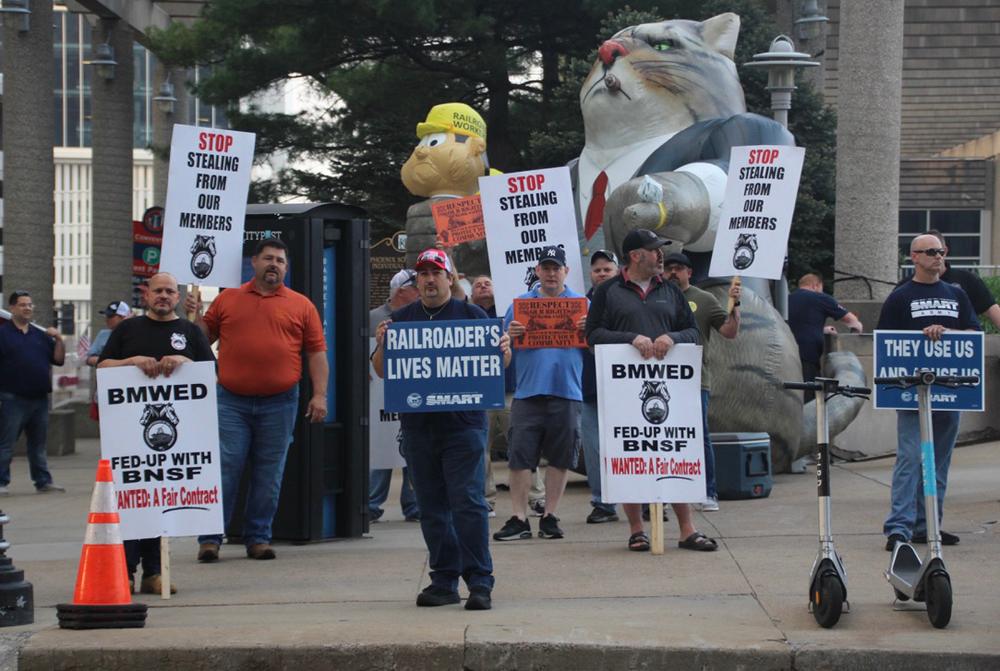
Fresh off a victory against workers demanding sick days as part of recent contract negotiations, two major railroads are pursuing a merger and a third, owned by billionaire Warren Buffett, is retaliating against one railroader who helped lead the push for better working conditions.
On Wednesday, a coalition of 10 organizations sent a letter to the Surface Transportation Board urging it to reject the merger of Canadian Pacific and Kansas City Southern on a number of different grounds, warning that further consolidation would lead to diminished service, higher prices, and more trucks on the road, despite rosy promises from the carriers to the contrary. Concentrated and brittle supply chains, they argue, have already helped drive inflation amid the pandemic.
In North Dakota, BNSF railroader Deven Mantz, who played a public role in the fight for sick days in Congress, has suddenly found himself the subject of a Kafka-esque investigation by Buffett’s railroad company, which is accusing him of stealing time from the company. The railroad would be forced into arbitration if it fires him, Mantz said, and would likely lose, owing him years of back pay for wrongful termination. But it would be a small price to pay to get a motivated advocate for the union out of the workforce.
In the summer of 2021, the Biden administration laid out a comprehensive competition policy aimed at breaking up concentrated corporate power and reversing the wave of consolidation across industries.
The merger’s coalition of opponents, which includes Open Markets Institute and Public Citizen, argue that monopolization has not led to more efficiency. Rather, railroads have abused their market power by refusing to carry low-margin loads from small businesses and otherwise cutting their capacity. That leaves them no flexibility in the event of even a minor shock to the system, they wrote:
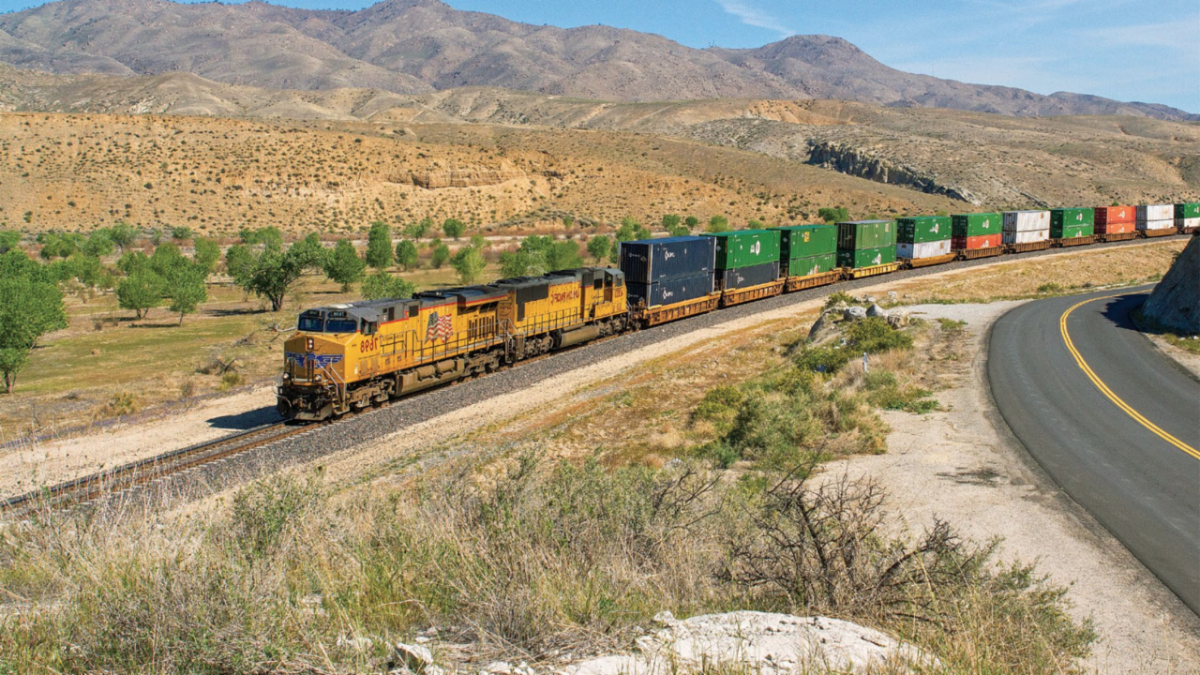
In July 2021 for example, the Union Pacific suspended all container freight service between West Coast ports and its Global IV terminal in Chicago, a hub clogged with stacked containers that the rail operator lacked the capacity to sort and redirect. The embargo immediately meant that still more boxes coming from Asia, with everything from auto parts to transistors, piled up on docks as West Coast ports waited for canceled trains.
|
|
(Editor's Note: RWU is proud to have done our part in publicizing all that is wrong with the railroads system. It has become obvious that the labor problems, customer service issues, Amtrak delays, declining freight shipments, and all the rest of self-inflicted wounds by the Class One carriers themselves. But all of this does not simply amount to corrupt and incompetent management. In fact, their irresponsible and reckless actions have actually achieved exactly what they were designed to do - make record short-term profits for the industry at the expense of its long-term health.) |
|
Labor Strife, Service Problems Railroads’ Biggest Issues in 2022 |
|
To say that 2022 was an eventful year for the U.S. and Canadian freight railroads would be an understatement. U.S. freight railroads made national news at least twice this year amid speculation that union members would go on strike over disagreements on what should be included in a new labor agreement, while both U.S. and Canadian railroads sought to improve rail service and become more nimble players within the supply chain network. Here are some of the big news stories of this past year:
Labor issues come to forefront
The challenges in reaching and ratifying labor agreements between the major freight railroads and their unions highlighted some of the issues that the industry is facing with its craft workforce. On one hand, the railroads are competing with other industries to attract and retain people and talent. On the other hand, the industry is also grappling with low morale among some union members who feel that recent operational changes have caused the railroads to do more with less, leaving union members who have stayed to feel stretched thin. The national negotiations and most recent bargaining round may have ended, but issues about how to establish sick leave and attendance policies that promote a better quality of life will likely be discussed at the local level in the next several months.
Railroads stymied by subpar rail service
Toward the end of 2022, the argument that the industry’s head count reductions had a direct role in deteriorating rail service entered more forcefully into public debate. Earlier this month, the chairman of the Surface Transportation Board was seeking to bring that connection more to light during a hearing on Union Pacific’s increased use of embargoes over the past five years.
|
|
(Editor's Note: In terms of worker injuries and fatalities, one would think that - all things being equal - if an industry operated with 30% fewer workers, then there should proportionately be 30% fewer fatalities and injuries, right off the bat. Period.) |
|
GAO Studies Impact of PSR on US Freight Rail |
|
The report essentially summarizes the various views of stakeholders on PSR, which GAO defined as a “strategy intended to increase efficiency and reduce costs.”
Congressional leaders had directed GAO to study the effect PSR has on freight rail safety and service. The agency interviewed 28 stakeholders to produce the report, which describes stakeholders’ views about how PSR changed railroad operations and what the Federal Railroad Administration and the Surface Transportation Board have done to document and record these changes, including through data collected from 2011 to 2022.
The report, released to the public last Friday, details the data available to FRA and STB and how that data might reflect larger operational trends. While FRA and STB said the data they collect so far does not show a clear causal relationship between PSR and safety incidents or rail service, both agencies said they are seeking to address issues raised by industry stakeholders.
|
|
(Editor's Note: As the expression goes, "There are lies, damn lies and statistics." UP and the Class One's have tried to get single person operations of trains since 2004. They have lied and they have used damn lies. Now they hope to use statistics to "prove" how fluid and safe they can run the railroad using "ground based" conductors. Since contractually, the UP cannot run the trains currently with one crew member, these ground based positions will presumably be bulletined and worked by the existing trainmen. Given how the workforce is already stretched thin and exhausted, is this the best way to deploy scarce human resources right now?) |
|
Union Pacific Proposes Pilot Program to Have Just 1 Person Operating Trains |
|
However, unions and rail employees disagree that automation has made the role of rail conductor redundant. They also say that having only one person in the cab of a freight train would make the job more unsafe. It could also threaten communities through which railroads traverse.
Union Pacific’s pilot program rebrands the conductor role into “expeditors.” Rod Doerr, vice president of crew management and interline operations at Union Pacific, outlined the pilot in the Tuesday announcement:
During the pilot, the conductor will remain on the train and continue to perform his or her role; documenting dates and times of service activities and how long it took to perform the activities. The expeditor will do the same from the ground. At the end of the pilot, Union Pacific will compare the results and adjust the plan as necessary.
|
|
(Editor's Note: We run this article to show that the airline's dramatic service failures are the result of its own self-inflicted wounds, including failure to maintain enough staff, failure to modernize and prepare for the future, massive stock by-backs, and a general disregard for customer service. Sound familiar? Like the rail industry, the airlines are taking the American people for a ride. Note one difference: while rail CEO's are largely unapologetic and blame everything and everyone but themselves, the CEO of Southwest claims "ownership" of this mess. Perhaps that is because - unlike the rail industry - his airline is not in such a monopolistic situation and stands to actually lose market share over this debacle.) |
|
Sanders Calls on Buttigieg to Hold Southwest CEO Accountable for 'Greed and Incompetence'
"This is a company that got a $7 billion taxpayer bailout and will be handing out $428 million in dividends to their wealthy shareholders," said Sen. Bernie Sanders.
|
|
Sen. Bernie Sanders on Wednesday urged the Transportation Department to ensure Southwest's chief executive pays a price for mass U.S. flight cancellations that have left passengers and employees stranded around the country, throwing lives into chaos and drawing further attention to the company's business practices.
"Southwest's flight delays and cancellations are beyond unacceptable," Sanders (I-Vt.) wrote on Twitter. "This is a company that got a $7 billion taxpayer bailout and will be handing out $428 million in dividends to their wealthy shareholders. The U.S. Department of Transportation must hold Southwest's CEO accountable for his greed and incompetence."
Bob Jordan, who has worked for Southwest for decades and became the company's CEO earlier this year, acknowledged on Tuesday that the airline needs to "upgrade" its outdated scheduling system and other technology that flight attendants and pilots have been warning about for years.
"For more than a decade, leadership shortcomings in adapting, innovating, and safeguarding our operations have led to repeated system disruptions, countless disappointed passengers, and millions in lost profits," the Southwest Airlines Pilots Association (SWAPA) said in a statement Wednesday. "The holiday meltdown has been blamed on weather that had been forecast five days prior, but this problem began many years ago when the complexity of our network outgrew its ability to withstand meteorological and technological disruptions. SWAPA subject matter experts have repeatedly presented years of data, countless proposals that make Southwest pilots more efficient and resilient."
|
|
(Editor's Note: Service apparently continues to degenerate. The Class Ones continue to falter, and UP's slogan "We will Deliver," has become, "We will Deliver, Just not Saying When." With no end in sight to this debacle, the American people are losing any faith in the private rail system. Please see the RWU Resolution in Support of Public Ownership of the Railroads and let us know what you think!)
|
|
STB Orders Union Pacific to Deliver Trains to Foster Farms While it Considers Emergency Order
Foster Farms says it's running out of feed for chickens, dairy cows
|
|
WASHINGTON — The Surface Transportation Board has issued a decision requiring Union Pacific to deliver five trains of corn to the largest chicken producer in the western U.S. while the board considers a request by that producer, Foster Farms, for an emergency order that would require UP to prioritize shipments to the company. It would be the second such order this year.
In a decision issued tonight (Friday, Dec. 30), the board has ordered UP to deliver five trains destined for Foster Farms facilities in Traver, Turlock, and Delhi, Calif., on a schedule provided by UP in a pleading to the board, which would see those five trains arrive between Dec. 31 and Jan. 3. The railroad must also provide the board with daily updates on the location of the trains, and by Jan. 3, provide the board with its plans to service Foster Farms over the next 30 days.
Those five trains will alleviate the immediate feed crisis, Foster Farms told the board.
Foster Farms told the board that it had again reached the point “where hundreds of thousands of dairy cattle are not being fed, and when millions of chickens will starve to death because of UP’s service failures,” according to a Dec. 29 filing that was posted on the STB’s website earlier today.
The Foster Farms facilities rely on 100-car unit trains of corn that originate in the Midwest. The company produces feed from the corn, which is then distributed to dairy farms, Foster chicken and turkey farms, as well as other poultry producers.
But Foster Farms said UP’s service began to slip in October and has worsened since.
|
|
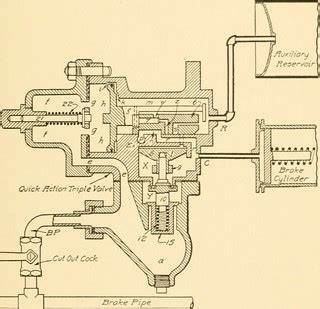
(Editor's Note: This is one of those unique and bizarre circumstances, like a "false positive" signal aspect - a clear signal when the block is in fact occupied. Theoretically, the system is "fail safe" and this sort of thing is not supposed to happen. For trainmen and engineers, this is like the sun not rising or setting, a nightmare. One cannot help but wonder, how this is even possible based upon FRA's speculation that, "air pressure slowly bled down from some of the cars' auxiliary reservoirs. The pressure maintaining feature of modern locomotives' air brake systems, combined with the "equalization" feature of each car's brake valve - "triple" valve - would seem to mitigate against this being a possibility ... unless the brake valves on these rail cars have been poorly maintained and are not working as intended.) |
|
FRA Issues ‘Unintended Train Brake Release’ Safety Advisory |
|
The Federal Railroad Administration (FRA) on Dec. 29 issued a safety advisory to make the rail industry aware “of a recent issue encountered by a train crew that experienced an unintended brake release of a train’s automatic air brakes while stopped at a signal,” and to recommend four steps to address the unintended release of train air brakes.
FRA published Safety Advisory 2022-02 (download below) in the Federal Register following its review of a June 22, 2022 incident. The agency reported that “during a significant thunderstorm, a crew consisting of a locomotive engineer and conductor operated a conventionally powered, intermodal train with three head-end locomotives, 47 loaded cars, and six empty cars, totaling 9,204 feet in length and 7,392 tons in weight. The engineer stopped the train on a downhill grade of 0.9-1.18% near the signal governing the train’s movement, set the train’s air brakes at approximately 12 pounds, and fully set the locomotive consist’s independent brakes. After being stopped for approximately three hours, the engineer and conductor, located in the lead locomotive cab, observed the train roll toward the signal interlocking displaying a stop indication. This train experienced an unintended automatic brake release. The locomotive consist’s independent brakes remained fully applied but due to the grade, tonnage and wet rail could not solely hold the train without the automatic air brakes also being applied.”
According to FRA, “[a]t the time an opposing train on the same track was preparing to cross through the interlocking in front of the rolling train. The locomotive engineer of the rolling train applied full-service airbrakes and full dynamic braking but was not satisfied that the brakes were working effectively or fast enough. The conductor operated the emergency brake valve and stopped the train short of the signal and the train that was preparing to cross through the interlocking. The crew then contacted the dispatcher and railroad management to report the unintended brake release and the conductor set a sufficient number of car handbrakes to hold the train on the grade.”
|
|
(Editor's Note: For the first time really in half a century, we have a chance to expand passenger rail in the U.S. Thousands of good union jobs will accompany this great expansion, jobs that might assist those railroaders fleeing the Class One freight industry. Let's do what we can to make sure it actually happens!) |
|
Flush with New Funding Opportunities, Amtrak Preps for Growth |
|
In 2021, Amtrak executives spent most of the railroad's 50th anniversary year promoting a 15-year strategy for expansion that would connect dozens of cities — up to 160 communities — to new Amtrak service.
Dubbed "Amtrak Connects US," the plan hung in the balance until President Joe Biden in November 2021 signed the Infrastructure Investment and Jobs Act (IIJA), the $1.2 trillion, five-year surface transportation reauthorization legislation. The law calls for $66 billion in funding for rail that could help pave the way for new intercity routes.
Today, Amtrak — flush with new federal funding opportunities — is juggling multiple priorities, including preparing to offer service in new rail corridors; upgrading aging assets; recovering ridership lost during the pandemic; addressing customer service problems; and recruiting and retaining enough workers to run the trains now and into the future.
"All these things take time," says Amtrak President Roger Harris, who was promoted to his post in June after serving as the railroad’s chief commercial officer since April 2019. "Having the money released [through the IIJA] is probably the biggest piece of work ahead of us."
Since late last year, Amtrak officials have been working on securing billions in grant funds, including those that could help pay for intercity passenger-rail expansion through the new Corridor Identification and Development Program, which was created under the IIJA. The Federal Railroad Administration has begun the process that will eventually identify and establish new rail corridors through which Amtrak could expand rail service. Since mid-May, the FRA has been collecting “expressions of interest” from states, regions, local governments and other entities that want to be considered for future passenger-rail service.
|
|
(Editor's Note: While we commend the effort, we know that the railroads have a solid track record of opposing state legislation in the courts, which consistently rule that the railroad is exempt from state regulation. But just as we have seen with gay marriage and soon Marijuana Legalization, if enough states adopt such laws, the feds finally act. The rail unions should all band together, and along with citizen group allies, mount a coordinated campaign in all 50 states to limit train length.) |
|
Rail Union Seeks Iowa Bill to Limit Train Length
Legislation introduced in 2022 would not allow trains over 8,500 feet
|
|
DES MOINES, Iowa — An Iowa representative of the SMART-TD union says the union will try again next year to advance a bill that would limit freight train lengths in the state.
House File 2339, introduced last February, was sponsored by outgoing Rep. David Maxwell (R-District 76). It would not allow any train “that exceeds 8,500 feet in length on any part of a railroad,” with penalties of not less than $500 and not more than $5,00 per violation. The Iowa Legislature website does not show it advancing out of committee.
Radio Iowa reports that Chris Smith, state director for SMART-TD, said he and others will return to the statehouse to lobby for the bill next year. Smith, who has worked for Union Pacific for 18 years as a conductor and engineer, said they would be working “to be at the forefront in Iowa and in the United States” to pass the legislation to “help protect its citizens.”
He argues that longer trains are more unsafe, lead to more accidents, and pose a danger by blocking crossings for extended periods; a railroad spokesman says trains of all lengths have been operated safely for years and cites economic benefits to longer trains. The report does not identify the railroad.
|
|
(Editor's Note: Humor, parody, and lampooning can all be effective weapons in the class war. The fat cat Class One rail carriers - with their bloated profits, lousy service, exploited workforce, blocked crossings, delayed trains, and arrogant attitudes - are ripe targets for such ammunition. Fire away!) |
|
Fast Track to the Gilded Age
"I been screwing over workers" sung to the tune of "I been working on the Railroad."
|
|
Republicans and Democrats in Congress recently joined together to force rail workers to accept a contract with exactly zero paid sick days and one measly “personal day.” Thanks to the 1926 Railway Labor Act, lawmakers sided with (surprise, surprise!) multibillion dollar rail corporations instead of workers.
Sure, they make decent money, but conditions sound brutal. CEOs overseeing a small handful of rail companies that made $21 billion in the first nine months of this year were willing to blow up the U.S. economy rather than shell out $321 million for 7 paid sick days for their workers. Sounds like good ol’ fashioned railroad baron greed to me.
|
|
(Editor's Note: The only reason we reprint this article is because the numbers look encouraging ... until we see that the category leading the pack is, you guessed it "executives, officials, and staff assistants.") |
|
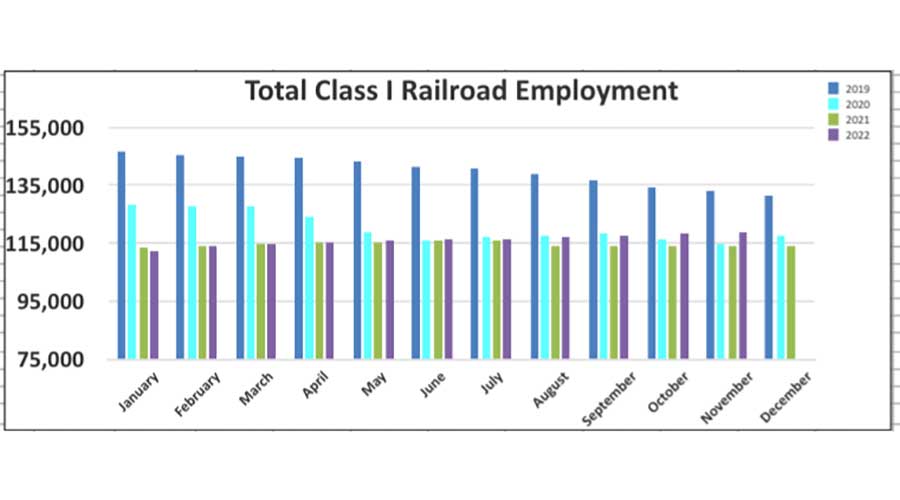
Class I Employment Grew 4.4 Percent in November |
|
Class Is employed 118,944 people as of mid-November, a 0.62% increase from mid-October employment levels and a 4.38% increase year over year, according to Surface Transportation Board data.
Five of six employment categories registered employment increases between October and November. They were: transportation (other than train and engine), up 1.34% to 4,779 employees; professional and administrative, up 1.11% to 9,998; executives, officials and staff assistants, up 0.96% to 8,030; maintenance of equipment and stores, up 0.77% to 17,774; and transportation (train and engine), up 0.74% to 49,934.
The only category to post a decrease in employment between October and November was maintenance of way and structures, which dipped 0.05% to 28,429 employees.
Year over year, all categories logged increases: executives, officials and staff assistants, up 10.29%; transportation (T&E), up 6.29%; maintenance of equipment and stores, up 3.15%; transportation (other than T&E), up 2.8%; professional and administrative, up 2.47%; and maintenance of way and structures, up 1.31%.
|
|
(Editor's Note: The Class Ones round out the year with a spectacular 5% decline in freight shipments moved year-over-year. We approach 17 years now that the rail industry has moved less freight since 2006. A national disgrace, a squandering of our national infrastructure.) |
|
U.S. Rail Volumes Fell Nearly 5 Percent in Week 51 |
|
U.S. freight railroads logged a combined 400,289 carloads and intermodal units for the week ending Dec. 24, a 4.8% decrease compared with volumes in the same period in 2021, according to Association of American Railroads data.
The railroads hauled 193,195 carloads for the week, down 4.1%, and 207,094 containers and trailers, down 5.5%.
Half of the 10 carload commodity groups that AAR tracks every week posted increases. They included motor vehicles and parts, up 1,486 carloads to 11,349; petroleum and petroleum products, up 892 carloads to 9,599; and nonmetallic minerals, up 870 carloads to 23,735.
Commodity groups that posted decreases included coal, down 9,265 carloads to 50,264; chemicals, down 1,069 carloads to 29,505; and grain, down 997 carloads to 18,198.
|
|
|
|
|
|
|