|
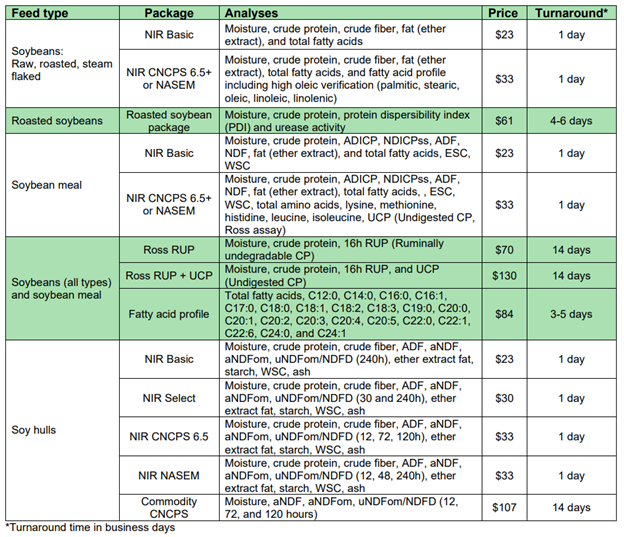
Whether you need to optimize diet formulations, evaluate roasting quality, or verify fatty acid profiles, our soy analysis packages provide actionable insights into the composition and quality of soybeans and their byproducts.
All xml files and example reports referenced in this document can be found in the link to supporting files.
Formulate according to soybean type
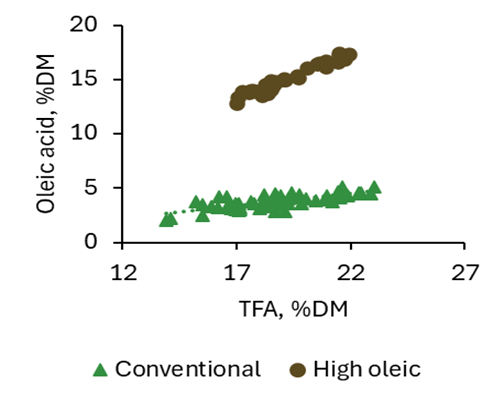
Making informed, cost-effective decisions starts with measuring the right factors. Book values can guide ration formulation for known soybean varieties, as natural variation is typically small. Most ration balancing platforms already include soybeans in their feed libraries, but if yours doesn’t, the XML files linked above can be used as reasonable starting points for formulation inputs. Book values are type-specific and should not be applied across soybean varieties (Figure 1). The following XML files are available:
High oleic: Raw | Roasted
Conventional: Raw | Roasted
If the variety is uncertain or if you’re feeding a blend of high oleic and conventional beans, testing is recommended to ensure accurate formulation and NIR analysis is the most economical way to determine fatty acid profiles. The following sample reports for soybeans are included in the link to supporting files:
NIR Packages: Basic | CNCPS 6.5+ | NASEM
Roasted soybeans: Protein dispersibility index (PDI)
Digestibility: Ross 16h RUP + Undigested CP
|