NSPIRE:

A New Era of Housing Inspections

Effective July 1, 2025: Everett Housing Authority (EHA) will adopt the National Standards for the Physical Inspection of Real Estate (NSPIRE) to replace the current Housing Quality Standards (HQS) for all Housing Choice Voucher (HCV) inspections. We encourage you to review the resource links provided in this newsletter. 


Under NSPIRE, inspections will assess minimum habitability requirements across three distinct areas:

  • The Unit - inside the individual assisted dwelling
  • The Building Inside - Shared spaces such as hallways and stairways
  • The Building Outside - Exterior elements like roofs, foundations, and common grounds


Each area will be evaluated for deficiencies categorized by severity (Life-Threatening, Severe, Moderate, or Low), with required timelines for correction.


Additionally, the Public and Federally Assisted Housing Fire Safety Act of 2022 required all smoke alarms to have a sealed 10-year battery beginning December 29, 2024. Landlords were previously notified of this requirement. This will continue to be enforced through NSPIRE. 

Examples of changes you will see with NSPIRE:

  • Smoke alarms are required on each level of the home and inside each sleeping area (bedrooms or other rooms used for sleeping).
  • Any interior wall (unit or inside) hole must be less than 2 inches in diameter. Units must not have multiple wall holes that add up to 6 inches by 6 inches or larger.
  • A parking lot pothole that is 4 inches deep and 1 square foot or greater will require repair.
  • All outlets located within 6 feet of a water source must be protected by GFCI.
  • Water heater discharge piping must terminate no more than 6 inches above the waste receptor (e.g. drain pan or floor drain) flood level.

Correction Timeframes:

When a unit does not pass inspection, landlords will be provided with a list of deficiencies and the timeframe repairs must be completed within. Each deficiency is identified in the NSPIRE standards as either life threatening, severe, moderate, or low.


Life-Threatening Deficiencies

Severe and Moderate Deficiencies

Low Level Deficiencies

Correction Timeframe

Within 24 hours after notice provided - see list of life-threatening deficiencies

Within 30 days after notice provided

Noted by the inspector for informational purposes; corrective action not required

Extensions

Not available

May be granted on a case-by-case basis with management approval

N/A

Extension Requests

Please contact the EHA Inspections Team if you need an extension to complete the necessary corrections. Extension requests will be granted for Non-Life-Threatening deficiencies only. Be prepared to provide the following information:

  1. Reason for extension
  2. Timeline of repairs
  3. Steps you will take to complete the repairs
  4. Any additional information regarding the repairs (contractor/company name, if applicable, estimates, etc.)


Who is Responsible for Repairs?

Family Responsibilities

The family is held responsible for the following deficiencies:

  • Tenant-paid utilities not in service
  • Damage to the unit or premises cause by a household member or guest beyond ordinary wear and tear (damages which could be assessed against the security deposit under state law or in a court practice). If the family fails to correct discrepancy or allow the landlord to correct it within the period allowed, EHA will terminate the family's assistance.

Landlord Responsibilities

The landlord is responsible for all NSPIRE deficiencies not listed as a Family Responsibility. If the landlord fails to correct deficiencies by the time specified, EHA must stop housing assistance payments (abatement) no later than the first of the month following the specified correction period (including any approved extension) [24 CFR 985.3(f)]. No retroactive payments will be made to the owner for the period the rent was abated. If the repairs are not made by the end of the abated month, Housing Assistance Payments are terminated fully. Owner rents are not abated as a result of deficiencies that are the family's responsibility.

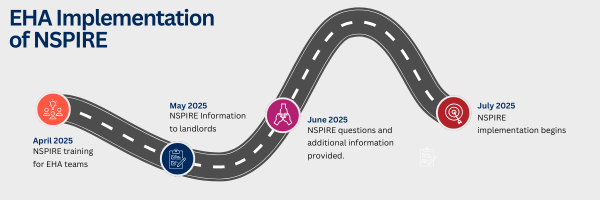
April 2025-June 2025, EHA will be continuing HQS inspections, but will be noting any NSPIRE-related deficiencies seen during the course of the inspection and providing those to landlords as an educational preparation method. Repairs on NSPIRE deficiencies during this time are not required to continue receiving Housing Assistance Payments but will be suggested.


EHA is committed to supporting landlords through this transition to the NSPIRE standards. Over the next few months, we will be providing additional resources, including informative materials and interactive information sessions designed to help you navigate the new standards. Please watch for information session dates and other important NSPIRE information coming soon.


Beginning July 1, 2025, EHA will be fully implementing NSPIRE inspection standards, and all NSPIRE deficiencies must be completed within the required timeframe in order to continue receiving Housing Assistance Payments.


Please view HUD's NSPIRE standards here. View our landlord inspections resource page on our website here.

REMINDER: Landlord & Partner Survey


Our optional survey is available through May 10, 2025. The purpose of this survey is to determine how satisfied EHA landlords and partners are with our customer service. By providing feedback, it help us understand areas where we are doing well and areas where we can improve in order to better serve you. Your feedback is greatly appreciated.

Next Issue: NSPIRE Tools & Resources

 
EVERETT HOUSING AUTHORITY | 425-258-9222
 
Facebook  Linkedin  Web