|
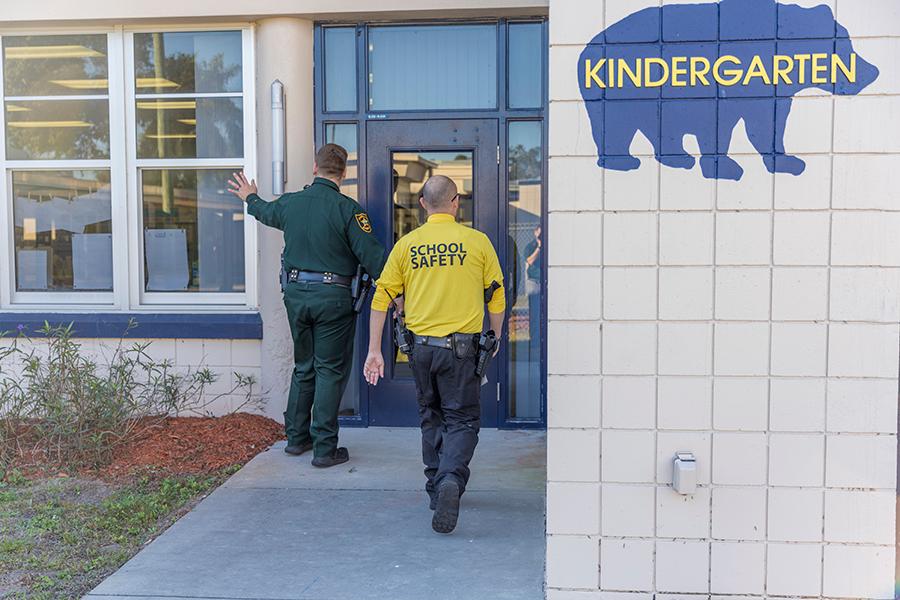
A law enforcement response time of just two or three minutes is impressive but to Sheriff Bob Gualtieri, who was following behind the designated shooter in a training scenario, those few minutes felt like forever. The response time was fast, but it can never be fast enough. “If you look at Stoneman Douglas, if you look at what happened in Parkland, 34 people were shot in 3 minutes and 51 seconds,” the sheriff said. “Somebody has to be there to stop it as soon as it starts because the cops can’t be there fast enough.” That somebody could be a School Resource Officer (SRO) or an armed, highly trained civilian Guardian. Before it became Florida law, it was the sheriff’s goal to have a ‘good guy with a gun’ in every school.
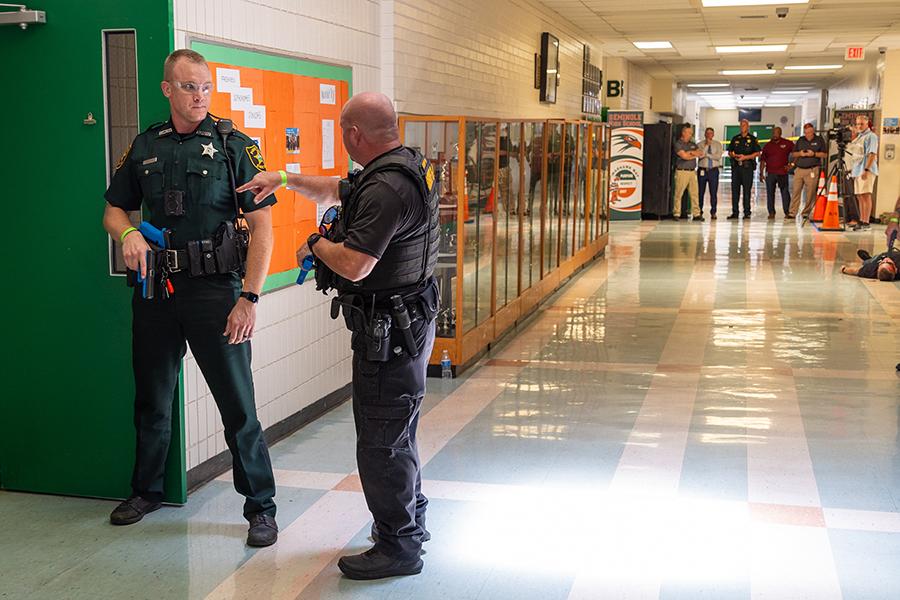
For the second year in a row, the Pinellas County Sheriff’s Office (PCSO) ran a massive multi-agency training scenario that involved an active shooter, mass casualties, and the combined response of local fire departments, EMS, and the school board. The scenario showed how well prepared our agencies are if the worst should ever happen here – but also exposed the terrible reality of the hard choices that must be made both before and during a tragedy like the one simulated this day.
The elaborate training scenario used Seminole Middle and High Schools to stage two related scenes, with the middle school standing in for an insurance agency. In the script, a teen student (played by a PCSO detective) who had been previously expelled from the high school was also fired from his job at the insurance agency, and returned with a rifle to cause mayhem at both locales. After gunning down several people at the insurance agency, the shooter moved to the high school across the street where unsuspecting students – played by PCSO family members, kids from the Police Athletic League, and other young volunteers – had just been dismissed for the day. After moving through the school the shooter was confronted by the SRO, who stopped the threat but was wounded in the process.
Whenever they are dispatched on a call, law enforcement officers must expect the unexpected. Last year the training scenario featured a female shooter, a choice that could have thrown off some responders because statistically mass shooters are male, and the call even initially identified the shooter as “he.” In this year’s scenario, an unexpected second shooter – the first shooter’s girlfriend – opened fire in a nearby classroom shortly after the initial shooter was dispatched. Responding deputies rushed toward the sound of gunfire and eliminated the threat.
Though there will be a comprehensive after-action report compiled from video footage and notes from the many observers, evaluators, and facilitators, the sheriff had an early take on the scenario shortly after the scene went cold. “Some of the things I saw that I liked were the single-deputy response, as soon as the deputies got here they were going in. There was absolutely no hesitation to confront the shooter and to go to the sound of the gunshots.”
The first deputy on scene is trained to enter and confront the threat without waiting for backup, and that’s exactly what they did in this scenario. “They go in, they go right to the stimulus and they don’t stop until they kill the killer.” In fact, as heartbreaking as it might be, deputies can’t pause to help the wounded until the shooter is stopped. “Our initial responsibility is not to treat anybody, and that’s one of the things that’s hard to get instilled in the mind of a cop because they want to save people. But that’s not their job, that’s the Fire/EMS job. Their job is to stop the killing, and you’ve got to walk past people, you’ve got to step over victims, because nobody can save these people until the shooting stops and the killing stops.”
Stopping an active shooter is only the first part of what this huge training exercise pressure tested. After the shooters were stopped, the next task was to treat the wounded. Responders set up Casualty Collection Points where the wounded could be quickly evaluated and then transported. “One of the things that did happen this year that didn’t happen last year was the formation of what we call Rescue Task Forces, which is a combination of Fire, EMS, and law enforcement going in together.”
Some 300 people were involved in this training exercise, and one of the challenges of any multi-agency action is getting people to communicate smoothly and work efficiently with each other. Sheriff Gualtieri said he was impressed by the level of cooperation he saw this year. On the law enforcement side they came from the PCSO, the Largo Police Department, the St. Petersburg Police Department, the Clearwater Police Department, and the Indian Shores Police Department. They’re given limited information, just like they would on an actual call when citizens might give dispatchers partial or inaccurate information. Then the responders had to work together to share information and strategies.
Young volunteers contributed to the realism of the event, whether their role was to add to the chaos by sprinting for safety, or they were playing injured victims. Pinellas County Schools Superintendent Kevin Hendrick said that some of the teens were thespians from Seminole High or other schools who put their acting skills to the test by playing casualties. Makeup artists added realistic looking wounds – bullet holes, protruding bones, and blood. Combined with realistic weapons and the sound of gunfire the scenario had a level of reality that pushed deputies to their best response, but also could have shocked the student actors. Hendrick said they work hard to prepare all of the civilian participants for what they might experience. “There’s a lot of mental health and wellness checks that go into getting ready for this day. This is a part – unfortunately – of the world we live in today and so the students were very excited to help keep our county safe.”
After the shooter is stopped and the wounded are treated, there is still plenty of work to do. Particularly in a school, but also at any mass casualty event, the citizens involved must be reunited with their family and friends. In this scenario, Pinellas County Schools practiced the reunification process that would bring children back to their frantic families.
“We hope that none of these scenes ever play out in our schools, but we have to practice,” said Superintendent Hendrick. “We bring the parents in, bring the students in, offer counseling, make sure they have what they need, reunify them with their parents, and then work collaboratively with agencies to move forward.” Many teachers and administrators also participated as actors so they could learn as much as possible from this scenario. “It’s important for our parents to know that we’re prepared., we’re making them as safe as we possibly can.”
|