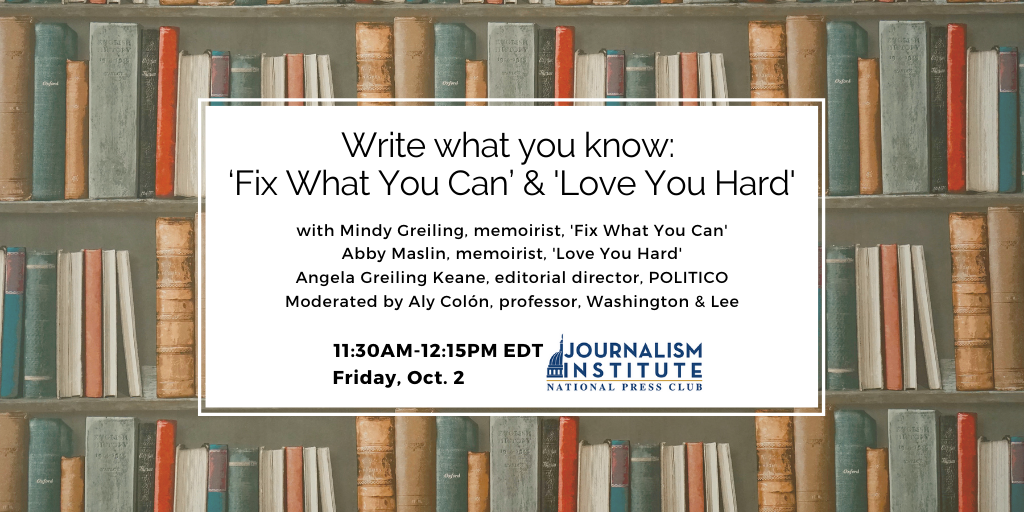
“The discipline of journalism has essentially beaten the I pronoun out of us,” said New York Times correspondent Rukmini Callimachi at an Institute program on Monday. “Writing about yourself is just not something that we do.”
While writing the memoir, Nir saw the pivotal role horses played in helping her heal from childhood traumas and being assaulted as an adult. She described the book as a reported look at an obsession — one that she shares with countless others.
“Everywhere I've gone around the world reporting, when I'm done, I put away my notebook and I take out another, and I go find the horses,” she said. “Our natural predilection to ask why sought me to understand the people around those horses. Why did they have this passion? Why does this passion exist worldwide?”
On memoir and courage
Callimachi: It takes some level of courage, I would say, to write so frankly about your family, about personal trauma, in a medium that is going to be read by all of your peers.
Nir: What happened is true, and the tragedy of those relationships is true. And so if you're not falsifying, if it's just reality … it's irrefutable. And I was willing to maybe risk those relationships for the truth. I felt that it was worth it.
On the power of empathy
Nir: I think I feel tough as nails because I survived being stabbed in my own bed, but I think I felt tough as nails before because as a journalist we’re called upon to empathize and when we enter dangerous situations in our lives as journalists, you ally build. …
When I go into frightening corners of the world, you'd expect perhaps I have a level of trauma that I won't go in. But I look to someone there — maybe a dude hanging on the corner — and I say, you know, I'm pretty frightened, right now. ... And then that is... a humanizing connection. Just being a little self-revealing as a journalist is part of my process.
On the ‘elements of journalism’ when reporting as an outsider
Callimachi: I haven't reported on America in like over a decade, you know, so just reporting on America feels very foreign to me. …
My go to has just been the elements of journalism. I'm working extremely hard to get documents. I learned through my work on terrorism that documents — things written on paper — are just the surest way to go. Whether it's the terrorist groups’ own records, or whether it's classified information that you're able to get from governments. The same thing here [in reporting on Breonna Taylor]. I'm trying to get the document behind the documents. … There were many police officers that were there that night. All of them have given testimonies. I'm trying to get those. There's an autopsy report, there's a ballistics report. There's body cam footage. ... That's where I've sort of found myself is basically hunting for those things and trying to divine the closest thing to the truth from those documents.
On ‘unpacking the why behind the why’
Nir: I could easily say, I love horses. I start the book and I say why do I love horses? Because, horses, that's an answer for me because it feels part of my bones and my soul. But there is so much more to really any story. ...
I realized so much of my compulsion to be in this horse world was about passing. My dad [as a Holocaust survivor] had all these false identities to survive like ... a false baptismal certificate as a Catholic. And so being immersed and accepted in this very Aryan, waspy world, was my version of passing as a Jew.
On transformation
Nir: When [the book] first came out, I would have said it helped me. It really helped me put a pin in some unfinished thoughts I had and it also helped me process them. But actually — and this is something that has never happened with my journalism — it has resurfaced a lot of the trauma. …
That has not happened with my journalism before because I think I can get distance from it, but the book has reopened and unearthed things. And if there are any horse people on here, I'm riding terribly right now because I am so conscious of everything it means and I can't get to that place of just being. But, you know, life’s a process.