Ohio Water Resources Center Newsletter
|
|
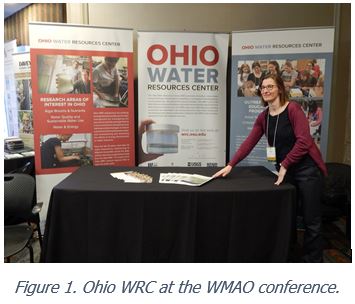
The Water Management Association of Ohio (WMAO) was organized in 1972. A basic objective of WMAO is to promote and support the water resources of Ohio for all beneficial purposes. WMAO is the only professional organization in Ohio focused on all water disciplines and multiple interest areas.
The Ohio Water Resources Center has a long lasting partnership with WMAO and from its inception, WMAO has served to represent the voice of water professionals in the determination of our research priorities. The Ohio WRC participates on the WMAO Board as a director for research and data management and helps fulfill the educational mission of WMAO by co-administering Project WET, quarterly luncheons and helping with the statewide conference.
|
|
The 48th Annual WMAO Conference and Symposium
|
|
Weather today is weird, with extreme events happening more frequently. This affects water systems and how we must manage our precious natural resources. Global climate weirding is a descriptive way to refer to this phenomenon. Water management in Ohio is equally influenced by this worldwide weirding causing hotter, drier, wetter, and windier conditions. Do you have a story to tell related to identifying such problems of water weirding? What about a community response to extreme weather in seeking sustainability? What technology or innovation have you witnessed to improve the protection and restoration of impacted groundwater, wetlands, streams, and lakes?
Join WMAO to learn how Ohio is protecting water resources from water weirding. The 48th Annual WMAO Conference and Symposium will be held from November 13th to November 14th at the Crowne Plaza Columbus North. For information including the agenda and registration, please visit the
WMAO website
.
|
|
Via Toledo Blade, October 25
th
, 2019
Via News 5 Cleveland, October 24th, 2019
Via Bloomberg Law, October 23
rd
, 2019
Via Michigan Radio, October 23
rd
, 2019
Via YSNEWS.com, October 18
th
, 2019
Via
Port Clinton News Herald, October 18
th
, 2019
Via WHIO, October 16
th
, 2019
Via JD SUPRA, October 15
th
, 2019
Via WFMJ, October 13
th
, 2019
Via AP, October 11
th
, 2019
Via The Washington Post, October 10
th
, 2019
Via Cleveland.com, October 9
th
, 2019
|
|
Have a news article you'd like us to feature in our Newsletter? Email us at OhioWRC@osu.edu!
|
|
Ohio WRC Research Highlight
|
|
Assessing Ultrasound as a Source Water Reservoir Management Strategy to Control Cyanobacteria Blooms
|
|
In Ohio, seasonal harmful algal blooms (HABs) have increased in frequency and intensity. These blooms have greatly affected many water resources in Ohio, including drinking water reservoirs. Ohio WRC researchers Drs. Weavers, Bohrerova and Cheng together with C.R. Weaver from Columbus’s Division of Water and Liz Crafton from Hazen and Sawyer teamed up to evaluate ultrasound as a reservoir management strategy to control HABs. The OWDA funded project focused on ultrasound as a physical strategy. Compared to other physical strategies and the use of algaecides, ultrasound has the advantage of low energy and no chemical addition. For these reasons, the technology is gaining in popularity among reservoir managers.
|
|
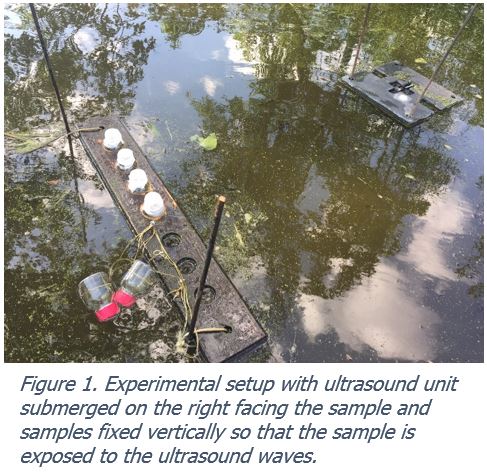
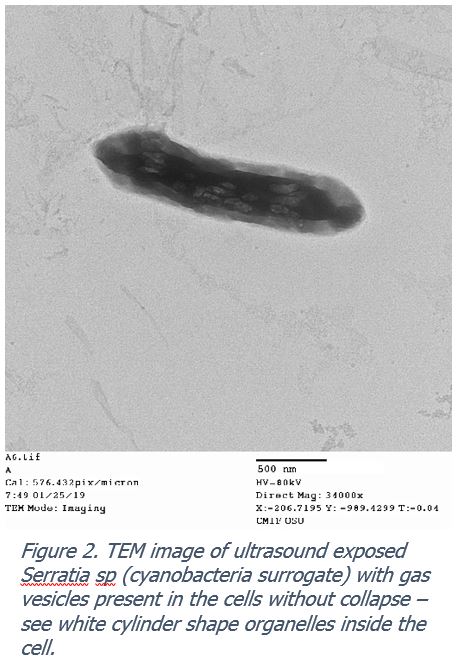
The teams’ investigation focused on cyanobacterial gas vesicles (aerotops) – proteins specific to cyanobacteria that helps them control their buoyancy and depth regulation and therefore gives them the advantage of fast growth when nutrients are present. Ultrasound is believed to collapse these vesicles due to pressure changes it creates with sound waves, making the cyanobacteria sink. First, using a bacterial surrogate and later a HAB impacted water, we evaluated ultrasound on gas vesicles (Figure 1 of experimental setup). Surprisingly, the series of experiments showed that gas vesicles in both the bacteria surrogate and two algal species (Microcystis and Anabaena/Dolichospermum) were unaffected by ultrasound after two weeks of ultrasound exposure (Figure 2). Further work is needed to evaluate other mechanisms that may affect cyanobacteria growth in reservoirs using ultrasound to control HABs.
|
|
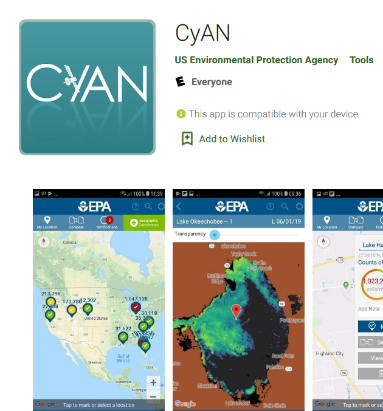
The Cyanobacteria Assessment Network (CyAN) is a multi-agency project between the EPA, NASA, NOAA, and USGS to develop an early warning indicator system using historical and current satellite data to detect algal blooms in U.S. freshwater systems. This research supports federal, state, and local partners in their monitoring efforts to assess water quality to protect aquatic and human health.
The CyAN app provides an easy to use, customizable interface to scan water bodies for changes in cyanobacteria occurrence without requiring computer programming expertise. It is designed to inform decisions regarding recreational and drinking water safety by providing water quality managers with a user-friendly platform that reduces the complexities associated with accessing satellite data to allow fast and efficient initial assessments across water bodies that are roughly one square kilometer or greater. The primary satellite sensor collecting data is the European Space Agency’s
Copernicus Sentinel-3 Ocean and Land Colour Instrument
.
Users can view information about cyanobacteria concentrations on a national-scale or can zoom in to single-out data for a lake or reservoir. Users can determine their own thresholds for cyanobacteria concentrations and compare multiple water bodies at once, allowing for better-informed decisions based on recent changes at specific locations.
The
CyAN App
is available for download in the Google Play™ store for Android™ devices.
|
|
RFP - 2019 Water Research Consortium Challenge
|
|
The Confluence Water Research Consortium is a network platform for connecting researchers affiliated with member organizations to develop sustainable, innovative, environmental technologies in response to today's regional, national and global water challenges. The goal of the 2019 Water Research Consortium Grant Challenge is to incentivize greater participation and support of faculty and their students at regional colleges and universities in Confluence and the needs of its stakeholders.
Specific research focus areas include: 1) Lead Safe Cincinnati Initiative; 2) Detection and Monitoring of PFAS and Related Compounds; 3) Health of Urban Streams; 4) Other Areas of Interest.
|
|
Approaches to Reduce Nutrient Loadings for Harmful Algal Blooms (HABs) Management Request for Applications (RFA)
|
|
EPA aims to promote scientific progress towards preventing and controlling harmful algal blooms by seeking applications proposing research to:
- Determine the effectiveness of existing nutrient treatment technologies.
- Evaluate the scale-up of emerging nutrient treatment technologies and develop new technologies.
- Develop best management practices to help both rural and urban communities control nutrients in their watersheds.
|
|
Environmental Education Local Grants Program for Region 5-- Solicitation Notice for 2020
|
|
The Environmental Education Local Grants Program in Region 5 supports locally-focused environmental education projects. The closing date is
11:59 p.m. (ET) January 6, 2020
.
More information
.
|
|
Program Solicitation for National Artificial Intelligence Research Institutes
|
|
The National Science Foundation announced the creation of a new program to significantly advance research in AI and accelerate the development of transformational, AI-powered innovation by allowing researchers to focus on larger-scale, longer-term research.
Grant proposals for the National AI Research Institutes program are due to NSF no later than
Jan. 28, 2020
, for Institute proposals and
Jan. 30, 2020
, for planning grant proposals.
|
|
National Centers for Coastal Ocean Science Competitive Research Program
|
|
The NCCOS Competitive Research Program (CRP) has posted a Fiscal Year 2020 Federal Funding Opportunity (FFO) for the Prevention, Control and Mitigation of Harmful Algal Blooms (PCMHAB) program and Harmful Algal Bloom (HAB) Socioeconomics Research program. The deadline for Letters of Intent for both programs is
November 11, 2019
, and for full applications is
January 10, 2020
.
More information
.
|
|
The North Central Region Water Network and NCRCRD are accepting applications through their Supplemental Request for Applications
|
|
This fall, the North Central Region Water Network and the
North Central Regional Center for Rural Development
(NCRCRD) are partnering to address the challenges for agriculture and communities posed by devastating reoccurring floods. They are currently accepting applications through their Supplemental Request for Applications.
|
|
17th Annual P3 Awards: People, Prosperity and the Planet (P3) Student Design Competition Request for Applications (RFA) Now Open
|
|
The U.S. Environmental Protection Agency (EPA) announces the release of the 17
th
Annual P3 Awards: A National Student Design Competition Focusing on People, Prosperity and the Planet (P3) Phase I Request for Applications (RFA). This collegiate design competition promotes the use of scientific and engineering principles in creating innovative projects to address environmental challenges and develop real-world solutions. This RFA is seeking applications in the research areas of Air Quality, Safe and Sustainable Water Resources, Sustainable and Healthy Communities, and Chemical Safety. The closing date for this RFA is
November 19
th
, 2019
.
More information
|
|
Ohio EPA - 2020 Recycling & Litter Prevention Grant Information Webinar
|
|
This webinar discusses Ohio EPA’s 2020 Recycling & Litter Prevention Grant application process. The webinar will focus on how this competitive grant program provides opportunities for local governments, schools, businesses and nonprofit organizations to establish and implement recycling & litter prevention programs, recycling market development for manufacturers, expansion of recycling equipment and processing facilities and recycling infrastructure improvements. The webinar will be held on January 8, 2020 at 10:00 am. Register at
this website
.
|
|
Call for Abstracts - Confluence Tech Showcase & Aqua Pitch
|
|
The Confluence Tech Showcase & Aqua Pitch will bring together leaders from the water industry, government, and universities, to network and share perspectives on regional, national, and global water challenges. Confluence is dedicated to addressing these challenges, while creating important opportunities for innovation, commercialization, work force development, and economic growth.
This call for abstracts is addressed to the managers who maintain the key water infrastructure assets underpinning our regional and national economies, and to the engineers and scientists who research, develop, commercialize, and apply the innovative technologies for assessing, maintaining, and improving these assets.
|
|
Call for Abstracts - 2020 Ohio Stormwater Conference
|
|
The 2020 Ohio Stormwater Conference is an annual conference dedicated to advance the knowledge and understanding of comprehensive stormwater management for those dealing in all aspects of planning, design, implementation and regulatory compliance. This year’s conference is being held May 6-8, 2020 at the Kalahari Resort and Conference Center located in Sandusky, Ohio.
More information
.
|
|
Ohio EPA - Human Health Water Quality Criteria
|
|
This is the five year review of rules. The Agency is proposing new criteria for the protection of human health in order to be consistent with U.S. EPA's 2015 updates to 94 human health water quality criteria, and ORSANCO's 2015 pollution control standards (PCS). The Agency is also proposing to implement U.S. EPA's maximum contaminant levels (MCLs) statewide, where they were previously only applied in the Ohio River basin.
The Agency invites all interested parties to comment on these rules. The public comment period will run until 5:00 p.m. December 4, 2019. A public hearing on this proposed rulemaking will be held to consider public comments in accordance with Section 119.03 of the Ohio Revised Code. This hearing will be held at Conference Room A at the Ohio EPA Central Office, 50 West Town Street, Suite 700, Columbus, Ohio at 10:30 a.m. on December 4, 2019.
|
|
Early Stakeholder Outreach - General NPDES Permit Rules
|
|
This rulemaking includes two general NPDES permit rules in Ohio Administrative Code (OAC) Chapter 3745-38. A general permit is one permit that covers facilities that have similar operations and type of discharge. A general NPDES permit is a potential alternative to an individual NPDES permit and affords coverage to new and existing dischargers that meet the eligibility criteria given in the general permit. General permits are used to cover discharges that will have a minimal affect on the environment.
The Agency is considering an update of references and cross references with other rules, and the creation of an application procedure to modify coverage under a general permit.
|
|
Notification of Public Hearing on Proposed Rules - Human Health Water Quality Criteria
|
|
A public hearing regarding proposed amendments to three Water Quality Standards rules in Ohio Administrative Code (OAC) Chapter 3745-1 has been scheduled for December 4, 2019. This rulemaking includes the following rules:
3745-1-32: Ohio river standards.
3745-1-33: Water quality criteria for water supply use designation.
3745-1-33: Water quality criteria for the protection of human health [fish consumption].
The Agency invites all interested parties to comment on these rules. The public comment period will run until December 4, 2019. A public hearing on this proposed rulemaking will be held to consider public comments in accordance with Section 119.03 of the Ohio Revised Code. This hearing will be held at Conference Room A at the Ohio EPA Central Office, 50 West Town Street, Suite 700, Columbus, Ohio at 10:30 a.m. on December 4, 2019.
The preliminary proposed rules and a fact sheet explaining the rule revisions are posted on the Ohio EPA website at
www.epa.ohio.gov/dsw/dswrules.aspx
. Another notice will be provided when these rules are officially filed with the Joint Committee on Agency Rule Review and the rules will be posted on the Ohio EPA website at the above link.
|
|
OAWWA Southwest District Fall Meeting - November 8, 2019
|
|
The southwest district fall meeting will be held at the Yellow Springs, Ohio on Friday, November 8
th
.
More information
.
|
|
Ohio Department of Transportation Research Summit 2019 - December 5, 2019
|
|
Ohio Department of Transportation Research Summit 2019 will be held on Thursday December 5, 2019 from 9 am -3 pm at The Ohio Department of Transportation
Central Office, 1980 W. Broad Street, Columbus, OH. Save the date, and more information will be coming soon.
|
|
Green Lakes Blue Waters 2019 Conference - November 19 to 20, 2019
|
|
The way we farm can be the solution to big challenges – climate, water, wildlife, vibrant rural communities. Attendees at the previous GLBW conference dug deep into robust discussions, highlighting major barriers to increasing CLC across the agricultural landscape: markets and economic drivers, policy, research and information gaps, systems factors, and the most mentioned hurdle: mindset and message — human inertia stuck in the status quo.
More information
.
|
|
Midwest DEWS Regional Partner Meeting -
November 19 to 20, 2019
|
|
Please join NIDIS for the 2019 Midwest Drought Early Warning System (DEWS) Regional Partner Meeting, which will bring together federal, state, tribal, local, academic, and other partners from across multiple sectors in the Midwest to share and explore information and ideas that advance drought early warning and preparedness in this 8-state region.
More information
.
|
|
GIS Day 2019 at Ohio State - November 13, 2019
|
|
GIS Day
at Ohio State is an annual event for students, staff, faculty, and visitors to learn more about geographic information systems (GIS) and celebrate the power of geospatial analysis and visualization in answering research questions and solving real-world problems. This event will be held on November 13, 2019 from 9:00 am to 3:00 pm at the Research Commons, 175 W. 18th Avenue, Columbus, OH. For more information and registration, visit the
event page
.
|
|
Have an event you'd like us to feature in our Newsletter? Email us at OhioWRC@osu.edu!
|
|
Email
: OhioWRC@osu.edu
Phone
: 614-292-2807
Website
: https://wrc.osu.edu/
Address
: 311 Hitchcock Hall
2070 Neil Avenue
Columbus, OH 43210
|
|
|
|
|
|
|
|