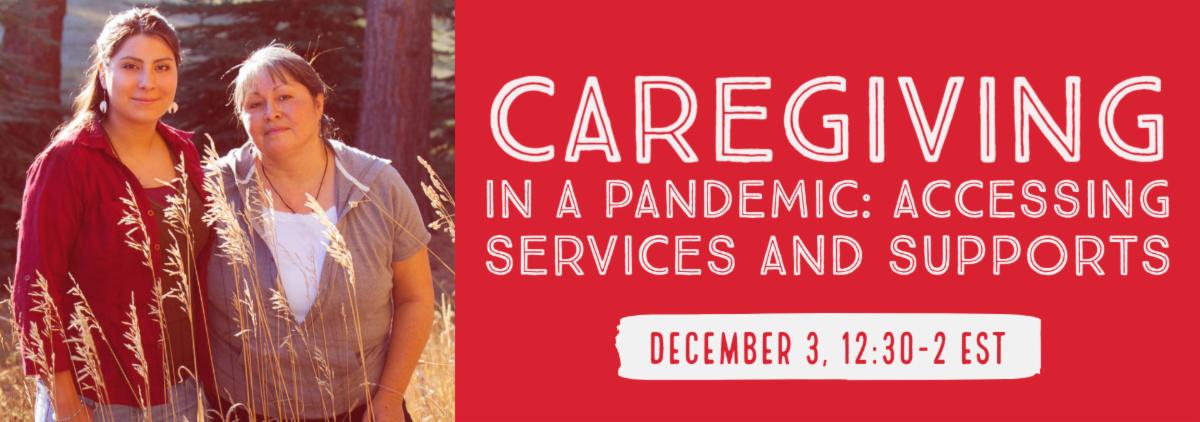
"Caregiving in a Pandemic" Webinar December 3 |
Do you provide care or support for a friend or relative? If so, this session is for you!
The webinar features interactive poll questions, and speakers such NICOA Executive Director Larry Curley; Captain Susan Karol, MD, Medical Officer for the Centers for Medicare and Medicaid Services, Division of Tribal Affairs; and Melissa Chlupach, Assistant Professor at the University of Alaska Anchorage, College of Health, School of Allied Health, Dietetics & Nutrition Program, and more.
First 75 participants will receive a $25 gift card.
|
|
|
|
NICOA Creates COVID-19 Tribal Needs Assessment |
As the leading national Native aging organization for elders, we strive to provide information that will assist tribes and their communities. The information we gather will help us better understand how tribes have been affected by COVID-19 and the mental, physical and social impact it has had on their health. It will also serve to illustrate what Indian Country looks like to those who do not know, and help us focus our efforts most effectively.
Once the information is collected and analyzed, we will create educational materials to share with NICOA members, Native advocacy groups and other aging organizations. Survey ends January 15, 2021.
|
|
|
|
NICOA Celebrates Native Elders with Live Webinar |
On November 10, 2020, American Indian and Alaska Native elders came together to recognize their many sacrifices, contributions and achievements as well as those who came before them. Listen as they celebrate their rich and vibrant cultures. The event included music, stress-busting tips, simple at-home exercises and more. |
The webinar features American Indian Development Expert Sherry Salway Black, speaking on the subject of “Native Wealth: So Much More than Money”. You’ll also hear from Sixtus Dominguez, a tribal injury prevention program coordinator at the Albuquerque Area Southwest Tribal Epidemiology Center, who talks about the importance of stretching and staying active for elders as well as demonstrates chair exercises. You can also learn about the new National Native American Veterans Memorial in Washington, D.C., as well as healthy ways to manage stress. |
|
|
|
Wells Fargo Grant Builds NICOA’s Capacity |
The National Indian Council on Aging (NICOA) has made great progress since it was awarded a national 501 (c) (3) Capacity Building grant by the Wells Fargo Foundation in 2018. The $400,000 multi-year grant has been utilized by NICOA for capacity building.
Capacity building refers to many different types of activities that are all designed to improve and enhance a nonprofit’s ability to achieve its mission and sustain itself over time. It is an investment in the effectiveness and future sustainability of NICOA. It strengthens our ability to fulfill our mission, thereby enhancing our ability to have a positive impact on lives and communities.
The Wells Fargo grant was used to develop a strategic plan to guide the organization as well as a working partnership (MOU) with the National Resource Center on Native American Aging at the University of North Dakota. It was also used to develop the board of directors and hire a fundraiser.
|
|
|
|
Housing Models Grounded in Equity |
|
|
|
|
|
Executive Director Larry Curley discusses the long and inspiring process of lobbying for the groundbreaking amendment to Title VI of the Older Americans Act to provide direct funding for American Indian tribes to support their elders. |
|
|
Creative Approaches to Keep Elders Engaged During COVID-19 |
|
|
|
|
|
Larry Curley provides an overview of cultural considerations when working with American Indian and Alaska Native elders, with a particular focus on social isolation and culturally sensitive strategies to connect and engage with Native elders to address social isolation. |
|
|
Why Every Elder Vote Counts |
In October 2020, NICOA held a live, national webinar about “Why Every Elder Vote Counts”. If you missed it, you can still watch it here. |
|
|
|
|
|
Learn about the history of American Indian and Alaska Native voting rights, hear from AARP on voter engagement, learn ways to vote safely, reflect on the barriers facing Native people and what can be done to overcome them. Discussions on the importance of advocacy, data, census, and financial security wrap up an information packed three-hour session. |
|
|
Featured speakers include Jacqueline De León, a staff attorney at Native American Rights Fund and member of the Isleta Pueblo, and Charmaine S. Fuller Cooper, the South Region AARP campaigns field manager and campaign liaison on multicultural voter engagement efforts focusing on American Indian and Alaska Native and African American audiences.
NICOA Executive Director and Navajo Nation member Larry Curley is also a featured speaker; along with Rebecca Owl Morgan, NICOA project coordinator and a member of the Eastern Band of Cherokee Indians; Cheryl Archibald, executive assistant to NICOA’s executive director; Sue Chapman, director of NICOA’s Senior Community Service Employment Program (SCSEP); Leslie Nicole Maly, NICOA’s SCSEP compliance manager; and NICOA Data Analyst Desiree Lapaphie (Navajo Nation).
|
|
|
|
2020-2021 Membership Available Online |
|
Membership with NICOA offers many valuable benefits. As a paid member you will receive NICOA’s online bimonthly newsletter, legislative updates on important issues and resolutions affecting elders, voting privileges for qualified members and discounted registration fees for qualified members to attend our biennial conferences.
Be an important part of a national membership network and become a NICOA member by applying online or by mail. |
|
|
|
Free Financial Coaching Available to Tribal Citizens |
The Oklahoma Native Assets Coalition, Inc. (ONAC) is offering three types of free financial coaching to tribal citizens across the United States: credit counseling, homebuyer education, and financial management (budgeting).
Confidential sessions are offered one-on-one, by teleconference (Zoom) or phone call, with certified credit counselor, homebuyer education provider, and financial educator, Felecia Freeman (Citizen Potawatomi). Typically, these sessions will last for an hour and are scheduled at a mutually agreeable time.
Thus far, ONAC has offered this free financial coaching to those who have received funding from their pandemic-related emergency cash assistance, Children's Savings Accounts, and emergency savings accounts programs (their outreach for these programs has been in partnership with various tribal and Native-led nonprofit partners).
Now, ONAC is offering these financial coaching services to a wider group of constituents. If you are working with tribal citizens who would like to receive these free ONAC financial coaching services from a Native certified financial coach, pass along this registration link to those tribal citizens you serve. Tribal citizens who are interested in such services may then complete the registration form. A financial coach will work with them to schedule a remote session by phone or teleconference. This financial coaching is available to any American Indian or Alaska Native in the United States, regardless of where they reside. |
|
|
|
New Guide for Native Veterans |
The Office for American Indian, Alaska Native, and Native Hawaiian Programs has announced a new Veterans Quick Guide. According to the Department of Defense, American Indians and Alaska Natives have one of the highest representations in the armed forces. This guide seeks to help all of those honorable veterans and their family members quickly access the information they need to apply or request assistance for benefits and health care services.
The first page provides important links, phone numbers and general information about main services offered by the U.S. Department of Veterans Affairs, while the second page has direct links to tribal governments that might offer additional support.
|
|
|
|
Vaccination Rates Among American Indians |
Immunization against childhood diseases is regarded as one of the greatest public health achievements in the United States and worldwide. The benefit of vaccinations has been particularly notable for American Indian and Alaska Native people, who have suffered disproportionately from infectious diseases compared with the general U.S. population.
Vaccination coverage among American Indian children is higher than national coverage levels for most vaccines. This finding contrasts with overall coverage estimates among all American Indians, which usually are slightly below national coverage levels.
Low vaccination rates among Native populations may be a result of mistrust of the medical community and a negative perception of health providers due to a history of institutional racism. Other barriers to vaccination include transportation difficulties, long waits for appointments, and poor patient-provider communication.
|
|
|
|
COVID-19 & the Flu: Fact vs. Fiction |
Flu season is just getting started, but misinformation about influenza and the coronavirus is already swirling. The Centers for Disease Control and Prevention says it’s likely that the viruses that cause the flu and the viruses that cause COVID-19 will both be circulating this fall and winter.
Here are some big misconceptions people have about the illnesses, which everyone needs to unlearn as we head into flu season and another high wave of COVID-19:
Myth: The flu won’t be a problem because we’re wearing masks.
Doctors are hoping for a lighter influenza season this year as people practice physical distancing, mask wearing and better hand hygiene. Which is why layering preventive measures is so important. People can get the flu by touching surfaces or objects that have been contaminated with flu viruses (which is also true with COVID-19).
Myth: The flu vaccine could make you sick, weak or more vulnerable to COVID-19.
The claim that the flu vaccine can give you the flu is not true. However, you could develop a flulike reaction to the vaccine (including muscle aches and fever) as your body produces antibodies.
But the vaccine itself will not give you an illness. That’s a key misconception to clear up now for anyone who is reluctant to get vaccinated over concerns the shot will make them sick and weaken their immune system amid a pandemic, making them more vulnerable to COVID-19. It won’t.
Myth: The flu vaccine could “mess” with a COVID-19 vaccine.
If a COVID-19 vaccine becomes available during flu season, after you have already received your flu shot, there should be no problem getting a subsequent vaccine any time this winter.
|
|
|
|
Hundreds of American Indian Treaties Digitized for the First Time |
The online collection features 374 ratified Indian treaties from the archives’ holdings. According to a blog post, these documents are housed in a specially protected area of the National Archives building and are unavailable for use in the Central Research Room due to their fragility and significance. More than 50 of the treaties are written on large sheets of parchment; several contain drawings, maps and wampum, or decorative beads used as currency in some Native American tribes.
Those hoping to delve into the trove can use Indigenous Digital Archive (IDA) Treaties Explorer, a free tool optimized for easily searching and studying the documents. In addition to providing a framework for research, the portal offers maps of different treaty land designations, as well as extensive historical and contextual information.
In addition to debuting the new resource, MIAC recently hosted a series of Facebook workshops on treaty law. Led by Sherri Thomas, assistant director of the University of New Mexico Law Library, the recorded sessions are now available to view online. |
|
|
|
Tribes Struggle to Receive COVID-19 Data |
As American Indian and other communities of color bear the brunt of COVID-19, tribal epidemiologists across the U.S. are struggling to access potentially life-saving information: several of the 12 tribal epidemiology centers have reported poor responses to their requests for data. These centers can fight the virus with public health messaging, contact tracing, and population surveillance in Native communities, but without data they’re unsure where to focus their efforts.
Without the data, the virus can spread not only within tribes, but throughout the general public as well. Tribal advocates say data withholding may violate tribes’ sovereignty and treaty rights; some leaders are prepared to take legislative and legal action to get the information they need.
Gathering data is difficult partly because American Indians and Alaska Natives receive care from a mix of federal, tribal, and private facilities, many of which don’t share Native patients’ results with tribal epidemiology centers, or don’t even identify Native patients at all. Federal Indian Health Service clinics don’t report directly to tribal epidemiology centers but to the national Indian Health Service system, where cases are often missed or inputted incorrectly.
If a Native patient is seen at a private facility, their result may never reach tribal epidemiologists at all. Since such facilities are unlikely to be aware of, let alone report to, their regional tribal epidemiology center, their results often only end up in the hands of states and the CDC — which aren’t sharing critical information with tribal centers. Data is crucial to this work. It is used to locate disease hot spots, track the spread of infections, and understand which health interventions are successful in specific communities.
|
|
|
|
|
|
The National Indian Council on Aging, Inc. (NICOA) is a not-for-profit 501 (c)(3) charitable organization. Please consider adding NICOA to the charities you support.
NICOA needs your financial support as the advocacy and political work we do for our elders is not free. Grants that have helped fund NICOA are under threat in Washington, D.C., but you can help.
Your financial support will go directly to support our mission to improve health, social services and economic wellbeing for all American Indian and Alaska Native elders. Donations are tax deductible.
|
|
|
|
|
|
|
|