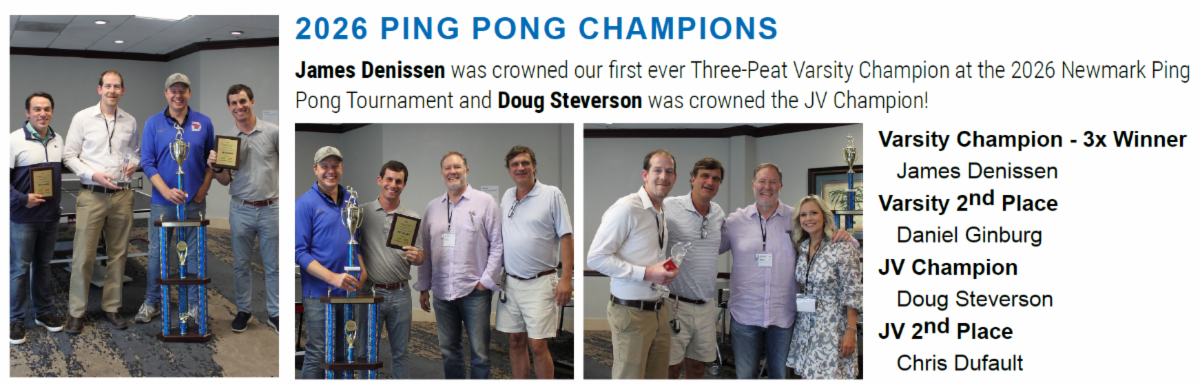
Thank You To Those Who Attended


2026 NEWMARK SELF STORAGE EXECUTIVE SYMPOSIUM


Last week we hosted our annual Symposium with continued strong attendance and engagement across the industry. From private operators to all the REITs as well as private equity and institutionally managed capital, the overall sentiment was decisively optimistic relating to transactions and only slightly less positive regarding operating fundamentals. Notably, decelerating new supply remains the most significant macro tailwind for the sector, moderately easing competitive pressures on street rates but lengthening stabilization timelines. Artificial Intelligence has rapidly evolved beyond basic automation into advanced operational applications, with companies managing upwards of 15 active use cases that are delivering measurable ROI in underwriting, customer service, and revenue management.


Stable capital markets conditions, and the continued evolution of revenue management strategies, are driving confidence in the medium-to-long-term outlook. Given robust deal pipelines, with some platforms reporting 25-50% more transactions in the first half of 2026 compared to all of 2025, and institutional capital allocators positioning themselves as net buyers over the next 12 to 24 months, the transaction market has begun to shift towards expansion. Operating fundamentals also reflect this optimism, albeit at a more muted degree. Existing Customer Rate Increases have become the primary revenue engine while

consumer mobility continues driving demand independent of housing market dynamics. The capital markets are functioning efficiently with narrowing bid-ask spreads and abundant capital for core-plus and value-add opportunities.


The transparency from the panelists, the support from the sponsors and the very engaged attendees all contribute to making this the most relevant event in the sector and we are committed to continuing to improve the event every year.


The following are highlights from the panel discussions. Thank you, again, to the sponsors, the panelists and everyone who attended the 2026 Self Storage Executive Symposium.

KEY TAKEAWAYS


State of the Transaction and Capital Markets


  • Transaction volume expectations for the second half of 2026 are robust as deal pipelines increase materially compared to last year, with some platforms reporting 25-50% more deals completed in the first half of the year compared to all of 2025.
  • The bid-ask spread is narrowing as financing extensions and loan maturities run out, though a disconnect remains for higher cash flowing assets where sellers want buyers to pay for projected future revenue growth.
  • Institutional capital allocators are increasing allocations to the sector and are looking to efficiently deploy large amounts of capital through portfolio acquisitions, while remaining disciplined on underwriting and pricing. 
  • Capital remains plentiful for core-plus and value-add deals, and there was unanimous alignment among institutional panelists positioning themselves as net buyers over the next 12 to 24 months.
  • Cap rates are expected to experience minimal movement (plus or minus 25 basis points) as debt markets remain accommodative, but spreads to benchmarks are already historically tight, while plenty of equity capital looks to deploy into the sector from both established firms and new entrants. 
  • Moving forward, public and private market valuations are expected to gradually converge, reducing the current public sector’s implied discounts, which should enable the REITs to become more constructive on acquiring assets on balance sheet.


Operational Trends and Expectations 


  • Existing Customer Rate Increases (ECRIs) have become the primary revenue engine for operators, frequently yielding 20% to 50% increases for existing tenants, while levels of tenant churn decline and lengths-of-stay elongate.
  • Street rates are now functioning more as a top-of-funnel customer acquisition tool, measured by “net effective rates,” rather than acting as the main driver of top-line revenue or as any prime indicator of “market rate”.
  • Seasonal demand peaks and troughs remain compressed compared to pre-pandemic years, though strong summer move-ins and healthy retention behavior are contributing to strong stabilized occupancy.
  • Consumer mobility remains a strong catalyst for demand independent of the housing market; an estimated 15 million people moved last year with 78% moving intrastate, driven largely by local life events. Meanwhile, a growing cohort of long-term apartment renters with space constraints are helping drive overall self storage utilization rates higher.
  • On the operating expense front, property insurance pressures are easing—with some portfolios expecting premiums to decline in 2026 while maintaining coverage amounts.
  • Operators believe maintaining an omnichannel approach—”coverage without compromise”—remains critical, balancing the expansion of digital tools with the reality that roughly one-third of tenants still prefer in-person interactions.


State of the Development Environment


  • Decelerating new supply is widely viewed as the most significant macro tailwind for the industry right now, easing the pressure on competitive street rates.
  • The current street rate environment is the largest impediment to new development, lengthening the timeline to revenue stabilization from historically three to four years out to five to six years.
  • Underwriting for new developments requires much larger spreads, as high construction costs and long entitlement timelines make it increasingly difficult for deals to pencil.
  • Although national supply metrics are dropping, supply impacts remain hyper-local; specific submarkets that experienced aggressive supply growth since 2019 are still feeling the impact on street rate pricing, while Midwest and rust belt markets that experienced fewer deliveries over the last few years outperform on operating fundamentals, reinforcing the impact of the declining new supply pipeline.


Technology and Artificial Intelligence Adoption


  • The industry is rapidly transitioning from using Artificial Intelligence for basic automation to advanced conceptual prediction, with companies managing upwards of 15 active use cases across their portfolios.
  • AI is fundamentally streamlining underwriting and back-office tasks, enabling teams to process rent rolls, complete unit-level pricing models, and draft investment committee memos in minutes instead of days.
  • Implementing conversational AI for call handling has yielded measurable ROI; one operator replaced a rollover call center with AI, handling up to 80% of after-hours calls and saving the portfolio $10,000 monthly.
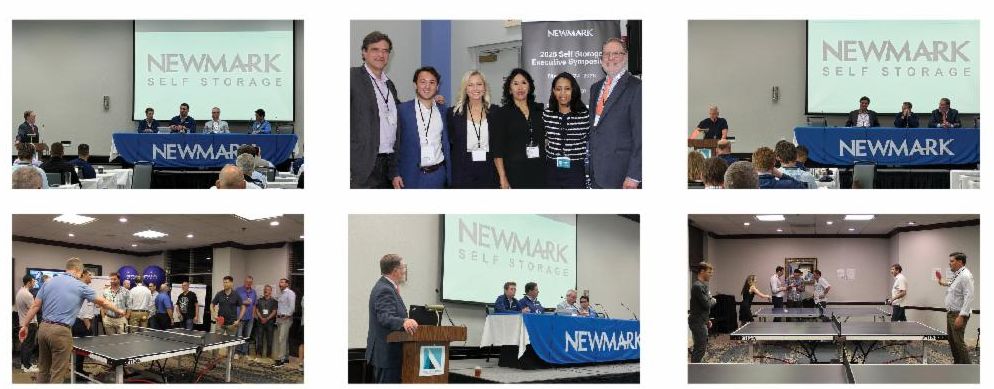
A Few Pictures from the Event

Thank You To Our Sponsors

 
Connect with Newmark Self Storage Group
Linkedin  Facebook  Instagram  

Aaron Swerdlin Vice Chairman aaron.swerdlin@nmrk.com

Kenneth Cox Vice Chairman kenneth.cox@nmrk.com

Taucha Hogue Executive Managing Director taucha.hogue@nmrk.com

Michael Gibbons Associate michael.gibbons@nmrk.com

 
The information contained herein has been obtained from sources deemed reliable but has not been verified and no guarantee, warranty or representation, either express or implied, is made with respect to such information. Terms of sale or lease and availability are subject to change or withdrawal without notice.
NOTICE: This e-mail message and any attachments are intended solely for the use of the intended recipient, and may contain information that is confidential, privileged and exempt from disclosure under applicable law. If you are not the intended recipient, you are not permitted to read, disclose, reproduce, distribute, use or take any action in reliance upon this message and any attachments, and we request that you promptly notify the sender and immediately delete this message and any attachments as well as any copies thereof. Delivery of this message to an unintended recipient is not intended to waive any right or privilege. Newmark is neither qualified nor authorized to give legal or tax advice, and any such advice should be obtained from an appropriate, qualified professional advisor of your own choosing.