|
|
Defending wildlife and habitat through:
Advocacy
Conservation
Education
|
|
|
News & Updates: February 2023 |
|
We usually highlight our three-fold mission in each newsletter with one article about advocacy, conservation, and education. However, the threats to wild lands are increasing and we feel the need to devote this newsletter to advocacy, or advancing environmentally-friendly legislation.
- Kansas Water Troubles
- Energy Development threatens Whooping Cranes and Greater Prairie-Chickens
- International Firm is planning a large-scale solar project between Cheyenne Bottom and Quivira
- Grain Belt Express (KS) and R-Project (NE) fragments prairie habitat and causes a mortality risk
- Politicians continue attacking Lesser Prairie-Chicken protections; AOK provides dissenting voice
- Banquet-only tickets available for Tiffany Kersten: "Birdie Big Year: Elevating Women Birders" on April 15 in Hays
-
Philanthropy Central: Support AOK while you shop!
-
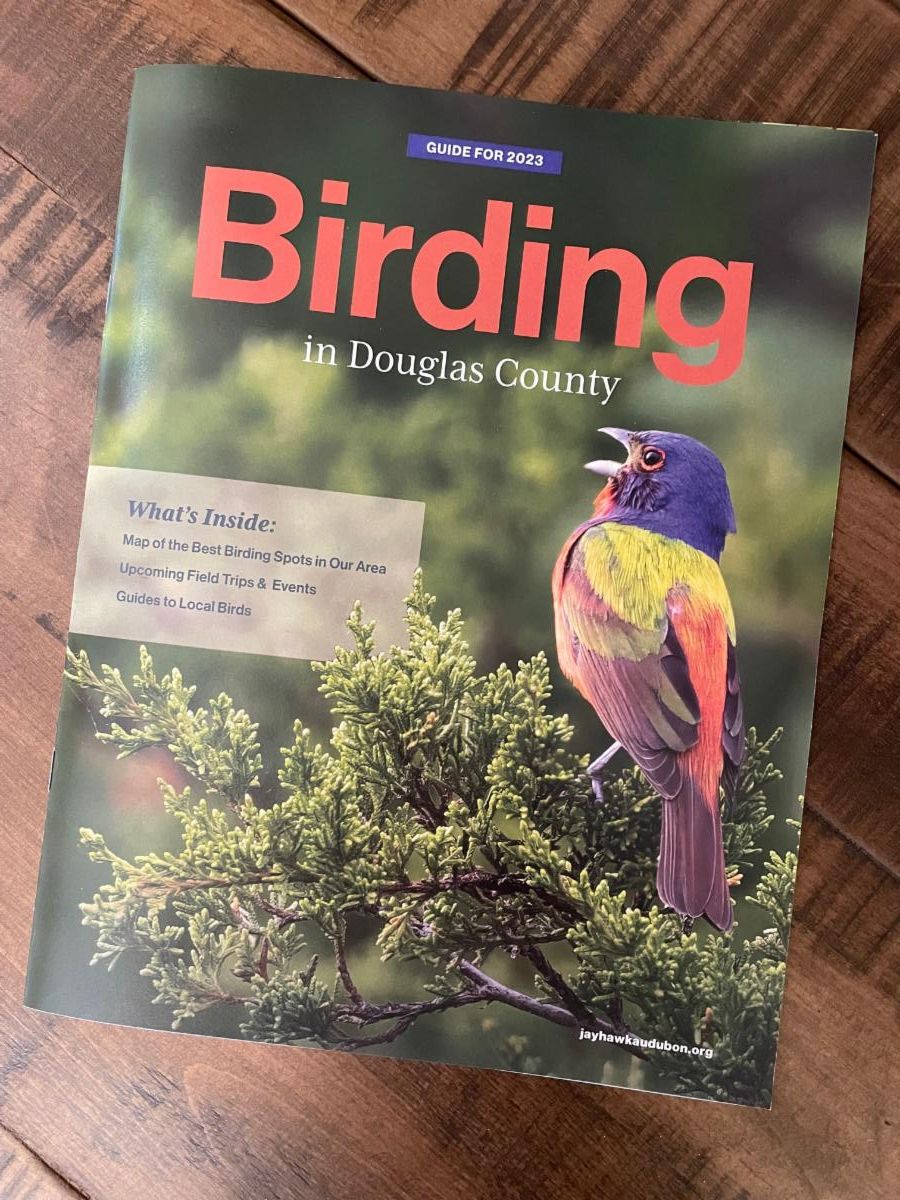
Chapter Spotlight: Jayhawk Audubon Society produced a beautiful guide to Birding in Douglas County
- Save the date!
-
AOK Nature Walk Recommendations: Clinton Lake in northeast Kansas offers something for everyone
|
|
|
Water concerns are ever present. There are now 67 Kansas counties in an emergency drought status. Last fall Cheyenne Bottoms went completely dry. At the Quivira National Wildlife Refuge, only 30 of the 5,500 acres held any water. 2022 was so dry that groundwater irrigation pumping was in over-drive. The Kansas Water Office updated the Kansas Water Plan (since 2014) to address critical water challenges. The Governor has pledged greater action to deal with water quantity and water quality issues. The Kansas Water Authority came out with policy recommendations to increase funding for the State Water Plan Fund (SWPF) from $20 to $25 million a year to $69 million annually. House Bill 2302 starts that dialogue by recommending that existing sales taxes be pledged to the SWPF. (House Bill 2302 passed the House 119 yea, 3 nay on Feb 23.)
Cheyenne Bottoms did go dry in 2013 but summer rains refilled it before the fall migration season. It can hold nearly 10 billion gallons of water. During an average fall, 750,000 migrating birds stop but in 2022 basically zero. The Platte River – another vital stopover point for birds on the Central Flyway had completely dried up in parts of central and western Nebraska. Quivira Refuge is another stopover on the Central Flyway. In past years, some 30,000 sandhill cranes would fill Quivira on a given morning during fall migration. In fall 2022, only a dozen cranes landed and left shortly.
Cheyenne Bottoms is owned by the State of Kansas and has the most senior water rights in the area. In 1992, the Kansas Department of Agriculture Division of Water Resources established the Walnut Creek Intensive Groundwater Use Control Area (IGUCA) to limit groundwater use by junior water rights holders (issued after 1965) by 20%. Farmers did not have a say in the levels of reductions. More efficient irrigation equipment was employed along with different crops such as sorghum and soybeans over corn. For the Quivira Refuge, the senior water rights are held by the U. S. Fish and Wildlife Service. Responding to political pressure from federal officials, the Groundwater Management District (GMD) for Rattlesnake Creek, and local farmers with junior water rights, there has been no action to curtail irrigation in the basin. AOK has a lawsuit before the 10th Circuit federal district court panel in Denver to force the U.S. Fish and Wildlife Service to enforce their senior water rights to curtail pumping and restore stream flows to start refilling Quivira.
The question remains what policy and resource allocations will come from the Kansas Legislature in 2023 or 2024? Kansas continues to buy public water storage in 14 reservoirs across Kansas. As key federal reservoirs such as Tuttle fill in with sediment what options are available to move that sediment downstream? There is a pilot program on Tuttle to see if that sediment can be moved through the base of the dam by water pumps. Over-appropriated groundwater rights are another matter. There are few new dollars to retire any significant quantities of water rights. If these water rights are indeed ‘property rights’ that must be bought back, should a portion of the $1 Billion+ ‘rainy day’ fund be dedicated to retiring water rights as economically and efficiently as possible? As the 2023 federal Farm Bill – that rains $1 Billion a year to the largest farms in Kansas to grow four grain crops – is debated this year, could these farm subsidies be reordered to finance conservation farming practices hopefully resulting in a greater selection of foods grown and less soil down the creek?
Reprinted from Kansas Rural Center Legislative Policy Watch, Issue No. 6, February 10, 2023. AOK is a co-sponsor.
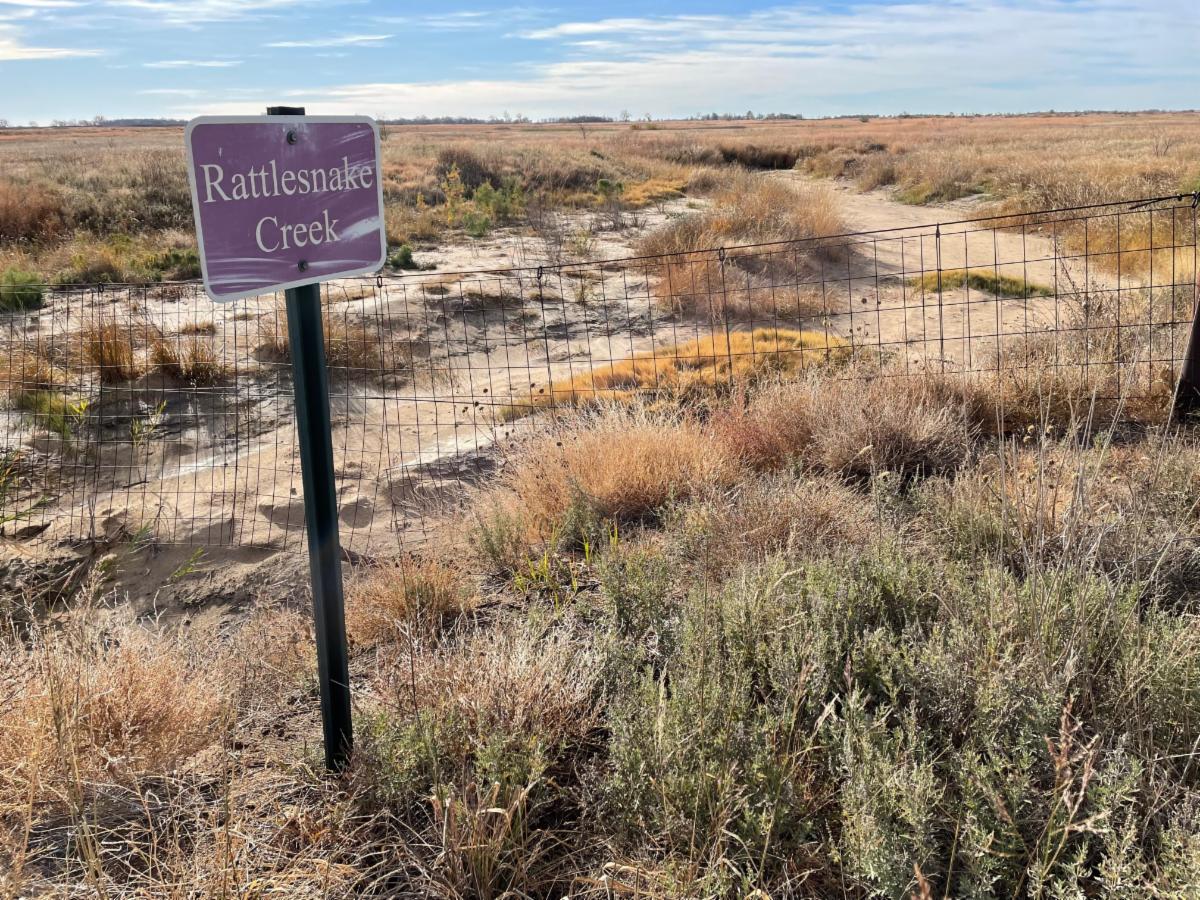
Photo: Rattlesnake Creek is supposed to supply water to Quivira National Wildlife Refuge. Photo taken Nov 6, 2022.
|
|
Energy Development threatens Whooping Cranes and Prairie-Chickens |
|
Audubon of Kansas does not recommend an outright ban on all solar or wind energy development in the state. We acknowledge that renewable energy is critically needed to counteract the impacts of climate change; however, appropriate siting is necessary to ensure our natural areas are protected.
Every month, Audubon of Kansas provides expert testimony to county, state, and federal entities regarding proper siting and best practices for wildlife-friendly energy development. We recommend:
- We advocate that these energy facilities and the associated infrastructure be located on already disturbed land - namely, agricultural and commercial areas. They should not be placed on native prairie or adjacent to our remaining wetlands.
- Transmission lines should be buried if passing through sensitive habitat or migration corridors.
- Turbines should be located adjacent to existing roads. Because all turbines have access roads for repairs, placing a turbine in the middle of the field causes more fragmentation than one placed on the edge of a field.
- Fencing surrounding solar facilities should allow for small animal movement under the fence and large animal movement through and around the development.
- Only native plant species should be planted under the solar panels and in surrounding landscaping. In the case of solar panels, this grass could be used to graze sheep, thereby preserving the farming heritage of the area.
- Finally, we would encourage the county to require environmental monitoring and reporting following construction of any energy development.
These recommendations (as well as other recommendations specific to the project) have been sent to three proposed energy development projects. An international firm is planning a large-scale solar project directly abutting Cheyenne Bottoms and between Cheyenne Bottom and Quivira National Wildlife Refuge. This is the absolute worst location for such a facility. There is some evidence that the shimmer off solar panels is mis-identified as water by insects and migrating waterbirds. We believe the effect will be particularly intense when Cheyenne Bottoms lacks water due to drought and migrating birds accustomed to finding refuge mistake the solar panels as their desperately-needed oasis.
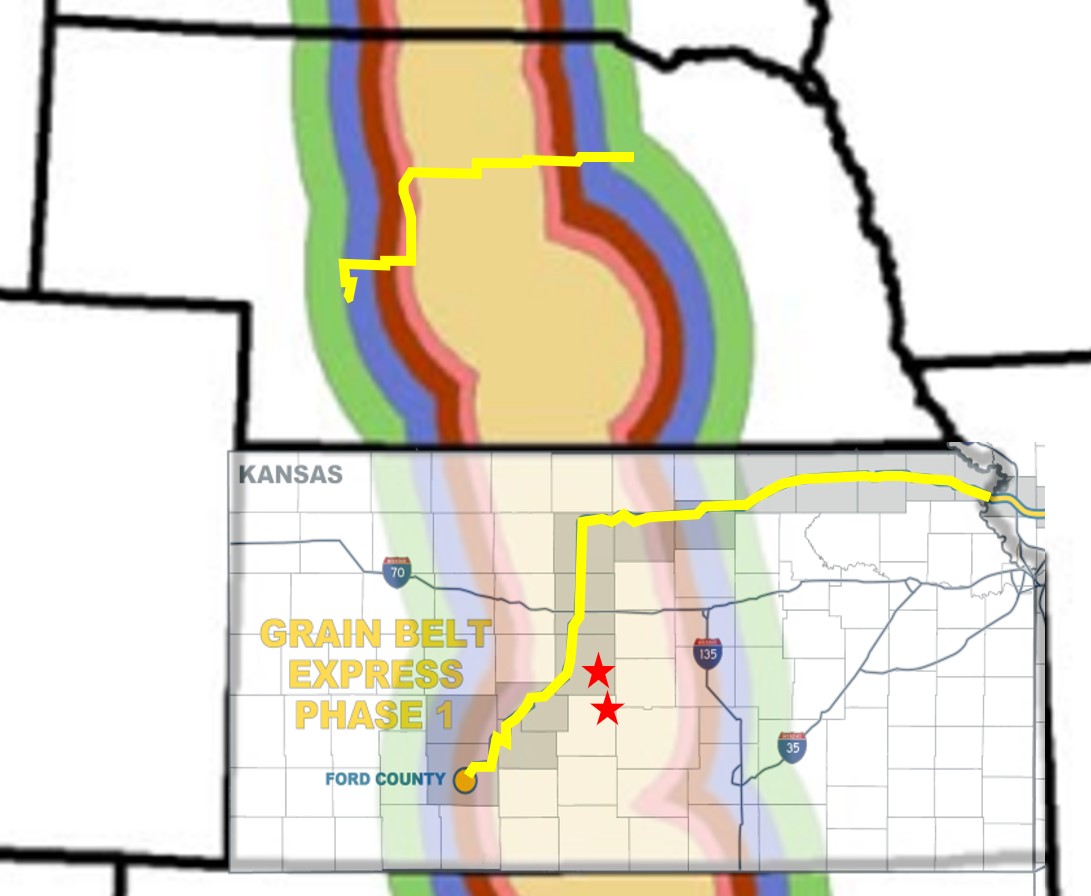
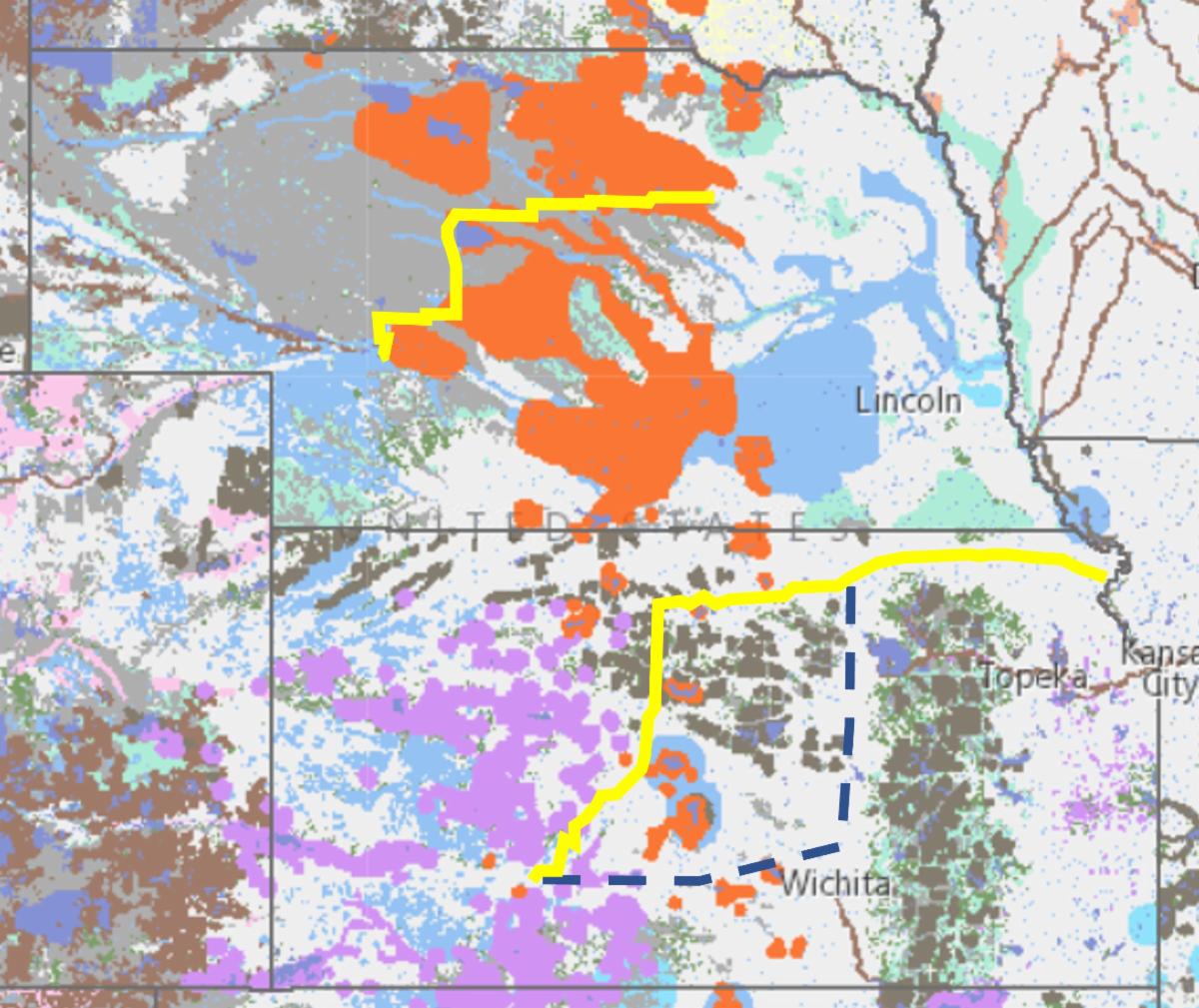
The two other projects involve high-voltage transmission lines. The R-project in Nebraska and the Grain Belt Express in Kansas and Missouri have the potential to fragment prairie habitat and cause a mortality risk to endangered Whooping Cranes. Collision with power lines is the greatest source of mortality for fledged Whooping Cranes in the western, migratory population. The young cranes have relatively poor eyesight thereby limiting their ability to detect power lines, and their large size prevents them from making quick maneuvers to avoid the power lines when they are detected. Threatened Lesser Prairie-Chickens rarely cross high-voltage power lines, so the lines can further fragment populations. Greater Prairie-Chickens are a bit more tolerant, but may avoid those areas or experience higher predation due to hawks which perch on the lines and poles.
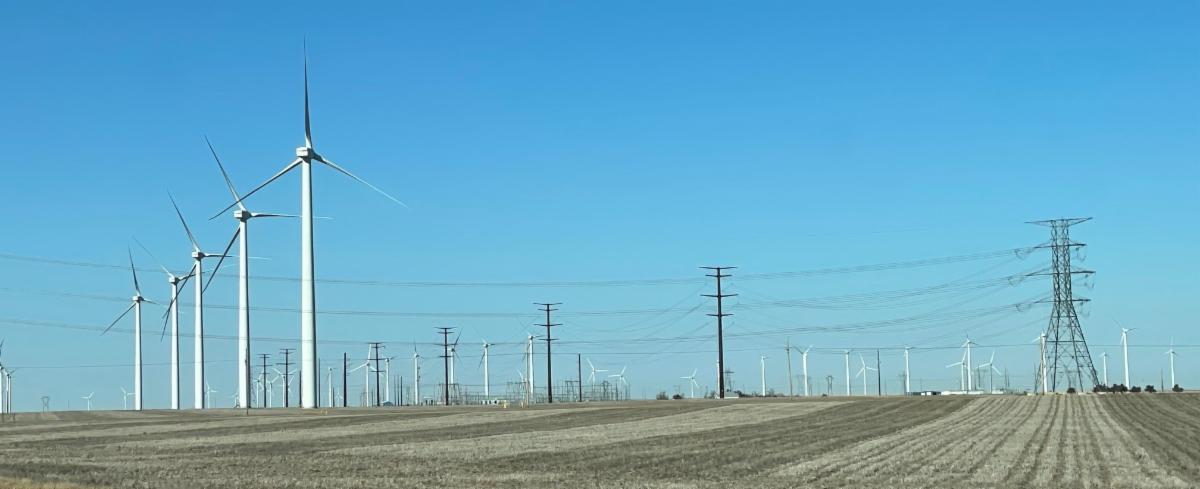
Photo above: A properly sited industrial wind facility in Ford County by JK Augustine.
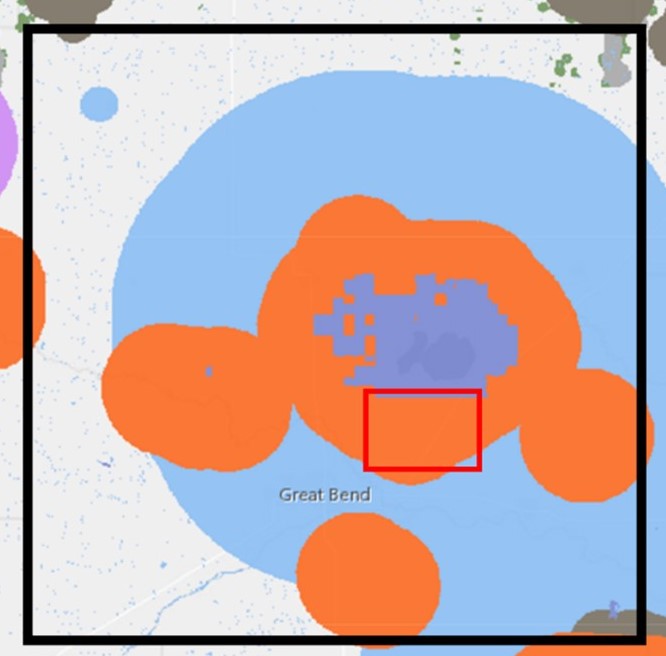
Photo above right: Location of proposed solar facility near Cheyenne Bottoms (red outline) with the outline of Barton County (black). Cheyenne Bottoms is shown in dark blue with associated wetlands in medium blue. The orange is critical habitat for Whooping Cranes. Map adapted from The Nature Conservancy's Site Renewables Right.
Photo below right: Important natural areas overlayed with the proposed R-Project (Nebraska) and Grain Belt Express (Kansas) transmission lines (yellow lines). Dashed line indicates a route which would avoid fragmenting Red Hills Prairie-Chicken habitat. Orange is Whooping Crane habitat, gray are intact natural habitats (supporting Greater Prairie-Chickens in Nebraska), dark gray/brown are areas supporting Greater Prairie-Chickens in the Smoky Hills, blue is wetlands, and purple is threatened species (presumably Lesser Prairie-Chickens). Map adapted from The Nature Conservancy's Site Renewables Right.
|
|
|
Politicians continue attacking Lesser Prairie-Chicken protections; AOK provides dissenting voice |
|
Last month, we discussed why Lesser Prairie-Chickens should be protected under the Endangered Species Act and the extraordinary lengths politicians in the state are undertaking to condemn the listing. SCR 1602 "Disapproving the designation of the lesser prairie chicken as a threatened species in Kansas by the United States Fish and Wildlife Service" passed in the house last month and was passed in the senate this month.
Despite all the attention the Lesser Prairie-Chicken is receiving, AOK is the only environmental organization willing to publicly take a stand supporting the listing. Dave Kendall has also voiced concern that focus on politics and economics distracts from the threats to our vanishing grassland habitat. He served as producer and host of the “Sunflower Journeys” series on public television for its first 27 seasons and continues to produce documentary videos through his own company, Prairie Hollow Productions.
This month, I hope to clarify what the Endangered Species Act does and does not require. The act prohibits 'take' of listed species. “Take” means to harass, harm, pursue, hunt, shoot, wound, kill, trap, capture, or collect, or to attempt to engage in any such conduct. So, anything that would result in take is prohibited, but exceptions can be included under the 4(d) rule.
Here are the facts about the implications for listing Lesser Prairie-Chickens as a threatened species:
-
Ranchers are NOT REQUIRED to ask the government for permission to move cattle from one pasture to another. If ranchers continue grazing practices currently in place, take is unlikely. For example, if a pasture is over-grazed, prairie-chickens are likely to be in low numbers. If over-grazing continues, and numbers continue to be low, there is no 'take' or no decrease in prairie-chicken numbers. These ranchers may just choose to not bother with getting a grazing plan approved, but they are not protected if 'take' is documented on their land. However, if ranchers want to change grazing practices (such as changing cattle density or pattern of grazing), or if they just want assurances that they will not be sued by the federal government, then they can choose to develop a grazing management plan. The plan must be approved by a "Service-Approved Party" and reviewed every 5 years. The Service did not dictate stocking rates or other requirements because they recognize that grazing will need to vary by past management, soil, precipitation, and other factors. Ranchers interested in increasing prairie-chickens on their property could also apply for a safe harbor agreement.
-
Farmers with cropland or hayfields can continue to harvest crop normally without interference. "This 4(d) rule provides that take of the lesser prairie-chicken will not be prohibited provided the take is incidental to activities that are conducted during the continuation of routine agricultural practices, as specified below, on cultivated lands that are in row crop, seed-drilled untilled crop, hay, or forage production. These lands must meet the definition of cropland as defined in 7 CFR 718.2, and, in addition, must have been cultivated, meaning tilled, planted, or harvested, within the 5 years preceding the proposed routine agricultural practice that may otherwise result in take."
-
New energy development (oil/gas, wind, solar, transmission lines) must be enrolled in a Candidate Conservation Agreement with Assurances before construction occurs. These agreements require that habitat must be preserved or restored for every acre that is destroyed during development. Generally, these agreements have a scaling factor where multiple acres are restored for every high-quality acre that is destroyed. Destroyed acreage not only includes the physical footprint of the structure, but also an avoidance buffer based on prairie-chicken biology that varies with the type of structure.
- New conversion of grasslands into agriculture are prohibited.
- Prescribed fire can be implemented to control woody vegetation.
|
|
|
Banquet-only tickets available for Tiffany Kersten: "Birdie Big Year: Elevating Women Birders"
on April 15 in Hays
|
|
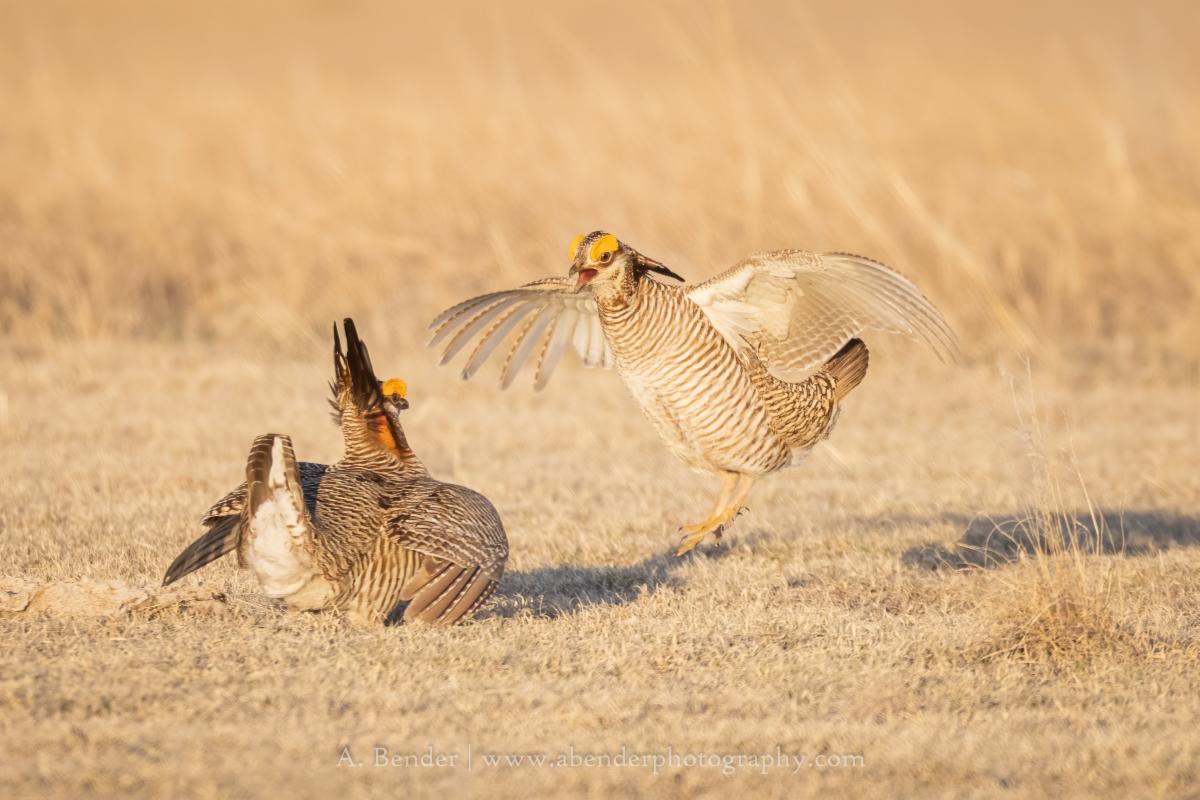
Although all prairie-chicken tours are sold out for this year’s Kansas Lek Treks festival, there is still an opportunity to see Tiffany Kersten speak at our banquet about
“Birdie Big Year: Elevating Women Birders”
When: Saturday April 15 at 6pm
Where: Sternberg Museum of Natural History in Hays (3000 Sternberg Drive, Hays, KS 67601)
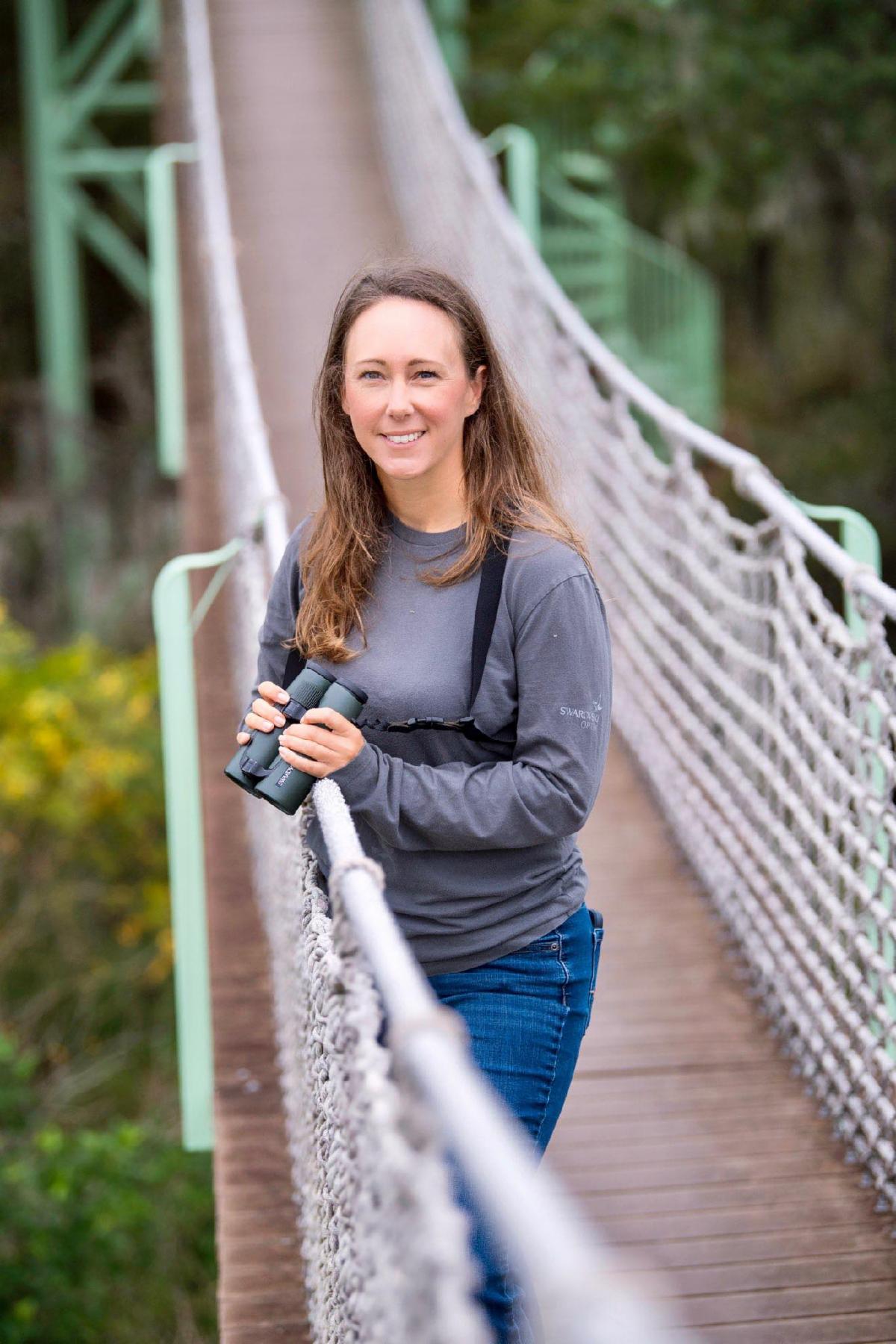
Tiffany Kersten didn't set out to do a big year, but after a series of unanticipated and serendipitous events, she suddenly found herself amidst one. As a sexual assault survivor, she spent 2021 traveling to all corners of the Lower 48 States, tallying birds and gifting personal safety alarms to women she met along the way. Her goal was to see 700 species, and to raise awareness of women's safety in the outdoors. She ended up surpassing her goal and setting a new Lower 48 Big Year record of 726. In her presentation, Tiffany will lead us through the fear, empowerment, struggles and healing that all played vital roles in the personal growth she experienced on this wild adventure.
Besides Tiffany's presentation, tickets will include a catered meal.
|
|
|
Philanthropy Central: Support AOK while you shop |
|
When you shop at these companies, you can designate AOK to receive a portion of your purchase dollars. We hope you will take a few moments and register. If you would like any additional help, please contact Kelley.
Dillons:
Go to www.dillons.com
Sign in to your account (or create one if you don't already have one - you will want to connect the account to your Dillons card). Then, choose account (top right of page), then in the left vertical menu choose Community Rewards. Search for Audubon of Kansas, and select it as your recipient. That’s it! Every time you shop at Dillons, AOK gets a donation.
PayPal:
Sign in to your account (or create one if you don't already have one) or click here to go directly to the AOK page. If signing in, select the "More" button with three dots in it located beneath the Log out button, next select "Donate to a cause". Search "Audubon of Kansas" (you can leave the other fields blank) and click "Favorite Charity" to give $1 for every purchase or donate directly from PayPal to have them cover all our fees.
Even though these are individually small donations, they add up to regular income throughout the year for AOK. Thank you!
Kelley is happy to answer all your questions about giving:
Kelley Hurst
Director of Philanthropy
785.917.0400
|
|
|
Chapter Spotlight: Jayhawk Audubon Society produced a beautiful guide to Birding in Douglas County |
|
Jayhawk Audubon Society has recently produced this wonderful guide to Birding in Douglas County. When I picked it up, I thought it would just be about birding locations. I was pleasantly surprised to see it was SO much more. The guide includes
- field trips and educational presentations for the year
- identification photos of backyard birds, woodpeckers, and rare birds
- tips on becoming a better birder
- online and print resources
- plants for birds information including locations to buy native plants
- educational articles about Red-tailed Hawks and fishing line recovery and recycling
- how to become a Jayhawk member
The guide is available for free at several locations around Lawrence, including the Lawrence Library, Raven Bookstore, The Merc Co+op, and Lawrence Visitors Center.
Photo: A photo of the cover of Jayhawk's 'Birding in Douglas County'.
|
|
|
Audubon of Kansas is planning events for the coming year. Mark these events on your calendar!
April 22: Earth Day, location and time TBD
May 7: Achterberg Work Day
May 22-26: Hutton Work Week
June 4: National Prairie Day, location and time TBD
July 24-28: Hutton Work Week
September 10: Achterberg Work Day
September 25-29: Hutton Work Week
Oct 1: Open House at Hutton
November 3-5: Celebration of Cranes at Quivira National Wildlife Refuge
Hutton is AOK's sanctuary near Bassett, Nebraska
Achterberg is AOK's sanctuary near Lincoln, Kansas
|
|
|
AOK shares favorite walks,
hikes and birding spots!
|
|
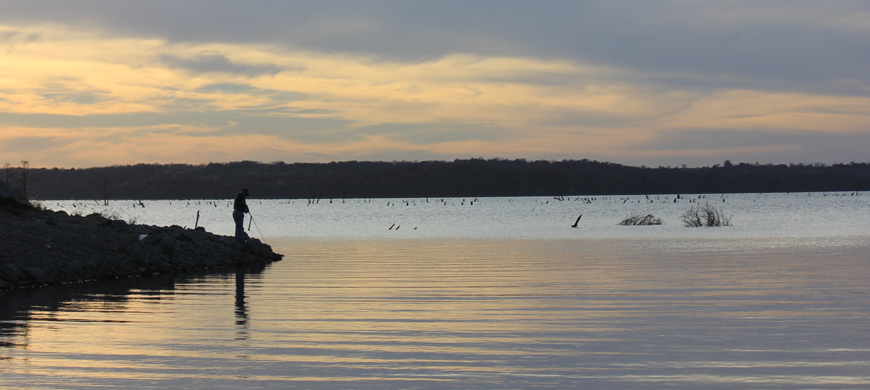
Clinton Lake in northeast Kansas has something for everyone
There are hiking trails for those who want to explore the woodland habitat. Wonderful overlooks of the lake are available for those that don't want to walk as far. Beaches can attract migrant waterbirds.
Start your visit at the Corps of Engineers Information Center near the north end of Clinton Lake dam. There you can learn about the lake and get maps to aide you as you bird around the lake. Two self-guided nature trails are located behind the Information Center. The Backwoods Trail is 5/8 of a mile in length, and is self-guided with a pamphlet, which is available at the Information Center. The half-mile long Discovery Trail is self-guided by use of signs placed along the trail. This area is part of the Overlook Park which is an excellent place to look for migrant songbirds and for scanning the lake for waterfowl, loons, Ospreys and Bald Eagles. In summer you can add color to your world in the Sanders Mound area where you can find nesting Blue Grosbeaks and Painted Buntings.
Address of the US Army Corps of Engineers Information Center:
872 N. 1402 Rd
Lawrence, KS 66049
Photo from Kansas Department of Wildlife and Parks website
|
|
|
Lana Arrowsmith - Hutton Niobrara Coordinator - Hutton Sanctuary Management & Reservations lanamicheel@gmail.com
Audubon of Kansas
PO Box 1106 - Manhattan, KS 66505
785-537-4385
|
|
|
|
|
|
|