|
Side #1: Artificial Intelligence
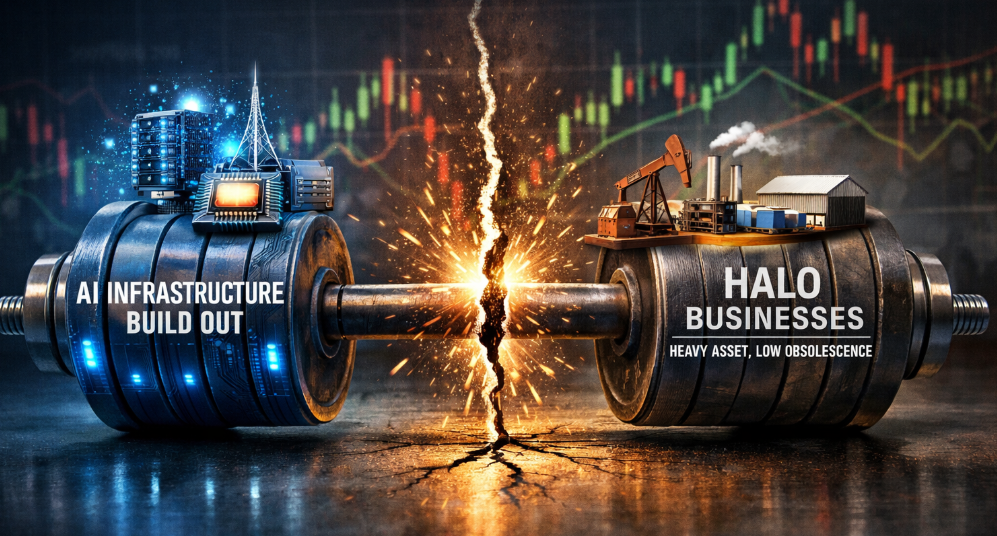
The first side of the barbell is the AI infrastructure buildout, which has been the dominant driver of market returns since late 2022. This includes the companies designing, manufacturing, and powering the compute backbone that makes artificial intelligence possible.
Semiconductor leaders such as Nvidia and Broadcom have been at the center of this trend, supplying the advanced chips required to train and run large language models. Surrounding them is an entire ecosystem that has benefited from the buildout, including memory manufacturers, advanced materials providers, networking equipment companies, and data center operators.
The ripple effects extend even further. Utilities and power generation companies are seeing rising demand as AI workloads consume enormous amounts of electricity. Industrial firms involved in cooling systems, electrical components, and grid infrastructure are also participating. Real estate investment trusts focused on data centers have experienced strong demand as hyperscalers race to expand capacity.
In short, this side of the barbell represents the physical and digital infrastructure required to power the AI revolution, and the market has rewarded it accordingly.
Side #2: HALO
On the opposite side of the barbell are what CNBC’s Josh Brown has called H.A.L.O. companies, short for "Heavy Assets, Low Obsolescence."
If the first side of the barbell represents the future being built, this side represents the real economy that still has to function regardless of technological change. These are businesses with tangible assets, entrenched demand, and services that are difficult to automate away. Energy producers such as Exxon Mobil and Chevron. Heavy equipment manufacturers like Caterpillar and John Deere. Logistics operators, railroads, materials producers, food suppliers, and more.
A simple test helps frame it. Will a chatbot, algorithm, or large language model meaningfully reduce the need for oil production, farm equipment, freight transportation, or groceries in the next decade? The answer, at least for now, is no.
Artificial Intelligence may improve efficiency across these industries. It may enhance supply chains, optimize pricing, or improve productivity. But it is unlikely to eliminate the core demand for energy, food, infrastructure, and physical goods.
That durability is exactly why many of these companies have led the market so far in 2026. In an environment where investors are reassessing which business models are vulnerable to disruption, capital has rotated toward companies with heavy assets, hard revenue streams, and lower risk of technological obsolescence.
The Middle
If a company is neither building the AI backbone nor insulated from disruption, it increasingly falls into the middle, and that is where we are seeing the most pressure. These are businesses built on software, consulting, and digital services that benefited for years from scalable models and premium valuations. Companies such as Microsoft, Salesforce, Uber, and other enterprise platforms now face a new reality. AI is not just a tailwind. In some cases, it may compress pricing, automate services, or reduce demand for parts of their offerings.
The same force driving the infrastructure winners is creating uncertainty for portions of the application layer.
Even with indices near highs, hundreds of individual stocks are down 25 to 50 percent from their peaks. This is less about a broad market pullback and more about a repricing of business models. For now, strength on the two ends of the barbell has masked that weakness. If either side falters, however, the pressure could become much more visible.
This is why we feel it is imperative to remain disciplined and active in managing your portfolio. We are monitoring your positions daily, evaluating both cyclical and structural risks, and ensuring that capital is allocated thoughtfully across themes that we believe are durable.
Please reach out if you have any questions or if you need anything at all.
Best,
Kent
|