Volume 83 | July/August 2026

Let's Put the Health Back in Healthcare

IHPC Urges Department of Education to align student loan accountability with America’s Healthcare Workforce Needs


Consortium warns that earnings-based accountability rules could restrict access to prevention-focused healthcare professions


The Integrative Health Policy Consortium (IHPC) has submitted formal comments to the U.S. Department of Education regarding the proposed Student Tuition and Transparency System (STATS) rulemaking, warning that overly rigid earnings-based accountability measures may unintentionally restrict access to prevention-focused healthcare professions and undermine long-term workforce objectives.


The submission responds to the Department’s proposed framework for evaluating educational program eligibility under federal student aid policies. While supporting efforts to improve transparency and accountability, IHPC cautioned that early-career earnings metrics alone may not accurately reflect long-term repayment success or the economic realities of many licensed healthcare professions.


“Federal student aid policy directly shapes the future healthcare workforce,” said Dr. Stephen P. Welsh, DC, Chair of IHPC. “Accountability is important, but evaluation systems must accurately reflect how healthcare professions function in the real world. Many prevention-focused professions involve gradual income development, independent practice models, and strong long-term repayment outcomes that are not fully captured by short-term earnings measures.”


Read more here


SAVE THE DATE!

The August IHPC Assembly Meeting is August 25, 2026 at 12:30 pm EDT.

Dr. Helene Langevin, Research Director of the Osher Center for Integrative Health at the University of Vermont, has graciously agreed to address members of IHPC at the upcoming Assembly meeting on August 25th.


Please mark your calendars for this incredible opportunity, and share the link below to your board, association members, and friends as we are welcoming guests (all are welcome).


Read more and reserve a spot here.


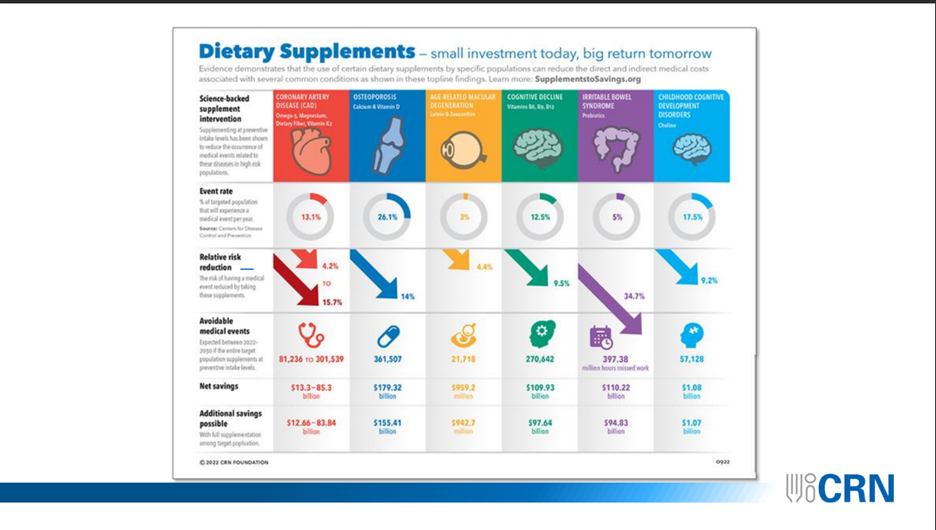
Council for Responsible Nutrition’s Steve Mister Provides Insights on the Current FSA/HSA Legislation

Congress is considering bipartisan legislation (S 4587 sponsored by Senators Kevin Cramer and John Curtis and HR 8933 introduced by Representatives Darin LaHood, Josh Gottheimer, Claudia Tenney and Brendan Boyle). If enacted the bicameral Dietary Supplement Access Act would amend the IRS code to recognize dietary supplements as eligible medical expenses and allow consumers to use their HSA/FSA funds to purchase dietary supplements, subject to annual limits. Dietary supplement groups like the Council for Responsible Nutrition strongly support the legislation noting that the policy promotes better health, nutrition and well-being for Americans.


In a June presentation to IHPC’s Policy Committee, Steve Mister, president and CEO of CRN discussed why his group believes the change will not only promote better health but also be cost effective.

Mister noted that the bills do face some obstacles on both sides of the aisle, but it largely comes down to cost. Republicans, he noted, have concerns about anything that would add to the deficit, Democrats see these programs as mostly benefiting the rich and both sides have a general mistrust of the supplements industry.


Read more here


IHPC has a new and improved website


The newly redesigned website of the Integrative Health Policy Consortium (IHPC) has been developed to better serve healthcare professionals, policymakers, researchers, partner organizations, and the public by providing timely access to IHPC’s policy initiatives, research, official statements, and educational resources.


As healthcare policy continues to evolve, IHPC remains committed to advancing whole-person, integrative, preventive, and patient-centered healthcare through thoughtful analysis, collaboration, and evidence-informed public policy.


Read more here

Checkout the website here


Can probiotics detoxify heavy metals? New study says 'yes'


Certain probiotic bacteria, namely Lactiplantibacillus plantarum LP14, Lactobacillus crispatus LCRO4, and Lactobacillus acidophilus LA12, are able in varying degrees, to detoxify cadmium, lead, and other toxic metals. These microbial allies may also be able to mitigate intestinal epithelial damage caused by heavy metal exposures.


Those are the key signals from a new paper published in Frontiers in Microbiology. 

Though the observations were from in vitro experiments, and not an in vivo human trial, they provide strong proof of concept that certain microbes can sequester and detoxify toxic metals, and that they hold potential for reducing the toxicity associated with heavy metals we humans absorb via our food and water.


Read more


Events and

Conferences 2026


Save the Date: IHPC August Assembly Meeting: August 25 / Speaker: Helene Langevin, MD

Register here

A special request

to our

Partners for Health


In order to keep up with the work of IHPC, we encourage you to follow our Facebook page and our LinkedIN page and then please share a link to these pages in your next newsletter!

Integrative Health Policy Consortium | 712 H Street NE Suite 1108, Washington DC, 20002 |
202.505.IHPC (4472) | www.ihpc.org