|
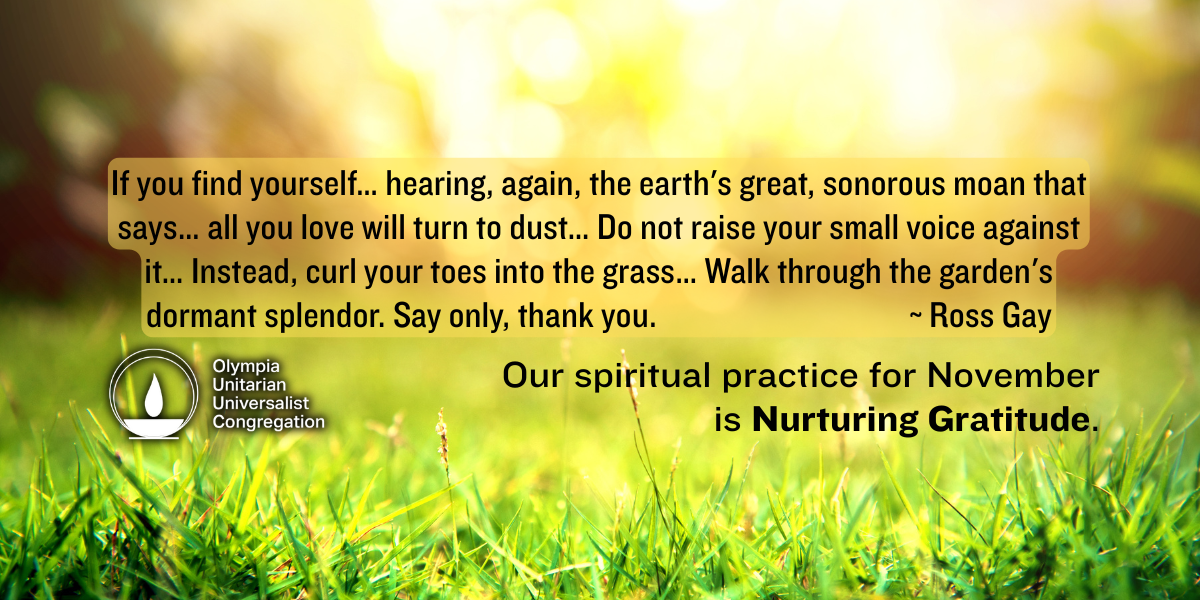
The “nurturing” part of the theme is a reminder that gratitude is a mindset, a practice that requires intention and attention. Gratitude can come upon us in some moments, and we need attention to notice it. And, when gratitude doesn’t just appear, we can set an intention to notice all that we can be grateful for. Even amid struggle, there is usually something to be grateful for.
I have often said that grief and gratitude can coexist, and that gratitude is a necessary practice when we are struggling with grief and other hard emotions. (You’ll hear about this again in worship this month). What is arising for some now is the interplay of gratitude and guilt. How can I have so much, feel such abundance, when so many don’t and are suffering? How can I feel safe when some are threatened? How can I feel calm and peaceful when the world is so chaotic?
This sense of guilt has shown up lately in the Thursday evening Community Dinners when some people have said that they should not come so that others can eat, or that they should not take leftovers home so others can. Our response has been to remind us of our primary intention for the Community Dinners which is to build community at OUUC. It is a time for people to connect across generations and with people they do not know. It is also time for people to connect with others more deeply. That we humans do this with food is simply part of how we are wired. Community first, food second. We also encourage everyone to take home the perishable leftovers and then help those in the community struggling with food insecurity in other ways.
This sense of guilt can drive us to do things that don’t help, like leaving leftovers at OUUC. While the leftovers don't go to waste, if nothing else they feed Rev. Sara’s chickens, if the leftovers can feed a person connected to OUUC , we’d prefer that.
At a recent Thursday dinner, I also experienced guilt and fear driving a well-meaning person to act in a way that was unwelcoming for a visitor. The visitor was a young person of color. A well intentioned, white OUUC member handed them a pamphlet about ICE saying the visitor needed the information to be safe. I’m grateful that the visitor spoke with me about how this action impacted them: they felt profiled, that (incorrect) assumptions were made about them based on their appearance, and that while this may have made the OUUC member feel better, it was an “ouch” for them adding to their concern about being welcomed in the world right now.
This action was a microaggression, defined as “a statement, action, or incident regarded as an instance of indirect, subtle, or unintentional discrimination against members of a marginalized group such as a racial or ethnic minority.” The OUUC member intended to do a service, and their slight was unintended. However, we have learned that intent and impact are different. The intent was good; the impact was harmful.
We have learned about microaggressions at OUUC over these past few years. You can find more information here under 2024 Volunteer Training & Resources, Welcome and Inclusion. You can also hear more from Rev. Sara in her service from February 9 of this year.
When I spoke with the OUUC member, they shared that it was certainly fear for this young visitor that led them to hand them an ICE flyer. They were also feeling guilt about all the advantages afforded to those who are white, as they were. We cannot change the color of our skin; we can change how we use our privilege.
The first step is to notice how we feel and name it as guilt. “I feel guilty that I am white and don't have to worry as much about being detained. I am afraid for this young person who seems so kind.”
The next step is to step back and consider options. In most situations, starting with building relationships is the best next step. Rather than handing this visitor a flyer, the OUUC member might have engaged the visitor in conversation with curiosity about who and how they are. From that may have come knowledge about whether this visitor was worried or felt unsafe. If so, then an ICE flyer might have been helpful. If they were not worried or unsafe, then no flyer is needed.
The final step is to consider how we can use the energy of our fear or guilt to make a difference. Perhaps this OUUC member would want to volunteer to help those impacted by the current immigration policies, such as volunteering to accompany people to their immigration hearings. Or they might donate to the local fund to help those who are detained. Maybe they’d want to join the OUUC SWIFT group that is tracking immigration issues. There are many options for constructive engagement.
Handing someone a flyer can discharge our own guilt and fear in a moment, but the impact on others can be harmful. This process means holding our own discomfort for a bit as we figure out how to put it to good use. This may seem counterintuitive as we want to relieve our discomfort as soon as possible. The reality is that part of privilege is that we have the choice to put our energy into something that contributes to healing, not to more harm.
In this month of Thanksgiving, I invite you to consider how you nurture gratitude for the abundance in our lives and notice all the feelings that arise with that thankfulness.
With gratitude for this ministry with you,
Rev. Mary
Minister@ouuc.org
|