|
What does it look like when a professional development experience truly meets educators where they are? For me, Amy Tudor, the answer came through the ETLA Coaching Certification Course. This course is currently wrapping up its inaugural cohort this month, and it is already proving its value in real classrooms and schools.
A First Cohort Worth Celebrating
The first cohort was intentionally designed to allow participants to fully engage. Participants met online each month for two-hour learning sessions alongside regular meetups designed for networking and conversation. In these spaces, we unpacked how the concepts being introduced were actually showing up in our day-to-day coaching work. That blend of structured learning and peer dialogue turned out to be one of the program’s most powerful features.
The collaboration between coaches was so helpful for the learning. When practitioners share what's working, what isn't, and how they're adapting new ideas in real time, the learning goes deeper than any single session can.
Learning That Flexes With You
One of the hallmarks of the program is its flexibility. The portfolio project at the heart of the certification is designed to apply across a wide variety of coaching roles. This means participants aren't forced to retrofit their work into someone else's framework. Instead, they build something genuinely useful for the context they're in.
For me, that flexibility opened a door I hadn't initially planned to walk through. I entered the cohort focused on classroom and technology coaching but, as the program unfolded, my focus shifted toward data privacy. This pivot allowed me to focus on my current role and responsibilities at the EdTech Leaders Alliance. Rather than being a detour, this shift became the foundation of my portfolio work.
Putting Standards Into Practice
My portfolio spans all three domains of the Core of Coaching Framework: Building Relationships, Advancing Sustainable Change in Teacher Practice, and Leading Organizational Shifts, with each piece of evidence aligned to specific standards that reflect my current work in data privacy coaching.
Rather than starting from scratch, the portfolio process gave me a structure for recognizing and documenting the coaching work I was already doing. Domain 1 looks at artifacts that demonstrate how I build trust and communicate my role clearly to the educators and administrators I support. Domain 2 captures how I help technology leaders develop and reflect on their practice around student data privacy, helping them move from awareness to genuine, lasting shifts in how they approach digital tools. And in Domain 3, my work connects to Standard 3.3, empowering technology leaders and building systems that keep the work going even when a coach isn't in the room.
That last piece is where my focus on data privacy becomes especially powerful. The goal isn't just to answer districts' questions about which tools are safe but to build their capacity to ask those questions themselves. Some of the work I am connecting to this standard was developed collaboratively, and the portfolio process gave me a way to situate that shared work within my own coaching practice and articulate the role I played in moving it forward.
Why This Program Stands Out
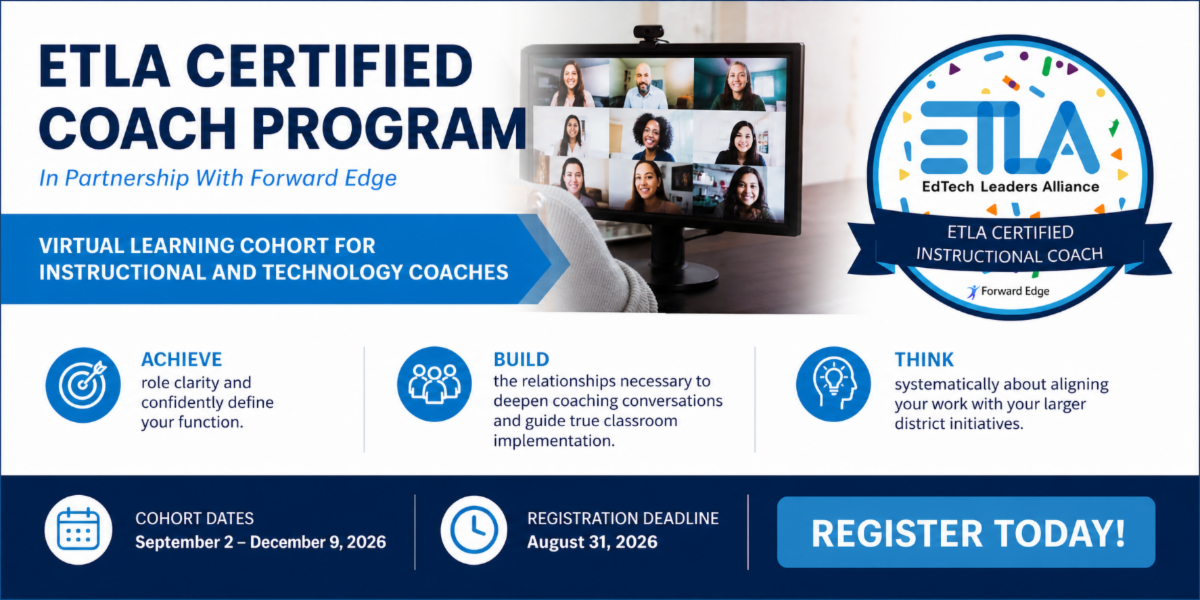
For anyone considering the upcoming fall cohort, Amy's experience points to something important: this isn't a generic professional development course. It's a focused, practical opportunity to differentiate yourself as a coach and deepen the skills that matter most in the work.
Participants come away with sharper skills in building relationships, advancing sustainable change in teacher practice, and leading organizational shifts. These competencies translate directly into impact. The cohort structure itself reinforces this, creating a community of practice where coaches learn from one another as much as from the curriculum.
The ETLA Certified Coach Program is developed in collaboration with Forward Edge, a partner that has been instrumental in bringing this experience to ETLA members.
|