|
|  | |
Retail Beat
updates for retailers + key business partners
October 5, 2026
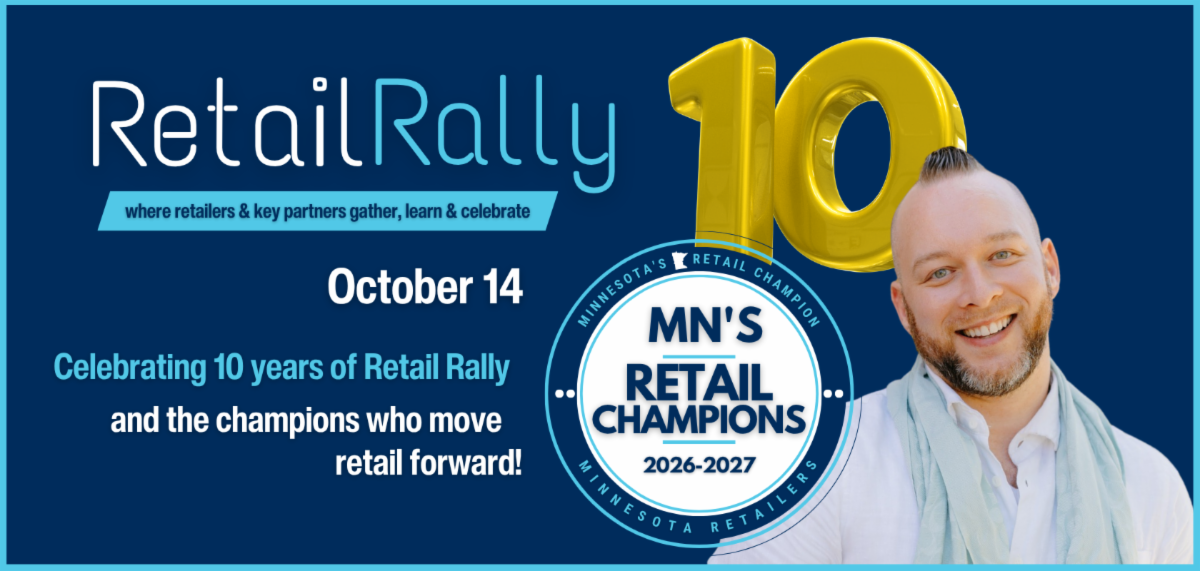
| | Celebrate 10 years of Retail Rally and the champions who move Minnesota retail forward! Join us October 14, from 2:00–4:00 p.m. at Brookview in Golden Valley, to recognize Minnesota’s Retail Champions and hear from Seth Ketron on AI in the customer journey. | | | Join Us October 14 for Retail Rally | | |
Retailers and key business partners are invited to come together for Retail Rally 2026 on Wednesday, October 14, from 2:00–4:00 p.m. at Brookview in Golden Valley. This year’s event will celebrate 10 years of Retail Rally while recognizing the people and businesses named Minnesota’s Retail Champions.
Our featured speaker is Seth Ketron, Ph.D., associate professor of marketing at the University of St. Thomas Opus College of Business. Ketron will share insights into artificial intelligence, changing consumer behavior and how new technology is reshaping the customer journey.
Join fellow retail leaders and community partners for an afternoon of timely ideas, valuable connections and a celebration of the people moving Minnesota retail forward.
Learn more here.
| | |
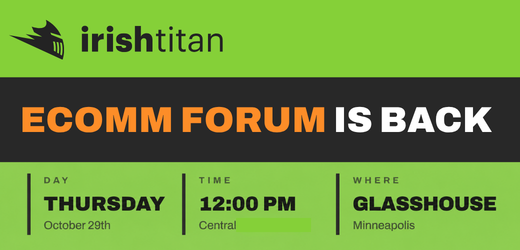
Ecomm Forum is back. Join Irish Titan on October 29th at Glass House in Minneapolis for a high-content, high-energy exploration of what’s happening now and what’s next in ecommerce.
Ecomm Forum celebrates ecommerce achievements and inspires those to come. We’ll dive into ecommerce best practices, emerging technology, automation, industry trends, and practical ideas you can put to work. From small businesses to global brands, today’s commerce landscape is pushing companies to innovate faster, adapt smarter, and continue raising the bar for customer expectations.
Hosted by Irish Titan, Ecomm Forum brings together a lineup of speakers, panelists, sponsors, and ecommerce leaders to explore the ideas, challenges, and opportunities shaping the future of commerce.
Learn more.
| | Rochester Construction Highlights Need to Support Local Businesses | | |
Major construction tied to Rochester’s Destination Medical Center initiative is putting pressure on local shops and restaurants, highlighting the importance of helping businesses remain accessible during infrastructure improvements.
MPR News reports that construction along Second Street for a new bus rapid transit line has complicated parking, reduced visibility and made reaching storefronts more difficult. Cafe Steam reported 30–40% fewer customers at one location, while Thesis Beer Project cited a roughly 50% revenue decline in its closure announcement. Other businesses are turning to pop-ups, special events and partnerships to bring in customers.
The city says it provides construction updates, weekly virtual meetings and signage to help customers navigate the area. However, some business owners describe uneven communication and uncertainty about when access will improve. The transit line is scheduled to open in August 2027.
For Minnesota’s retail community, the story underscores the need to include business survival in construction planning. Clear timelines, convenient access, visible signage and coordinated efforts to encourage shopping can help ensure existing businesses are there to benefit when improvements are complete.
Read the full story from MPR News.
| | Gen Z Shoppers Are Hardest to Please In-Store, Study Finds | |
Younger shoppers are leaving stores less satisfied than older consumers, according to new Sogolytics research highlighted by Chain Store Age.
The survey of 951 U.S. adults found that shoppers ages 18–24 reported negative outcomes on 45% of store visits, compared with 24% among shoppers 65 and older. Men also reported more negative experiences at big-box retailers than women.
Product availability emerged as a major challenge. Twenty-eight percent of shoppers encountered problems such as out-of-stock merchandise, missing sizes or colors, or difficulty finding products—twice the share reporting employee-related issues. Even one problem mattered: negative outcomes rose from 20% on issue-free visits to 48% on visits with exactly one issue.
Crowds also influence holiday shopping plans. Among respondents who were not firmly planning to shop in-store, 52% cited crowds and 33% cited checkout lines, compared with 26% citing better deals online.
Read the full article from Chain Store Age.
| | Common Cents Act Heads to President’s Desk | | |
Minnesota Retailers supports the Common Cents Act, which Congress passed earlier this week to establish clear, national rules for rounding cash transactions following the end of penny production.
The legislation would give retailers and consumers a consistent approach to cash payments, helping businesses avoid a patchwork of conflicting requirements. Minnesota Retailers supports clear, practical rules that employees can apply consistently and customers can easily understand.
The National Retail Federation and partners worked closely with the bill’s sponsors to ensure the final legislation is workable for businesses and addresses potential conflicts with cash payment laws.
The bill is expected to be sent to President Trump for his signature soon. Minnesota Retailers will keep members informed as the legislation moves forward and implementation details become available.
| NRF and RILA Urge FTC to Protect Consumer Savings in Pricing Policy | |
The National Retail Federation (NRF) and Retail Industry Leaders Association (RILA) have submitted comments to the Federal Trade Commission urging the agency to distinguish individualized price increases from discounts, loyalty rewards and other benefits that help consumers save money.
The comments respond to the FTC’s proposed enforcement policy statement on personalized pricing. NRF submitted its comments September 25, and RILA’s filing is also dated September 25.
NRF urged the FTC to define personalized pricing narrowly, focusing on situations where a business uses a specific consumer’s personal information to offer or charge that person a higher price based on their inferred willingness or ability to pay. It called for explicitly excluding personalized coupons, promotions, incentives and loyalty benefits.
NRF also cautioned against broad disclosure requirements that could confuse customers or require businesses to reveal competitively sensitive pricing strategies. Any required disclosures, it argued, should focus on individualized price increases. Read NRF’s comments to the FTC.
RILA raised similar concerns, warning that an overly broad policy could discourage loyalty programs and personalized promotions that lower prices. It asked the FTC to focus on individualized increases above published or generally available prices and actual deceptive statements, while excluding legitimate discounts and ordinary market-responsive pricing.
RILA also argued that vague standards could produce confusing disclosures and unnecessary litigation. Read RILA’s comments to the FTC.
| Rising Costs Prompt Pearson’s to Close Longtime St. Paul Candy Factory | |
Pearson’s Candy Company closed its longtime St. Paul factory September 28, citing rising production costs and higher ingredient prices that made operating the facility unsustainable.
According to MPR News, the closure of the 67-year-old factory resulted in approximately 80 employees being laid off. The facility is known for producing Pearson’s Salted Nut Roll, a familiar product on retail shelves in Minnesota and beyond.
The closure illustrates how cost pressures can affect the businesses behind the products consumers buy. When manufacturers face higher ingredient and operating expenses, those challenges can ripple through the retail supply chain, influencing sourcing decisions, product availability and prices.
For St. Paul, the loss also carries a community impact. Beyond the jobs, the factory represented a longstanding connection between a recognizable Minnesota brand and the neighborhood where its products were made.
Read the full story from MPR News.
| MPCA Finds Nearly 93% Compliance in Early PFAS Product Testing | |
Recent Minnesota Pollution Control Agency testing found that nearly 93% of sampled food packaging, menstrual products and dental floss complied with Minnesota’s PFAS restrictions, offering an early look at how manufacturers are adapting.
In its September 22 update, MPCA reported that 35 of 38 food-packaging products, 26 of 27 menstrual products and 17 of 19 dental-floss products passed testing. Agency staff purchased products from stores, selecting different brands and locations. The findings represent a snapshot of those three categories.
MPCA reported that 92.1% of packaging tested in 2026 complied, compared with 57.8% that did not contain elevated PFAS levels in 2023, before Minnesota’s food-packaging prohibition took effect.
MPCA is following up with manufacturers whose products failed testing and plans to expand testing into additional product categories.
For retailers, the results reinforce the value of ongoing conversations with suppliers about product compliance. Maintaining supplier documentation and reviewing affected merchandise can help businesses navigate Minnesota’s requirements as implementation continues.
Read the full update from MPCA.
| | | | |