Dear Angelenos:
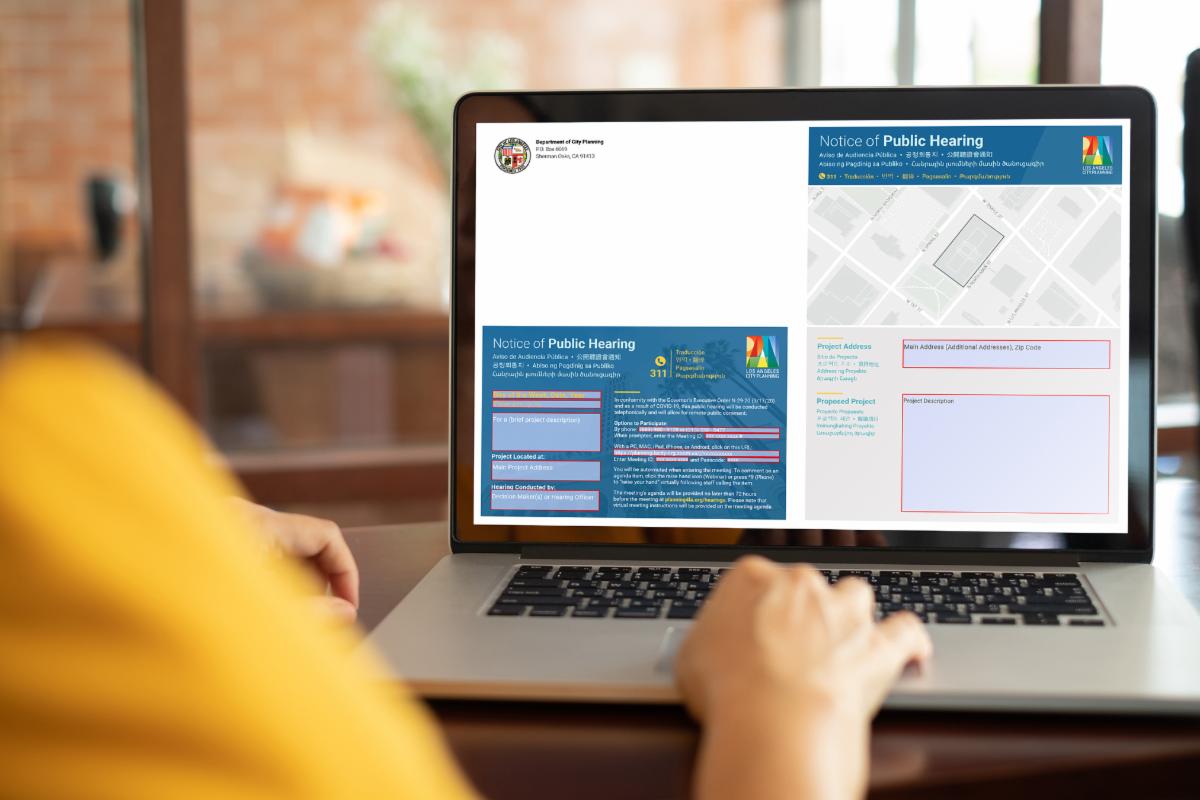
I’m pleased to announce that the Los Angeles Section of the American Planning Association (APA-LA) has selected our Department for the Award of Excellence in the Public Outreach category. The award recognizes City Planning’s user-friendly new design for project-related hearing notices, which incorporates graphic elements and highlights important written information.
When the time came to revisit the design of our hearing notices, we decided to standardize their format, ensuring that they communicate as clearly as possible and all provide the same key information. The new design displays a map of the location of the proposed project, as well a rendering or other image supplied by the applicant. Important details such as the time and venue of the public hearing are prominently featured in the new layout.
As with the other improvements we have made to our services recently, such as bringing applications and fee payments online and using videoconferencing to conduct outreach, the goal of our hearing notice redesign is to make participating in the planning process easier for all Angelenos. Together, we are Planning4LA.
Sincerely,
|
|
Vince Bertoni,
Director of Planning
|
|
|
|
New Affordable Housing Linkage Fee Schedule |
On July 1, the revised fee schedule for the Affordable Housing Linkage Fee (Linkage Fee) will take effect. It will incorporate the latest change to the Consumer Price Index (CPI-U) as well as annual inflation. Since its inception, the Linkage Fee has provided a permanent source of local funding for affordable housing, designed to help with citywide housing production goals.
The Linkage Fee, created in 2017, has also played a pivotal role in fostering an equitable mix of affordable units. Similar to other inclusionary programs, it requires projects that do not provide on-site affordable housing to pay a fee to fund the construction of affordable units.
The ordinance’s updated fee schedule outlines the fee amount that applies to different market areas across Los Angeles. Refer to ZIMAS, or the maps included in the fee schedule, to identify the per square foot cost associated for qualifying projects based on their geographic location.
|
|
|
|
State of California Approves Revised Housing Element |
On June 29, the California Department of Housing and Community Development (HCD) informed the City of Los Angeles that its 2021-2029 Housing Element was in full compliance with State law. The letter from Senior Program Manager Paul McDougall praised the City’s approach to Affirmatively Furthering Fair Housing (AFFH): "HCD applauds the City for the comprehensive approach to AFFH including rezoning in neighborhoods that were previously inaccessible due to historical land use and zoning policies. These efforts allow for increased access to higher resourced communities for lower-income households[...] HCD appreciates the City’s commitments and leadership for advancing policies and programs that promote inclusive communities."
The letter followed the City Council’s June 14 vote approving targeted amendments to the City’s 2021-2029 Housing Element, which had been unanimously endorsed by the City Planning Commission and the Planning and Land Use Management (PLUM) Committee.
The targeted amendments were prepared in response to a February 22 letter from HCD informing the City that additional revisions were needed to the Housing Element's programs to ensure compliance with new Affirmatively Furthering Fair Housing (AFFH) requirements. HCD notified the City in a May 11 letter that, upon adoption, the proposed revisions would meet all statutory requirements.
The Housing Element is a part of the City’s General Plan that lays out how Los Angeles will meet its obligations for housing, based on the City’s Regional Housing Needs Assessment (RHNA). Under State law, the City must update the Housing Element every eight years.
|
|
|
|
Westwood Village Specific Plan Amendment |
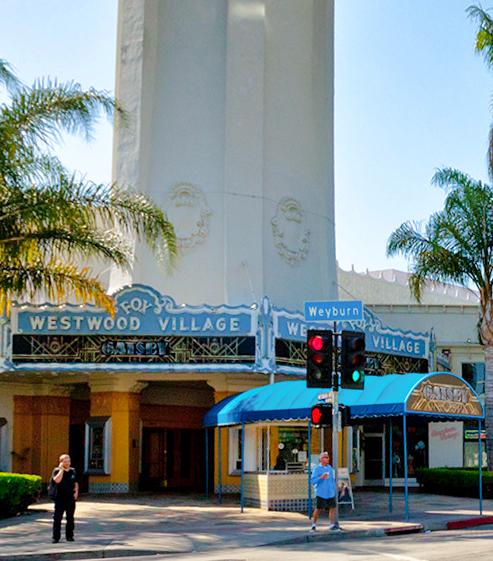
On May 31, the City Council’s Planning and Land Use Management Committee (PLUM) voted to advance City Planning’s proposed amendment to the Westwood Village Specific Plan. The amendment to the specific plan is intended to promote economic relief measures to spur investment in Westwood, especially in the aftermath of the pandemic.
With vacancy rates in the neighborhood approaching 40%, City Planning’s recommendations would eliminate burdensome and outdated development restrictions, reduce parking requirements, and provide a streamlined alternative approval process for qualifying projects.
The amendment to the Westwood Village Specific Plan would speed up permitting for signage and change of use projects that do not require facade alteration, construction, or expansion, among other things. The amendment is now with the City Attorney, who will prepare the final ordinance on which the City Council will vote.
|
|
|
|
Updated Guidance on State Law |
The first local implementation guidance pertains to SB 290, SB 728, and AB 634 and describes the changes, clarifications, and additions to State Density Bonus Law (including incentives for student and moderate-income housing), permits the purchase of for-sale units by a qualified nonprofit, and enables a jurisdiction to increase covenant terms beyond 55 years. The second memorandum focuses on SB 478, summarizes FAR allowances for sites permitting a density between three and 10 units, and clarifies minimum lot size requirements. |
|
OFFICE OF RACIAL JUSTICE, EQUITY, AND TRANSFORMATIVE PLANNING |
|
The killing of George Floyd in June 2020 marked a turning point for City Planning. In the wake of this significant event, Mayor Eric Garcetti signed Executive Directive 27, establishing the Office of Racial Justice, Equity, and Transformative Planning with the goals of acknowledging past internal inequities within City Planning and addressing the legacy of racism and segregation in planning practices that have affected our communities.
Led by Principal City Planner and Chief Equity Officer for Los Angeles City Planning, Faisal Roble, the office has made several strides in two years to advance racial justice and equity within the Department. Between 2020 and 2022, the office attended over 50 stakeholder-hosted events, collaborated with the City Planning Commission on several equity-related events, and facilitated internal listening sessions to address equity concerns within the Department. As the office approaches its second anniversary, it is expanding its focus to local communities and related planning issues.
With the new budget of 2022-2023 fiscal year, the office is currently increasing its staffing capacity to begin external engagement to address inequitable zoning and land use practices. These efforts will serve as the basis for a Strategic Action Plan that will outline steps the Department can take to advance its equity goals both internally and externally. The office will continue to update our stakeholders through this monthly report.
|
|
Southeast and Southwest Valley Community Plans Updates |
|
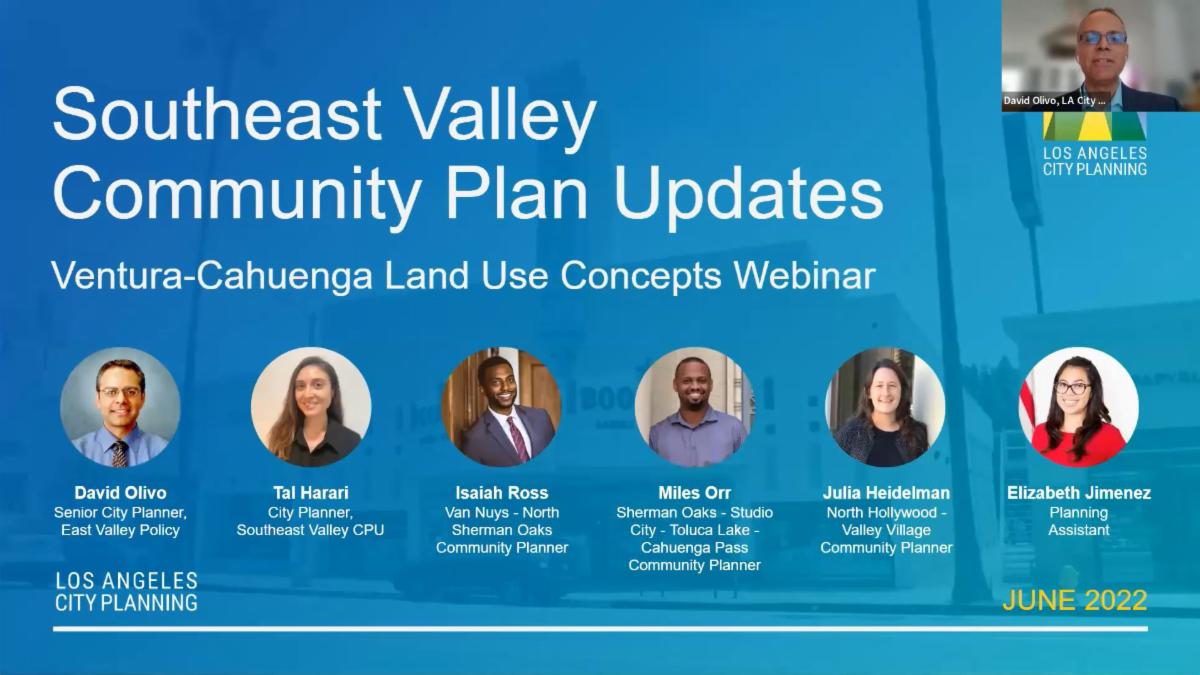
The Community Plan Update teams for the Southeast and Southwest Valley hosted events in June. Community Plans provide guidance and shape the environment through general plan land use designations and zoning that inform future planning decisions and are an integral part of City Planning and community member collaborations.
The Southwest Valley team gathered feedback about draft land use designations including draft concepts for the Ventura-Cahuenga Boulevard Corridor. From June 1 through June 18, community members met with planners during virtual office hours to review draft land use designations for the Canoga Park-Winnetka-Woodland Hills-West Hills, Encino-Tarzana, and Reseda-West Van Nuys-Lake Balboa Community Plan Updates.
The Southeast Valley team introduced and collected feedback on draft land use concepts for the Ventura-Cahuenga Corridor in Sherman Oaks, Studio City, and the Cahuenga Pass. From July 13 through July 19, community members will meet with Southeast Valley planners during virtual office hours to discuss the new land use proposals and share their vision for the Ventura-Cahuenga Corridor. |
|
On June 28, City Planning staff held a virtual information session about the proposed Wildlife District Ordinance, with a goal of having this ordinance considered by the City Planning Commission in the fall of 2022. The virtual public hearing is scheduled for July 13.
The Wildlife District Ordinance proposes new development standards for lot coverage, landscaping, and fencing, as well as grading and height limitations, among others. It would create a new Wildlife Supplemental Use District (WLD) and apply those supplemental regulations to properties in the area of the Santa Monica Mountains approximately bounded by the 405 and 101 freeways and Ventura Boulevard and Sunset Boulevard.
The interactive map, draft ordinance, and more information can be found on the project webpage. Participants are encouraged to view the recorded presentation that will be shared at the virtual information session, which is now available in Outreach & Events. |
|
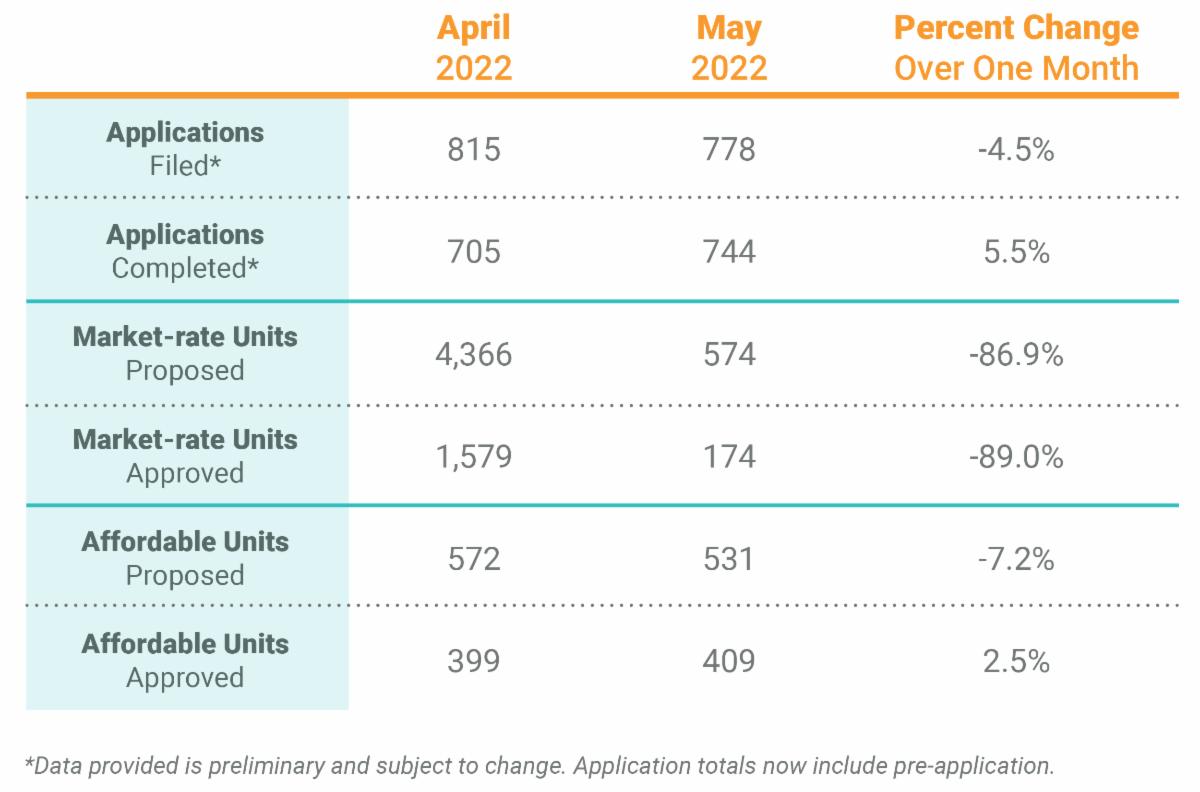
While the number of applications filed with City Planning declined by 4.5% between April and May, the number completed by the Department increased by nearly 6%. Following a high point in April, fewer units were proposed and approved in May. However, the number of housing units processed remains largely in line with the monthly average for the fiscal year to date. |
|
|
|
- Preparing final Letter of Determination (LOD) and the Final Environmental Impact Report (EIR) to be transmitted to the City Council later this summer of 2022
- Plan and New Zoning Code Recommended for Approval by the City Planning Commission in September 2021
- Released revised materials in advance of City Planning Commission hearing, including Zoning, Plan Text, Land Use Map, and Community Benefits Program, in June 2021
|
|
|
|
- Released the Preliminary Draft Plans (updated policy documents) for Harbor Gateway and Wilmington-Harbor City in May 2022
- Preparing Draft Zoning and EIR for the Harbor LA Community Plans Update
- Released Harbor LA StoryMap with new zoning information in December 2021
- Released the text-only draft policy documents for the Harbor LA Plans in Summer 2021
|
|
|
|
- Conducting outreach for Ventura-Cahuenga corridor in Spring/Summer 2022
- Releasing General Plan Land Use Map in Spring 2023
- Initiating EIR in Summer 2023
|
|
|
|
- Preparing draft Zoning and EIR for the SW Valley Community Plans Update
- Virtual Office Hours with Southwest Valley Community Plan Update Planners held in June 2022
- Updated Proposed General Plan Land Use Designations video series and StoryMap released in May 2022
|
|
|
|
- Reached out to Westside Community Plan Update Neighborhood Council land use committee chairs to inform them of the Westside Community Plan Advisory Group (WCPAG) roll-out
- Promoted opportunity to join the WCPAG, application review and selections in progress
- Preparing for website updates and informational orientation session with WCPAG
|
|
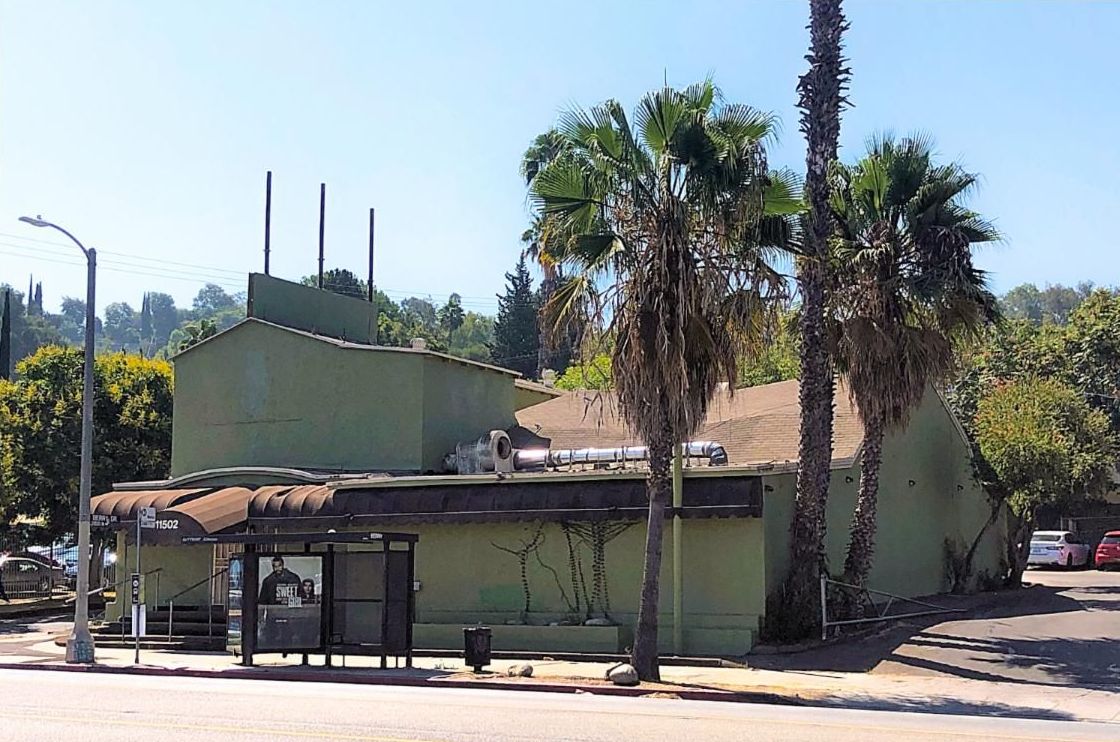
Recently declared a Historic-Cultural Monument, 11502-11506 W. Ventura Boulevard was the long-term site of Oil Can Harry’s, a gay bar and nightclub founded by William E. Byrne and Bert Charot in 1968. Opened during a phase of increased political organizing and group resistance to homophobia in Los Angeles, the venue served as a safe haven for the marginalized LGBTQ+ population of Los Angeles, who faced increased surveillance and harassment by law enforcement in the 1960s and 1970s. The club famously used a spy hole in the entry door and internal siren system to alert its patrons to police presence, allowing them to halt same-sex dancing or activity. The venue later became a hub for community support and fundraising during the HIV/AIDS epidemic of the 1980s, hosting near-daily events to support the cause. The venue continued to host and partner with numerous LGBTQ+ organizations throughout its tenure. In the mid-1980s, it also became a special gathering place for the country and western subculture of the LGBTQ+ community when it began hosting special western-themed events and free country dancing lessons. At the time of its closure in 2020, Oil Can Harry’s was one of the oldest LGBTQ+ bars in the country and an important institution within the LGBTQ+ community of Los Angeles. To learn more about other LGBTQ+ historic places in Los Angeles, explore the Lesbian, Gay, Bisexual, and Transgender (LGBT) Historic Context Statement. |
|
1715 North Bronson Avenue |
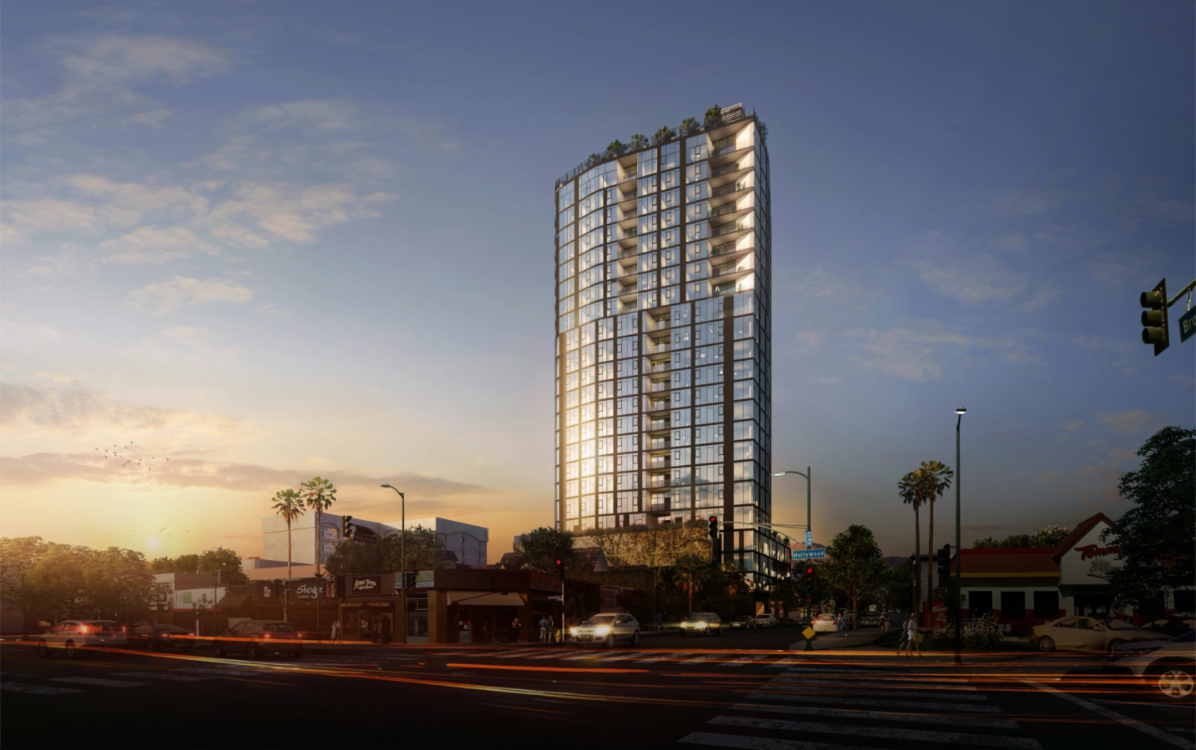
In June, the City Planning Commission approved a 128-unit residential development at 1715 North Bronson Avenue. Located in the Hollywood Community Plan Area, the proposed building will be 24 stories high and comprise 117 market-rate units and 11 units set aside for Very Low Income households.
In addition to creating 38 one-bedroom, 37 two-bedroom, and 53 five-bedroom units, the project will provide more than 17,000 square feet of combined private and shared open space, including a 7,231-square-foot rooftop deck, a 998-square-foot amenity room on the 24th floor, and private balcony space for each unit. In conjunction with the new building, the project will involve the preservation of the existing Lombardi House, a 7,000-square-foot, restored Victorian-style farmhouse that was originally built between 1904 and 1905.
|
|
July City Planning
Commission Meetings
|
|
|
July Area Planning
Commission Meetings
|
|
Central: July 26
South Los Angeles: July 19
South Valley: July 14, 28
West: July 6, 20
East: July 13, 27
Harbor: July 19
North Valley: July 7, 21
|
|
July Cultural Heritage
Commission Meetings
|
|
|
LOS ANGELES
CITY PLANNING
|
|
Sign up to receive citywide planning updates by email
|
|
|
|
|
|
|
|
|