Rail Workers Weekly News Digest
Number 37 - September 15th, 2020
|
|
Below is a series of articles compiled over the previous week.
They are of interest to railroad workers and activists.
|
|
ARTICLE #1 - RAILROAD WORKERS UNITED (RWU) NEWS
At the September Steering Committee meeting, RWU took action on a number of questions. Read the Highlights below.
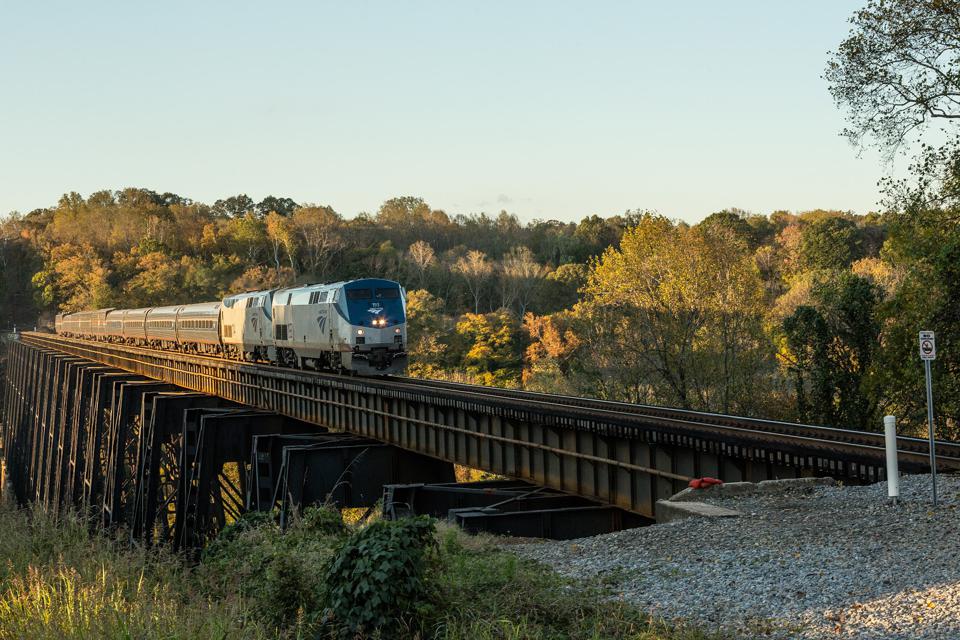
RWU Adopts Resolution of Support for Amtrak Daily Service
|
|
Whereas, three times weekly operations will cost the company dearly because:
· Many travelers will forgo the trip because the train either does not run on the outbound and/or inbound leg of travel on the desired dates.
· Confusion, lengthened trip times, will deter riders from using the system.
· Numerous fixed costs of train operations will remain, while revenue plummets.
· Additional wages must be paid to employees who exercise seniority to new territories, working many months before attaining qualification.
· Same-day connections will in many case be lost, deterring passenger ridership.
Therefore, Be it Resolved ....
|
|
RWU Endorses the THRIVE Agenda in Congress |
|
"The THRIVE Agenda is the bold new vision we need to create millions of good jobs, repair and revive our economy, and address the overlapping crises of mass unemployment, racial injustice, public health, and climate change,” said Mary Small, Legislative Director for Indivisible. “It is critical that any recovery package offered by Congress rise to meet the level of crisis, rather than inexcusably shrink to the scope of political convenience."
The THRIVE Agenda call for investment in:
- Millions of secure jobs with healthcare benefits
- Upgrading our broken infrastructure
- Building clean and affordable public transit
- Replacing lead pipes for clean water
- Expanding wind and solar power
- Increasing jobs, wages, and benefits for the work of caring for children, the elderly, and sick
- Modernizing buildings to cut pollution and costs
- Protecting and restoring wetlands, forests, and public lands
- Supporting family farmers, agricultural workers, and rural communities
- Creating high-skill, high-wage manufacturing jobs by expanding manufacturing of clean technologies
Job creation should ensure safe workplaces, family-sustaining wages, and protection of workers’ rights to organize. Specifically, THRIVE calls for an annual investment in rail of $21 billion!
85 members of Congress have already endorsed the THRIVE Resolution as original cosponsors, and a new poll finds strong majority support for THRIVE nationwide.
|
|
NOTE: Highlighted organizations in the listing at the above link include unions and other workers organizations, those who RWU has worked with on issues, and groups that RWU has fraternal ties to. RWU has been included. |
|
RWU to Launch Membership, Fundraising & Sustainer Drive |
|
For the past three years now, RWU has sent out a direct mailer with follow up communications to our members and supporters. We have urged our members to consider either making a one-time donation or to become a Sustainer Member. And we urged our supporters to join the organization. And we encouraged all of our members, supporters and others to consider a one-time donation to assist RWU in pushing our agenda forward in the coming year. Many of you answered the call.
This Fall we will undertake a similar effort, and hope that all of you who support the work of RWU will chip in and make the drive successful! Click on the links below to see how you can take part.
|
|
ARTICLE #2 - RAIL AND THE ENVIRONMENT NEWS
Amid Terror Warnings, AAR Passed on Intelligence on Environmental Journalist to Cops
By distributing private intelligence reports to federal “fusion centers,” industries can influence how law enforcement views threats
|
|
(Editor's Note: In the wake of many a "bomb train" derailment wreck and explosion, speculation often abounds as to a possible "terror" attack, such is the shock of such horrific spectacles. None of them have been the result of terrorism, but rather have been a result of the failure of the rail carriers to maintain a safe workplace. Yet, ironically, when a reporter such as Milkulka - one committed to uncovering the unsafe practices of the rail industry - dares to call out the rail carriers' for their failures, he is branded an instigator and a threat to rail safety!)
ENVIRONMENTAL REPORTER Justin Mikulka was unnerved as he scanned through the pages. “A friend had contacted me and said that he had found some documents with my name in them,” Mikulka recalled to The Intercept. “He told me I really had to see them for myself.”
Mikulka did see for himself. Descriptions of the journalist and his work were nestled among security reports detailing bloody terrorist attacks and far-right threats, in documents prepared by a private railway industry group and shared with law enforcement.
The series of documents suggested that law enforcement was being taught to view him — an author whose work specializes in the hazards of transporting oil by rail — as a possible instigator of criminal activity and a threat to railway safety.
|
|
ARTICLE #3 - RAIL WORKER FATALITY NEWS
Rail Worker Billy Wright Killed on the Job
|
|
SEPTEMBER 10 -- The Local 100 workforce at the 239th Street train yard in the Bronx is in mourning today with the tragic death of CED Cleaner Billy Wright. He was only 40 years old and was found unresponsive on the tracks at the yard by a co-worker. He appeared to have fallen and hit his head on the running rail, but the cause of death will be determined by the Medical Examiner.
The accident happened at about 5:00 a.m. Brother Wright worked the midnight shift at the yard. He had nearly four years on the job.
CED Vice President Shirley Martin said: “This is a very sad day for the entire workforce at 239th Street. We are reaching out to Brother Wright’s family and will assure them that the union will help them through this difficult time. Our hearts go out to his family, friends and co-workers. This has been a very difficult time for all transit workers. To lose another Brother member in this manner is truly heartbreaking.”
|
|
ARTICLE #4 - FREIGHT RAIL CORPORATE NEWS
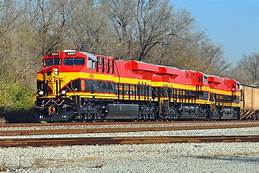
Kansas City Southern Rejects Takeover Bid, Report Says
|
|
(Editor's Note: Here we go again. The vulture capitalists of Wall Street that brought us excessive discipline, wholesale violation of union contracts, longer hours, draconian attendance policies, fewer employees, low morale and PSR, now have KCS in their sights.)
Global Infrastructure Partners and the infrastructure arm of private-equity firm Blackstone Group Inc. offered KCS $208 a share, the paper reported, citing people familiar with the situation.
KCS rejected the bid, arguing it undervalued the company. KCS turned away an earlier bid that was below $200 a share. The two sides are not in discussions, the paper reported.
|
|
ARTICLE #5 - RAIL EMPLOYMENT NEWS
Layoffs Continue at Union Pacific
|
|
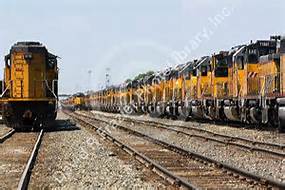
Union Pacific announced Sept. 4 that it plans to lay off an unspecified number of non-agreement and agreement employees, according to a report in the Omaha World-Herald. UP attributed “continuous efforts to streamline operations, while aligning our service product and resources to drive efficiency” as the reason.
In September 2018, UP announced a new operating plan, Unified Plan 2020, based on PSR (Precision Scheduled Railroading). At that time, the railroad employed 44,531, according to a filing with the Surface Transportation Board. By July 2019, UP had cut about 4,000 jobs, reducing its numbers to 40,491. In July, roughly another 7,700 jobs were eliminated, bringing the number down to 32,820.
|
|
ARTICLE #6 - RAIL AND ENVIRONMENT NEWS
UP Dispatches 'Water Train' to Fight California Wildfires
|
|
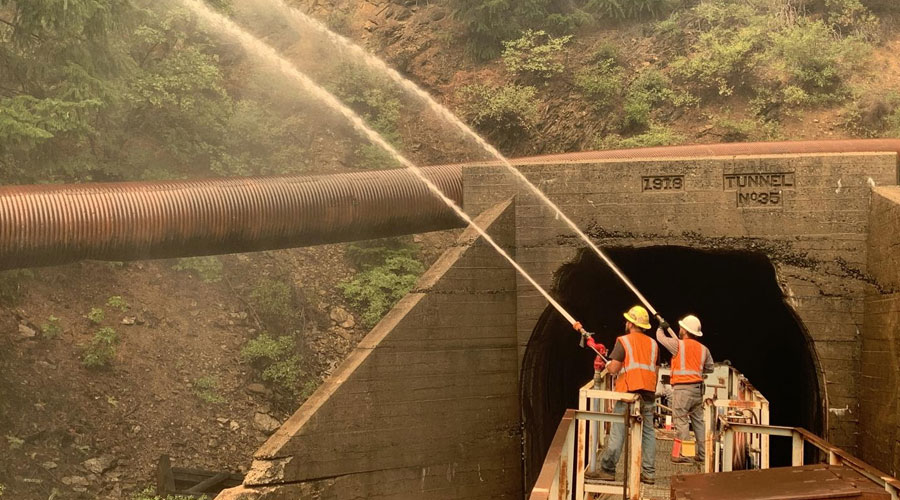
A team of Union Pacific Railroad engineering employees have been on the front lines of battling hot spots along the railroad's track, bridges and tunnels as wildfires roar across Northern California.
The crew have been using the UP water train, which consists of two rail cars that each hold 12,500 gallons of water and a pumper. The train goes back and forth over a 7-miles stretch, traversing up to 50 miles a day, UP officials said in railroad's InsideTrack newsletter.
Recently, the crew has been out in force on UP's Canyon Subdivision near Quincy, California.
"We've had more than 16 fires so far this year in the Valley, Winnemucca and Canyon subdivisions, and the Reno, Nevada, industrial leads," said Jerry Rhea, UP's manager of bridge maintenance engineering.
|
|
ARTICLE #7 - LABOR AND ECONOMIC NEWS
How Today’s Unions Help Working People
Giving workers the power to improve their jobs and unrig the economy
|
|
If we hope to ever rebuild an economy that works for everyone, we’re going to need many more workers in unions and a much stronger labor movement.
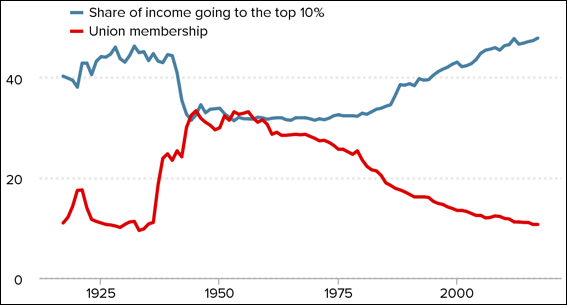
This graph comes from the Economic Policy Institute — it shows the relationship between union density and the percentage of national income going to the richest 10 percent of Americans. As you can see, the larger the share of the American workforce that’s unionized, the lower the share of national income goes to the super-rich — and vice versa.
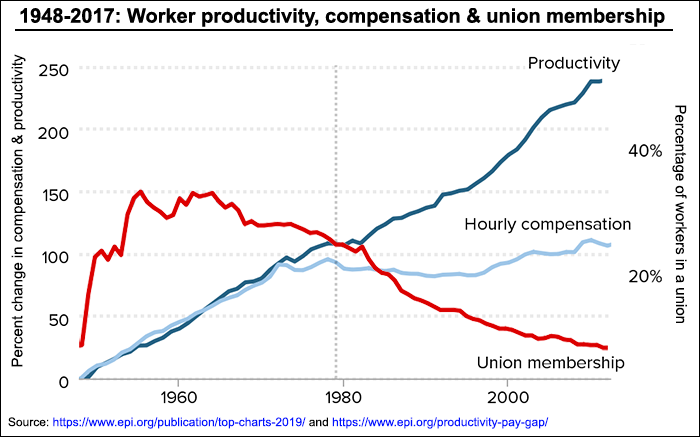
I’ve also combined the union density graph with another from EPI showing the break between worker productivity gains and worker compensation gains. Look at the story it tells about what happened between 1948 and 2017.
|
|
Before around 1980, worker productivity and compensation steadily increased as union membership grew and remained relatively high. Then when union membership declined, there wasn’t a sharp uptick in productivity (the rate of gain remained roughly the same from the days of stronger unions) — the thing that changed was workers’ compensation. With less union strength, workers simply started getting paid less. With fewer unions, workers’ productivity gains which had previously been compensated instead were pocketed by owners and shareholders (for more on this, read this terrific backgrounder).
|
|
ARTICLE #8 - INTERNATIONAL RAIL NEWS
UK Union to Lead Fight Against Transport Austerity in the Wake of Covid Pandemic
|
|
(Editor's Note: Perhaps the North American rail unions can follow the lead of the UK's biggest rail union and push for similar measures.)
SPECIALIST TRANSPORT UNION RMT will lead the fightback against any attempt to impose austerity cuts in the wake of the COVID-19 pandemic.
In a motion to the Trade Union Congress (TUC) today which will be moved by senior assistant General ,Secretary Steve Hedley RMT sets out the programme for that campaigning fightback: "Congress pays tribute to the key workers of the Coronavirus pandemic who, in protecting our lives and livelihoods risked and sadly lost their lives.
Congress will campaign for workplaces fit for heroes, including :
- No transport austerity, protect and improve rail, tube, bus, maritime, transport and offshore jobs, pay and conditions
- Stronger safety standards and stronger powers for safety reps.
- All key workers to benefit from the Coronavirus compensation scheme.
- End outsourcing which is unfair and unsafe; Sadiq Khan should lead through ending privatisation of Tube cleaning.
- Scrap planned new anti-union legislation against rail workers.
|
|
|
|
|
|
|