“I long, as does every human being, to be at home wherever I find myself.” - Maya Angelou
NRN Network News
January 19, 2023
|
“DEEP DIVE INTO NEEDHAM:
Community Satisfaction and Social Cohesion”
On Thursday, January 5th, the Needham Resilience Network met in Powers Hall at the Needham Town Hall. As the year begins, NRN continues to immerse in learning about both ‘The State of Needham’ and member sub-networks.
TEAM BUILDING ACTIVITY - HUMAN SCULPTURES
Members were asked to think about the values that underpin their individual work in the community and then, in groups of 3, to represent those values/roles in the form of a sculpture created with their body. Each small group then created a joint sculpture reflecting their combined work/goals/values and showcased it to the larger group.
The following themes emerged through the sculptures, exemplifying the unique ways in which NRN members give to our community, and underscoring how intertwined our goals and activities are:
- Build connections, and get everyone in line
- Protect, be a beacon of light in education
- Be a foundation, listen, plan
- Support mental health, represent Republican perspectives
- Build bridges/connections across challenge, tend to the afflicted, challenge the afflicters
COMMUNITY SATISFACTION & SOCIAL COHESION
NRN enjoyed presentations from two recent local surveys. Locally representative data for both were collected by POLCO and the National Research Center. The Town of Needham presented on Community Trust and Satisfaction, and the NRN presented on Community Social Cohesion and Belonging.
“COMMUNITY TRUST AND SATISFACTION”
Town Manager Kate Fitzpatrick summarized the results of the Town’s 630-person survey (the full survey report can be accessed here).
The Town of Needham exceeds the national baseline across many variables.
Residents rate Needham as an “Excellent” or “Good” place to live (95%), having a “good” or “excellent” quality of life (92%), and providing “good” or “excellent” services (82%). Additionally, the Town exceeds the national baseline for K-12 education, overall feeling of safety, freedom from violence and property crimes, neighborhood satisfaction, etc.
It is hard to read these scores and not feel fortunate, and/or proud. Needham is remarkable – a fact that may be worthy of amplification within our networks. At the same time, every community can be improved.
The Community Satisfaction Survey revealed a few areas for growth.
Needham is challenged by community affordability, and residents face barriers to living based on age, race, nationality, religion, sexual orientation and gender identity. Resident engagement with the Town is comparatively lower when it comes to attending public meetings, or outreach for help. Similarly, overall confidence in the Needham town government is above the national baseline but could be improved, and resident ratings on neighborliness (78%), welcoming (68%) and fair treatment of all residents (76%) were lower, on average, than other survey themes.
In addition to examining overall averages on a residential poll, it can also be helpful to look at differences between groups within a population. When we see statistically significant group-based disparities, it can clue us into previously unrecognized community needs or signal the need for targeted outreach with regard to communications, services and programs.
The Community Satisfaction Survey revealed statistically significant score differences between Needham’s white and non-white residents on some themes. *
The data showed statistically significant differences on the following themes:
- Sense of community (81% white vs 74% non-white)
- Worry about someone of your background experiencing unfair treatment related to race/ ethnicity: (a) in one’s family - 5% white vs. 27% non-white; (b) another person of your race - 16% white vs. 37% non-white
- Neighborliness/relying on neighbors: 83% white vs. 65% non-white
- Availability of affordable, quality health care (79% white vs. 68 non-white)
- Availability of affordable quality healthcare (53% white vs. 69% non-white)
- Opportunities for adult education, culture, arts (81% white vs. 68% non-white)
*small sample sizes per non-white racial group made it impossible to break the data down by race, but it was possible to analyze it by residents who identified as non-Hispanic/white versus non-white
“COMMUNITY COHESION & BELONGING”
NRN co-Director Nichole Argo previewed initial findings from the NRN’s 536-person Community Cohesion & Belonging Survey, data collection for which ended in late October. The goals of this survey were to:
1) Establish baseline data for social cohesion in Needham, against which we can measure the impact of the NRN in two years; and,
2) Identify differences between identity groups (e.g., age, race, gender or sexual orientation, religion, socioeconomic status, etc.) that could help us prioritize areas for growth and establish effective collaborative strategies for addressing them.
Similar to the Community Satisfaction Survey, it revealed high percentages of neighborhood and town satisfaction.
Eighty-nine percent of whites and 80% of non-white residents report being “fairly” or “very” satisfied at the neighborhood level, and 87% of whites and 83% of non-white residents report being “fairly” or “very” satisfied at the town level.
It found significant disparities between (non-Hispanic) white and non-white respondents for several themes, though it assessed different factors.
- “When interacting with others in Needham, I feel like I truly belong” (% agree or strongly agree: 64% for white vs 39% for non-white)
- “When interacting with residents who have different viewpoints than me, I feel confident that I am being listened to, understood and respected” (% agree or strongly agree: 56% of white vs 39% of non-white)
- “I feel confident in the community’s ability to address distrust or tension between polarized individuals and civic groups or between civic groups and Town bodies (% agree or strongly agree: 43% of white vs 43% non-white)
We note that the overall averages for these themes are low. One goal of the NRN over the next two years might be to raise the overall averages for these themes, while another could be to reduce the disparities seen in these themes between white and non-white residents.
The NRN’s Community Cohesion Survey was also designed to identify shared local values, in the hopes that the NRN will be able to amplify them and bolster our shared local identity through outreach and events in 2023. The survey thus asked respondents to write their own responses to a series of questions:
-
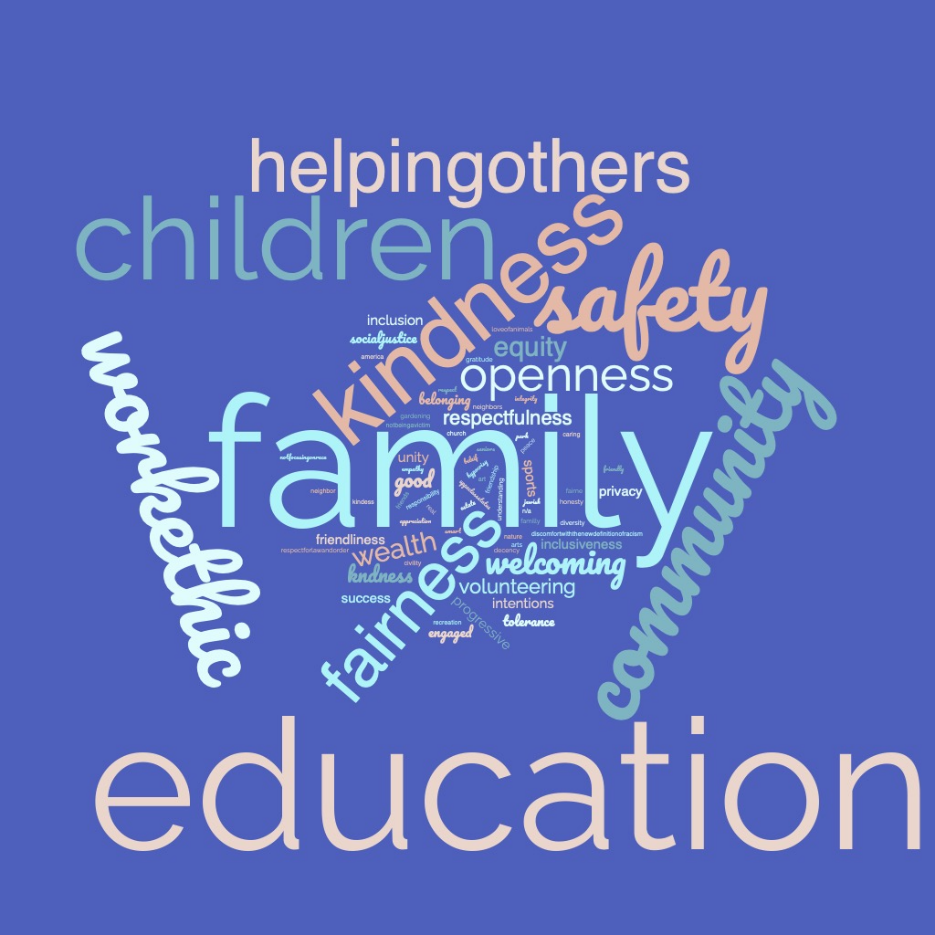
“In your opinion, what is one shared value among people who live in Needham?” Responses concentrated around values such as family and education, safety, children generally, kindness, community, work ethic, and helping others.
|
|
-
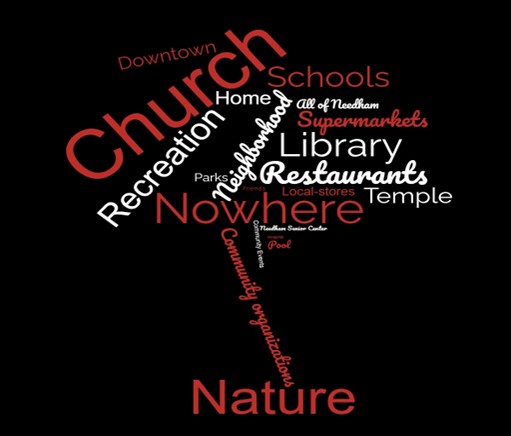
The survey asked, “What is the name of one place in Needham where you feel a sense of belonging?” For the purpose of better understanding the ways in which Needhamites seek and find local belonging, we coded responses by category. Frequent mentions included faith institutions, such as churches and temples, as well as in nature, the library, through recreational activities, etc. Notably, a significant proportion of respondents wrote, “Nowhere”, indicating that they lack a sense of belonging anywhere at all in Needham. Reducing the frequency of this response may make for a good community goal over the next couple of years. That said, we see similar findings in national data, where one third of Americans report not feeling like they belong in any setting outside of family and friends (see More in Common’s Two Stories of Distrust in America, 2021).
|
|
-
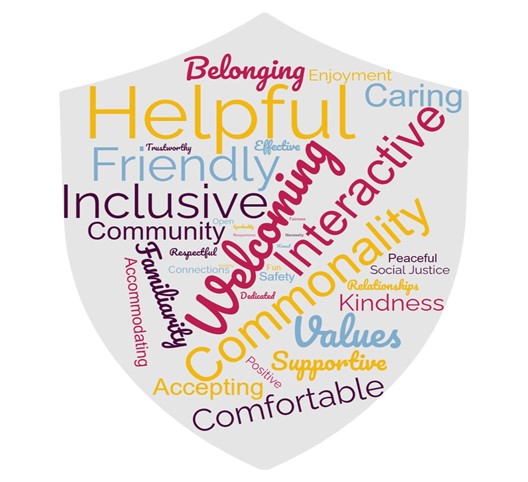
In addition to being asked WHERE they feel belonging in Needham, residents were asked, “What is it about this place that makes you feel that you belong?” Responses concentrated on attributes such as: helpful, friendly, inclusive, interactive, commonality, and comfortable. Note that feeling welcomed and included (via “friendly,” “inclusive,” “caring,” “accepting,” “belonging,” “kindness,” etc.) appear to be core attributes in Needham’s places of belonging. Some places may provide belonging as affinity groups where individuals share something in common (i.e., “commonality,” “values,” “social justice”) while others are identified more for their “openness” and exposure to diverse others.
|
|
-
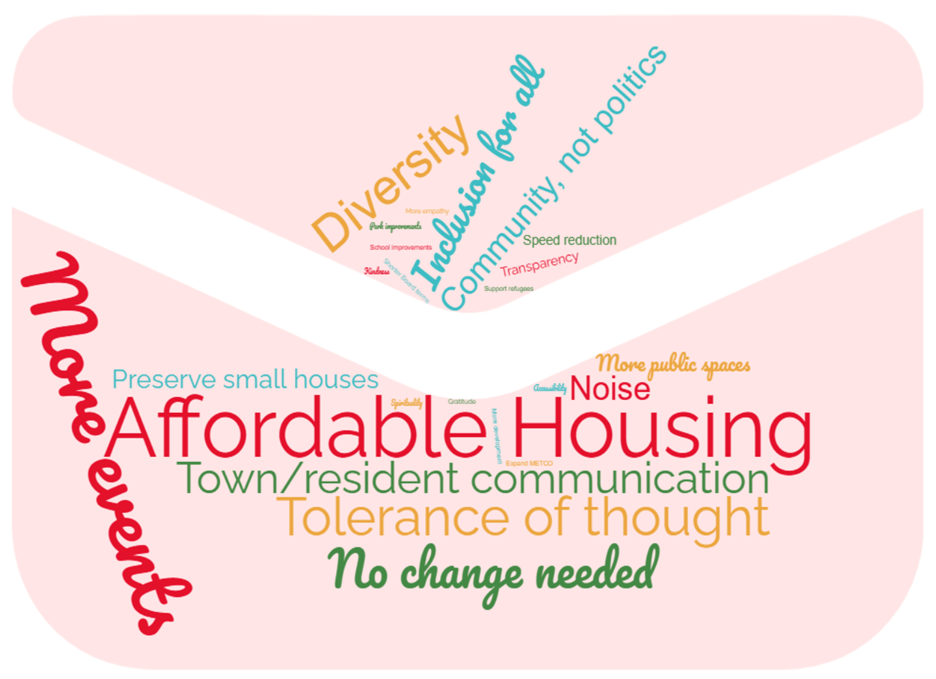
The survey asked respondents “Are there ways that Needham can improve residents’ experiences of diversity, equity, inclusion or belonging?” Affordable housing is mentioned with the highest frequency. "Tolerance of thought,” holding “more events,” and “town-resident communication” were also common responses. These responses lent themselves to the brainstorming of ideas for action steps in the small group discussions.
|
|
Stay tuned for the official report of the NRN’s “2022 Community Cohesion & Belonging Survey” this spring.
SMALL GROUP BREAK-OUTS
Breaking into small groups of five, NRN members were asked to reflect on what surprised them from the data review, what community strengths/assets/resources they saw in these data and what themes stood out as potential growth edges or areas of inequity.
Surprised by…
- The strength of the shared values around education and family
- The high percentage of people who are not engaged in/attending/watching Town Meetings
-
The fact that higher percentages of white residents reported access & affordability for health care compared to non-white residents (79% vs. 68%, respectively), but higher percentages of non-white residents reported access & affordability for mental health care compared to white residents (69% vs. 53%, respectively)
Strengths, Assets, and Resources…
- A vast majority of Needhamites feel safe from violence and property crime in Needham (99%)
- The strength of the shared values around education and family
- Identified attributes that help Needham to be a place of belonging
- Residents genuinely experience Needham as a good place to live
- Residents experience Needham as a source of a good quality of life, a good neighborhood experience, an excellent education, and a wonderful place to raise children
Areas for Growth, Disparities…
- There are significant white/non-white disparities in felt belonging
- Trust in government is notably weak even across races (which reflects national trend)
- Residents need better access to affordable health and mental health care
- The community needs more affordable housing
- There is a significant disparity between white and non-white access to adult education and culture
-
A significant proportion of the community chose to answer a question about where they experience local belonging with: “Nowhere”
LARGE GROUP DISCUSSION
Members returned to the large group circle to share potential strategies for amplifying Needham’s strengths and addressing challenges and disparities. Ideas included:
- Find a way to create/increase multi-family housing rentals
- Invest in town events designed to help people feel included - this should be with a collaboration of community partners so that planning does not fall solely on the town but is instead shared
- Create more opportunities for community organizations to lead arts and culture, and organize recruitment/access such that populations who currently lack access can obtain it
- Establish new data analysis guidelines such that data gets broken down demographically to reveal group differences, should they exist, so that the community can better understand disparities
- Write an op-ed discussing Needham residents’ shared values and community strengths
- Organize a community discussion around Needham’s strengths and growth edges – collect input on how to address challenges
- Create a recognition program, e.g., “Needham 2022 - Bedrock of Belonging,” whereby local sites that receive “X or more” mentions as a place of belonging in Needham receive a certificate and are recognized at a local ceremony
- The NRN and subnetworks could sponsor in-person belonging-focused gatherings in different neighborhoods and communities throughout Needham
These ideas are the seeds of potential NRN-led or inspired community activity that will be developed further over the next months.
GROUP BIOS
NEEDHAM PUBLIC SCHOOLS - Parent Teacher Council (PTC)
Frederica LaLonde, the Mitchell Parent Teacher Council Chair and liaison to other NPS PTCs, shared about the vast array of activities orchestrated to benefit the school community and its families. For instance, fundraising supports curriculum enrichment, faculty and staff, and community-building projects. The mission of B. Real, a new PTC project, is: “lifting every voice and embracing each individual in order to foster a safe, supportive, welcoming, and culturally and linguistically aware school community…”. Specific PTC endeavors, like the ‘Welcome Back Pizza Day’, “METCO Month”, and “Science in The City,” exemplify this welcoming and inclusive vision.
TOWN GOVERNMENT
Kate Fitzpatrick, Needham’s Town Manager, offered a comprehensive map of the Town. The Town Manager’s direct reports include the Chiefs of Police and Fire; Directors of HR, Building Design and Construction and Public Works; and the Assistant Town Manager. The Assistant Town Manager/Finance and Operation’s direct reports include the Town Accountant; Directors of IT and Assessing; the Parking Clerk; and the Directors of Health and Human Services, Parks and Recreation, and the Needham Free Library. Roles and responsibilities of both the Town Manager and Office of the Town Manager cover an extensive array of spheres, from Select Board support and Government Administration to Resident Support. Kate shared that Town employees take great enjoyment from interfacing with and helping a variety of Needham residents.
UPDATES
The “State of Needham” reports will continue and conclude over the next few months with the following data presentations and discussion:
February: Public Health and Housing
March: Needham Police / Public Safety
April: Needham Public Schools
RESOURCES
What We Are Reading/Watching/Listening to:
-
Joe Bubman of Urban Rural Action describe the experience of folks in Maryland coming together from different ideological perspectives to tackle issues of immigration, economic development, and inclusion with practical, local solutions for their state.
-
Faith and Polarization. Vice President for Programs at One America Movement, Chandra DeNap Whetstine gave an inspiring talk at Stand Together’s Catalyst Summit describing their approach to combating toxic polarization, working with faith communities across the U.S.
-
Read We Need To Build: Field Notes for Diverse Democracy by Evoo Patel. This is an exploration of social change that cultivates in people the importance of both individual parts and the connections between them, thus enhancing the health of the whole. Patel paints the picture of a pluralist society where people have conversations and can disagree on some fundamental things, while working together on others.
-
Read Option B: Facing Adversity, Building Resilience, and Finding Joy by Sheryl Sandberg and Adam Grant about personal resilience following grief. After the loss of her husband Sherly Sandberg and social psychologist Adam Grant penned this story-science narrative about shifting to Plan B in the face of loss, challenge or tragedy.
Onward!
Beth and Nichole (NRN Co-Directors)
|
|
NRN MONTHLY MEETING
NRN meetings take place on first Thursday of the month.
The Next NRN Meeting is Thursday, February 2nd at Powers Hall, Needham Town Hall
|
|
|
|
|
|
|