Rail Workers Weekly News Digest
Number 18 - July 23rd, 2019
|
|
Below is a series of articles compiled over the previous week.
They are of interest to railroad workers.
_____________________________________________
|
|
2019-18 Article 1
Train company cuts are dangerous, employees tell Reporter
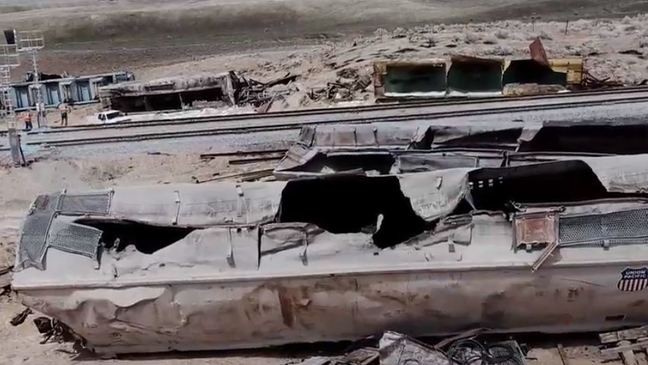
Union Pacific Railroad derailments have made a lot of headlines in our area in recent weeks.Last week, a train in Nevada left the tracks. Pictures show mangled automobiles on the ground and hanging from the toppled railcars.
Also last week, a train jumped the tracks near Pocatello, ID. Cell phone video shows a large white tanker on its side.
Last month, a
derailment shut down I-80.
Among the 19 cars that left the tracks, were some carrying hazardous materials, which reportedly spilled from the mangled cars. Some of the train cars that managed to hold on were carrying explosives, officials told 2News.
In March, a derailment in Juab County sent 24 cars off the tracks. Nine of those cars were tankers carrying phosphoric acid, bio diesel, propane and other non-hazardous materials. To clean up the mess, officials blew it up sending an amazing fireball into the night-sky.
In recent weeks, Get Gephardt has spoken to five former and current employees of Union Pacific. Each spoke on a condition of anonymity to avoid punishment from the railroad company. Each echoed the same thing: Union Pacific has implemented new practices and procedures that the workers feel are not safe.
|
|
2019-18 Article 2
Class One Railroads Report Record Profits
Ed. Note: As expected, despite traffic declines in most major fright categories, much pain and suffering for workers and shippers, "Precision Scheduled Railroading" has delivered massive short-term profits for Class One stockholders.
Kansas City Southern
Canadian Pacific
Union Pacific
CSX
|
|
2019-18 Article 3
U.S. rail traffic down 5.6 percent in Week 28
U.S. rail traffic has continued its downward trend so far this month, with railroads posting a combined 5.6 percent decline to 527,908 carloads and intermodal units for the week ending July 13 compared with the same week a year ago, according to
Association of American Railroads
(AAR) data.
Total carloads for the week fell 4 percent to 260,762 units, while intermodal volume plummeted 7.2 percent to 267,146 containers and trailers.
Only two of the 10 carload commodity groups that AAR tracks on a weekly basis logged increases. They were petroleum and petroleum products, up 1,140 carloads to 13,098; and chemicals, up 105 carloads to 32,859.
Commodity groups that posted decreases included coal, down 3,858 carloads to 80,874; nonmetallic minerals, down 2,728 carloads to 36,661; and motor vehicles and parts, down 2,005 carloads to 13,080.
Read more ...
|
|
2019- 18 Article 4
6 Years After This Train Exploded, Deadly Cargo Still Rolls Through Canada
Setting the Stage for Disaster: Deregulation
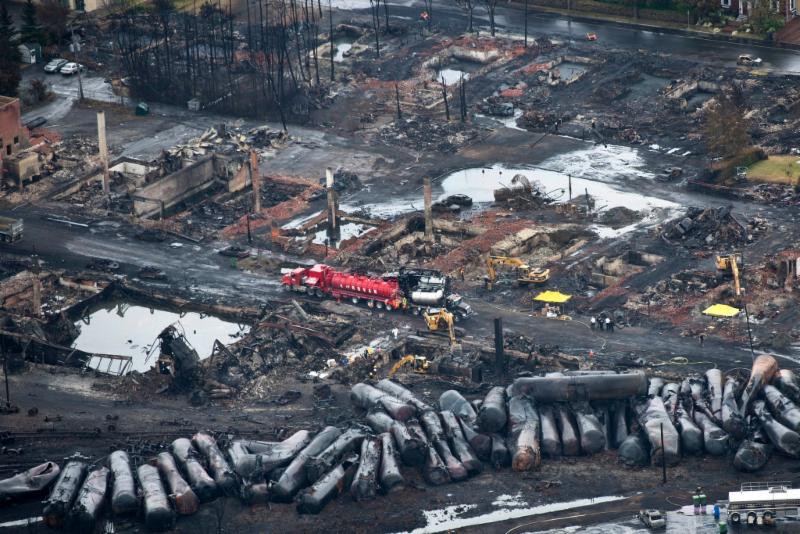
The Lac-Mégantic derailment came at a time of surging oil and gas production in Canada. It also followed a trend of deregulation that had turned over much in the way of safety oversight to the railways themselves.
In its
report after the accident
, Canada’s Transportation Safety Board portrayed the company responsible, the now-defunct Montreal, Maine and Atlantic, as a threadbare operation at which saving time and cutting costs trumped safety.
But the railway’s use of a skeleton crew, vulnerable tanker cars and routes going straight through population centers were all allowed under the country’s regulations.
“Lac-Mégantic was the violent consequence of a series of policy decisions interacting — whether they were deregulation or privatization or austerity — and the consequence was that there was a steady erosion of safety,” said Bruce Campbell, who prepared several studies on the accident as executive director of the Canadian Center for Policy Alternatives, a research group in Ottawa.
After the accident, Canada’s government did reverse that deregulation trend, increasing its oversight of railways, adding inspectors and introducing new safety rules. And for the first time, railways now must be licensed by Transport Canada to operate. If the regulator finds serious safety violations, it can immediately revoke that permit.
But the efficacy of some of these changes remains an open question. And one of the most important new rules comes with a loophole enormous enough for train after train to barrel right through.
Read more ...
|
|
2019-18 Article 5
Study makes strong case for Pacific Northwest high-speed rail
A new study makes the business case
for 220-mph high-speed rail in the Pacific Northwest. A brand-new high-speed line would be more cost-effective than other alternatives, it would cover its operating costs, and it would have a whole array of transformative benefits. It affirms that not only is high-speed rail feasible in the U.S., it’s a great idea. And, it lays out the sort of collaboration we need to bring high-speed rail to the Midwest.
The plan to connect Portland, Seattle and Vancouver, B.C. was first proposed in 2016 and has broad support from both government and the mega-region’s business community. This study—and a prior feasibility analysis—were funded by the governments of Oregon, Washington, and British Columbia, along with significant contributions from Microsoft.
The business plan envisions a train that puts both Portland and Vancouver less than an hour from Seattle. That’s as much as three to four times faster than making that trip today by car or Amtrak’s Cascades service.
This new study recommends as many as 30 daily round trips. That’s even more frequent than previously planned, because the convenience of having a train available at the right time is a critical factor. It also recommends more intermediate stations than originally envisioned, because creating a dense network is just as important as fast connections between the endpoints. (The study envisions a mix of express and stopping trains, connecting to and complementing the existing Cascades and commuter train services.)
Read more ...
|
|
2019-18 Article 6
Climate change will ruin train tracks and make travel hell
"We have a strong inclination based on evidence so far that a likely impact of climate change is more extended and hotter heat waves," said Nick Bassill, an atmospheric scientist at the University of Albany who researches weather and climate risks associated with the transportation industry.
"It was warmer than has ever been experienced on record by humans in France," he added, referencing Europe's scorching June heat wave. "You would imagine that would cause problems for things like rail lines."
The situation is similar across the pond. Earlier in June, triple-digit temperatures
caused "major delays"
on trains in California's Bay Area, with some trains running almost 40 minutes late. A widespread heat wave across the East Coast in 2018 resulted in
slowed
Amtrak trains. And during last year's European heat wave, trains in the UK were
delayed or canceled
.
"This is not a problem that’s going away," emphasized Paul Chinowsky, a civil engineer at the University of Colorado Boulder.
"The impacts are not something that is 10 years away," he added. "It's something that’s happening right now." Winiger, who was delayed two hours in Germany but eventually arrived safely in the Netherlands, agreed.
Critically, the hot weather doesn't just stress modern, high-tech trains. It can weaken and distort the steel rails — a notorious detriment to trains. When it starts getting really hot, the track essentially gets softer, explained Chinowsky. So when a heavy rail car moves over the tracks, it pushes the pliable rail down and out. "It causes the rails to warp," he said.
These warps, also known as buckling or sunkinks, can range from small to extreme, turning rail into wavy, serpentine-like tracks. "It’s kind of scary when you look at it," noted Chinowsky. Running over buckled tracks can easily derail a train, he said. It's easy to see why.
Read more ...
|
|
2019-18 Article 7
Solutionary Rail Prioritizes Safe & Humane Railroad Working Conditions
The Solutionary Rail concept would prove highly beneficial for working and retired railroad workers. In contrast to the current operating plan the major rail carriers have embraced, Solutionary Rail holds out the promise of:
- regular schedules
- a safer and healthier work environment
- a secure Railroad Retirement system.
Schedules and Precision Scheduled Railroading: While Precision Scheduled Railroading (PSR) sounds benign (who would not want more precision?), PSR is not bringing more precision to railroading. Instead, railroad workers continue to be plagued by unpredictable pools and extra boards, lengthy tours-of-duty, more time away from home, and a lower quality of work life. Wherever PSR takes hold on a rail carrier, the workforce suffers. Solutionary Rail, by contrast, is pledged to work with the workforce and the unions to provide for more regular schedules, guaranteeing workers more adequate rest, reasonable hours of work, and more time with their families.
Read more ...
|
|
2019-18 Article 8
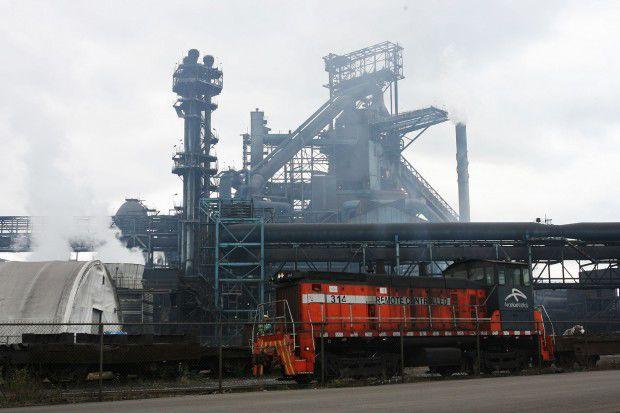
ArcelorMittal fined $14,000 for worker's death at Indiana Harbor steel mill
Indiana has fined ArcelorMittal $14,000 after the death of a steelworker in a fatal train accident at the ArcelorMittal Indiana Harbor steel mill in East Chicago in April.
Railroad operator Edwin L. Fleming, a 49-year-old Schererville man who had worked at the mill for nearly 17 years, was killed at the Indiana Harbor’s No. 7 blast furnace raw materials yard on April 2 when the engine he was operating struck a railcar on an adjacent track.
The Indiana Department of Labor Occupational Health and Safety Administration found two serious safety violations took place and fined the company $7,000 for each.
Read more ...
|
|
Railroad Workers United
Solidarity -- Unity -- Democracy
|
|
|
|
|
|
|