|
We all know what a shipping container is, at least fundamentally. It’s a big steel box.
Of course, just like everything else in this world there’s a lot more to it than that. From the perspective of shipping itself, containers became popular as a way to standardize transportation storage. By reducing the number of possible cargo configurations and sizes, as well as protecting them in a durable shell, the efficiency of transportation increased dramatically, causing widespread adoption. While there are numerous types of containers with several variations, they use very similar if not identical parts, allowing for interchangeability and universal compatibility for loading, unloading, and locking equipment.
From observing how containers are intended to be used, we can learn about how best to use them for our own purposes.
Your friend, Corrugation:
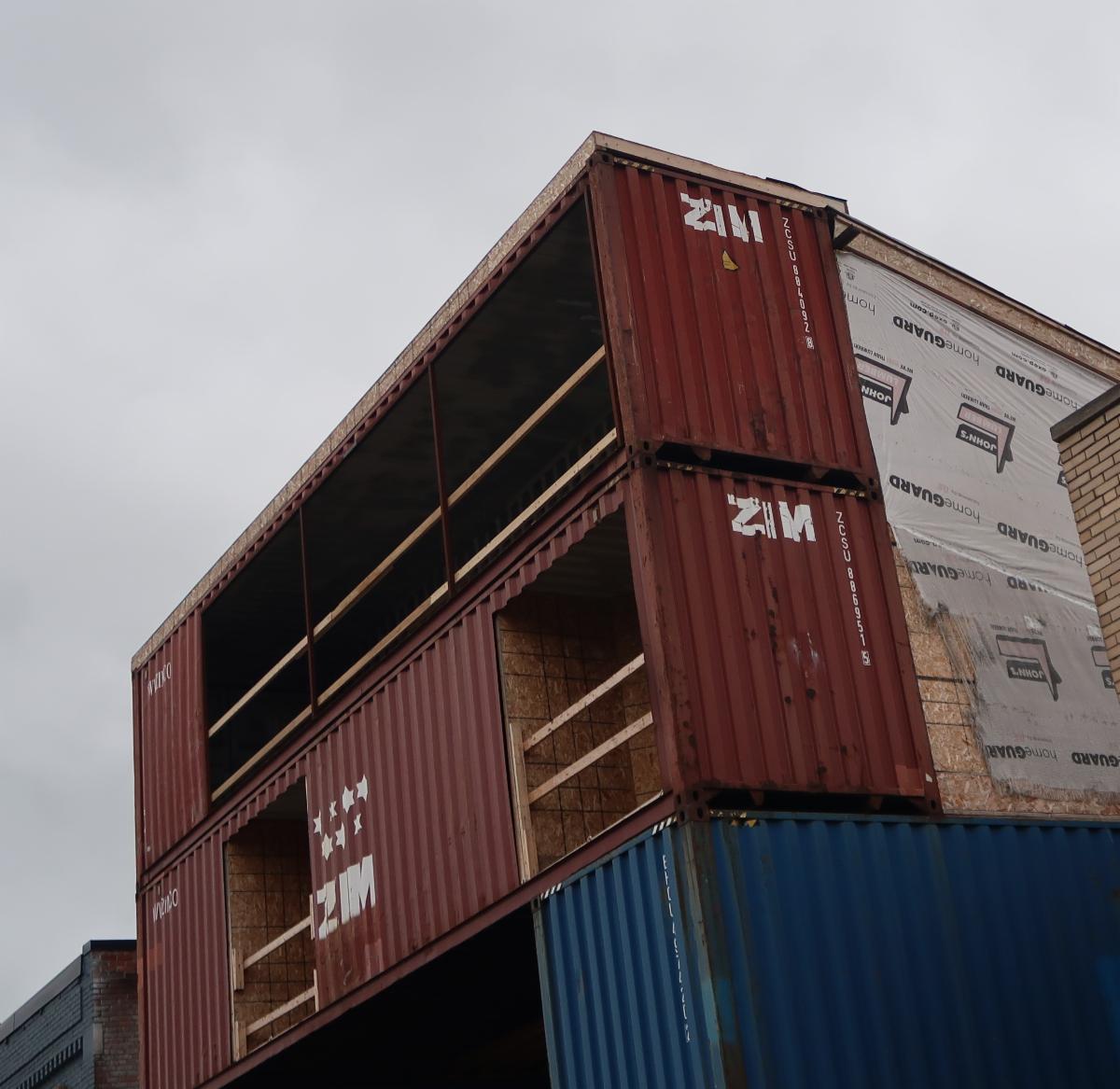
Shipping containers walls aren’t just there to keep water out and goods in. These corrugated side panels might be thin, but they provide the majority of the structural strength of an individual container and keep it rigid even when filled with all sorts of items, like a tall, narrow beam. While obviously a building can’t be built with no windows or doors, it’s important to seriously consider how much corrugation you’re going to remove. An entire wall of corrugation gone means that 40’ of roof is being supported by a hollow tube called the top rail, with a sectional area of barely more than 1 in2. For reference, a golf ball has twice that sectional area at 2.2 in2. Steel is strong, but the longer the distance, the weaker it effectively is, and 40’ is very long. If a large amount of corrugation must be removed for the building to serve its purpose, try to ensure that columns can be placed somewhere under the top rail, to lessen that unsupported length. Your engineer will thank you.
Crucial Corners:
When aboard a barge, you’ll see shipping containers stacked almost 10 high without issue, but a building only two stories can terrify an engineer. Why? While in part due to the profession’s notoriously weak constitution, the main difference is how the containers are stacked. On ships, trains, or awaiting transport, containers will be stacked directly one on top of each other, with only the corners meeting, as containers have raised corners to facilitate this connection called corner castings. This is essential, as it allows the weight of the containers to be transferred directly to support at the base, without creating a torque inside the container below. While this isn’t necessarily the most stylish design, it is by far the strongest. Any other configuration requires multiple different sets of shims and columns, which can have ramifications throughout the design. If at all possible, try to keep vertical connections corner-to corner. This will keep your design much simpler and much cheaper when it comes time to build.
A Good Foundation:
As previously mentioned, containers are designed to be supported only at their corners. This means that by far the best way to support them is with isolated foundations. With enough corrugation remaining and directly stacked containers, foundations may only be needed under the corners. Usually however, the amount of corrugation removed would cause the floors to bounce were they not supported more frequently, requiring slightly more foundations.
Regardless, isolated foundations are almost always preferrable to wall or slab foundations, so unless there’s a good reason to break the mold, we highly recommend isolated foundations for virtually all container projects.
Used correctly, shipping containers can be more durable, more cost-effective, and quicker to install than conventional construction. But if the strengths of a container aren’t utilized in the design, then it might end up costing more than wood or steel construction.
|