October 7, 2026 | Volume 6 | Issue 11 | As of Week 38 | | Welcome to the Florida Disease Activity Update from
the desk of Dr. Jonathan Day. | | |
It continues to be Clarke’s privilege to share Dr. Day's weekly analysis of arbovirus disease activity in Florida with mosquito control professionals and public health professionals across the state. Our shared goal with Dr. Day is to provide timely and actionable information that mosquito control and public health programs can use to make operational decisions and protect the public from vector-borne diseases.
An archive of all past newsletter issues remains available on the Clarke website.
| | |
Q. Sarah from Orlando, Florida asks: “Is the incidence of locally acquired dengue increasing in Florida?”
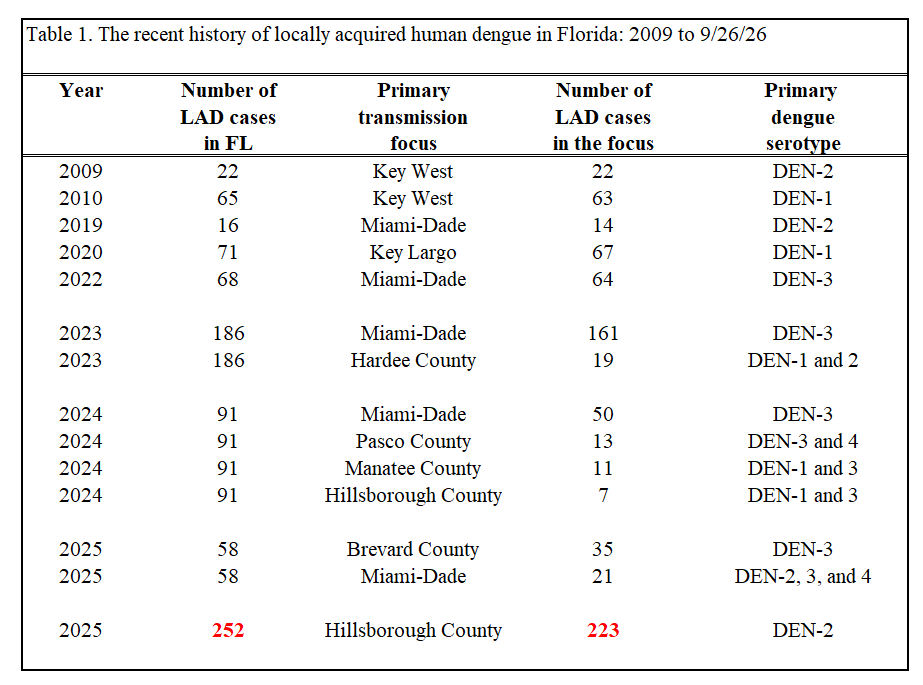
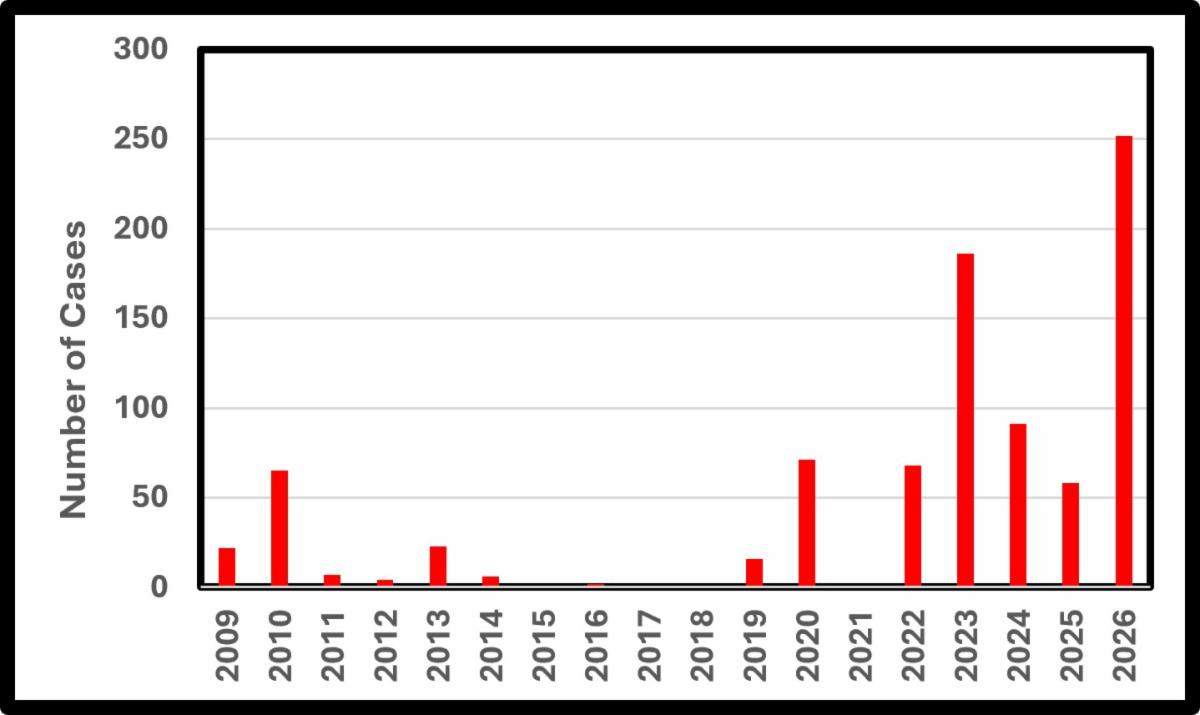
A. Yes. Locally acquired dengue in Florida started to resurge in 2009 with an outbreak in Key West (Table 1). Since then, the annual number of locally acquired dengue cases has continued to increase, peaking in 2026 (Figure 1).
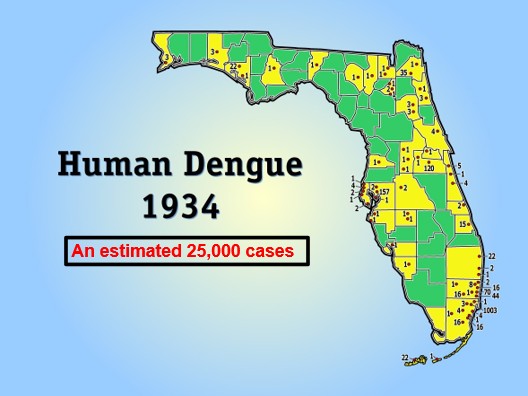
The last major dengue epidemic reported in Florida occurred in 1934 when there were an estimated 25,000 human cases across the state (Figure 2). Major South Florida transmission foci in 1934 were in Tampa and Miami, where the epidemic likely started. From there the virus followed the rail lines north probably in the form of infected travelers and hitchhiking mosquitoes. In 1934, populations of Aedes aegypti were found in every Florida household and the environmental conditions in the summer of 1934 likely supported dengue transmission throughout the state from Key West to Pensacola.
Dengue transmission in Florida during 2026 suggests that the state may now be vulnerable to annual epidemics. The only way to curtail this will be effective disease surveillance and Aedes aegypti control.
| Figure 1. The temporal distribution of locally acquired human dengue in Florida from 2009 through 9/26/26. | | Figure 2. The temporal distribution of locally acquired dengue reported in Florida during the 1934 epidemic. | | |
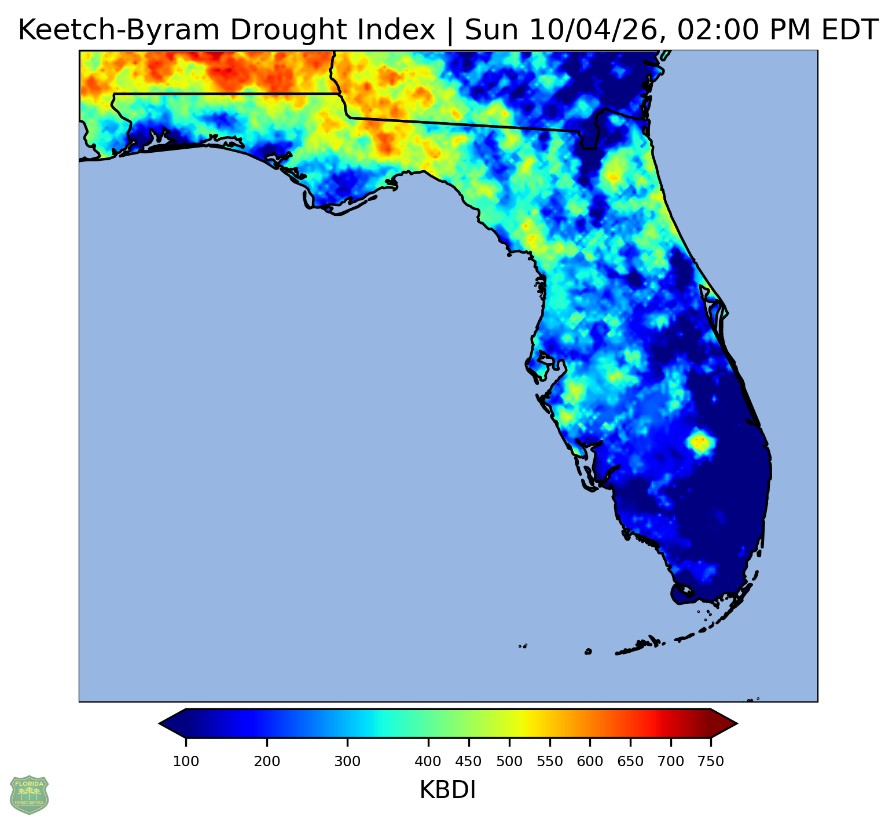
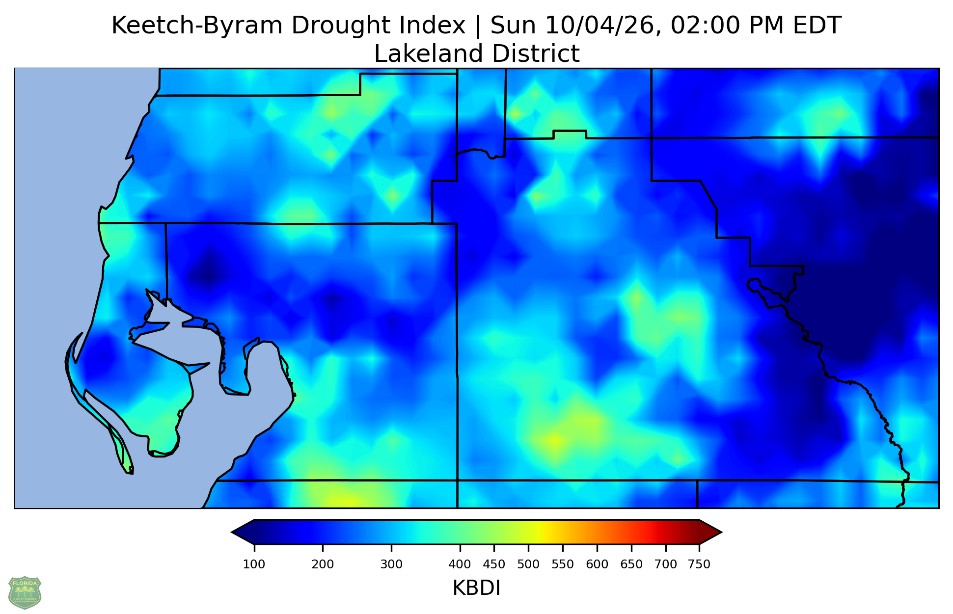
The epidemic of dengue in the Tampa Bay area continues to intensify. The southern tip of Florida, south of Lake Okeechobee, remains wet, while the central peninsula, North Florida, and the Florida Panhandle are all beginning to dry (Figure 3).
The Tampa Bay area is beginning to dry (Figure 4), which may restrict the movements of dengue-infected Ae. aegypti in the region and begin to temper the transmission of virus to humans.
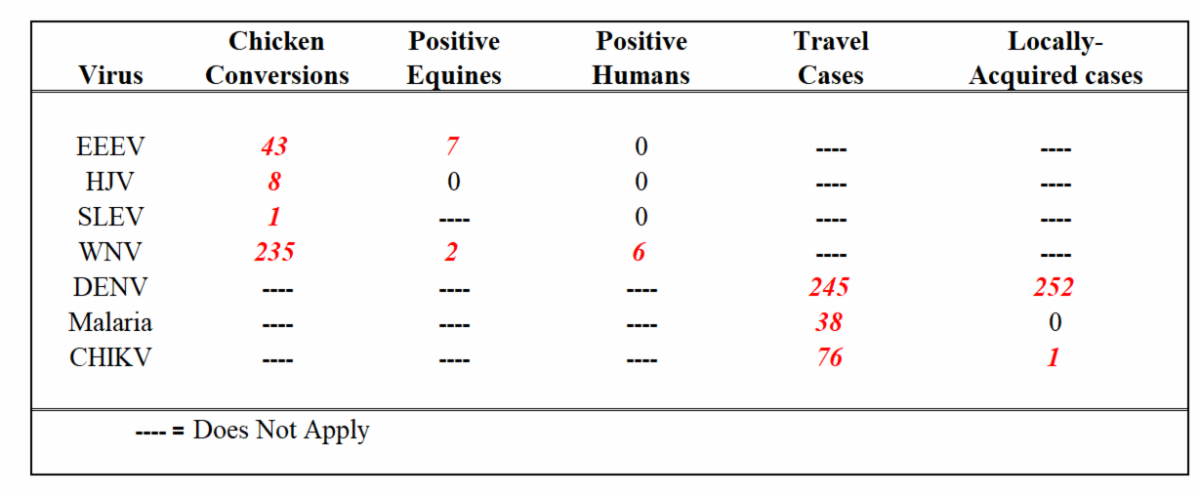
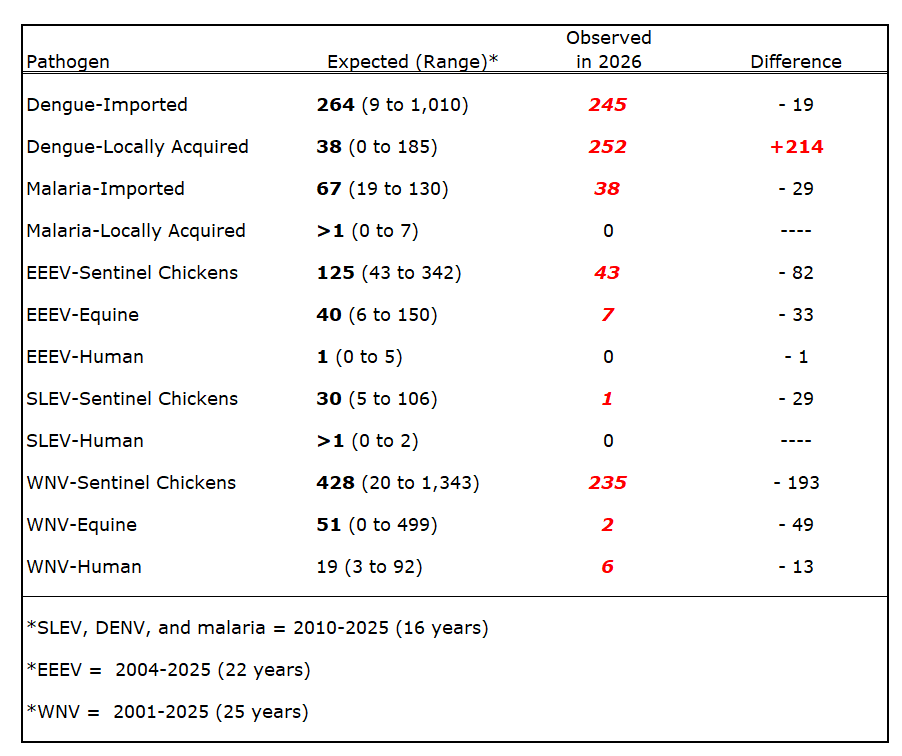
| | Figure 3. The Florida Keetch-Byram Drought Index for 10/4/26. | | Figure 4. The 10/4/26 Keetch-Byram Drought Index for the Lakeland District of Florida where there is currently a widespread outbreak of locally acquired dengue. | | The table below summarizes the status of vector-borne disease transmission and pathogen introductions in Florida as of 9/26/26. | | |
Dengue Virus
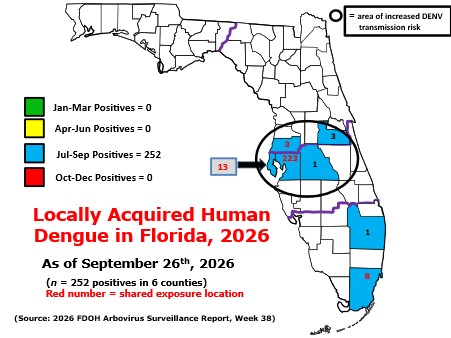
Sixty-two new cases of locally acquired dengue were reported last week: 53 in Hillsborough County, six in Pinellas County, and one each in Miami-Dade, Pasco, and Polk Counties. The statewide total of locally acquired dengue now stands at 252 cases (Figure 5).
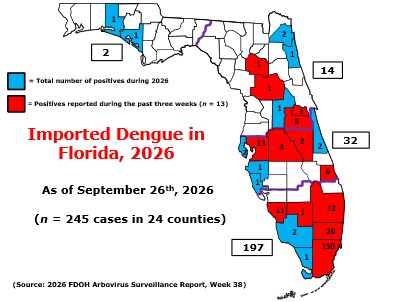
| | Figure 5. The spatial and temporal distributions of locally acquired dengue cases in Florida as of 9/26/26. | Thirty-three new travel-associated dengue cases were reported last week in Florida (Figure 6) bringing the 2026 total to 245 (Table 3). The new cases were widely distributed throughout the state, placing many more Florida Counties at risk for future locally acquired dengue transmission. | | Figure 6. The spatial distribution of the 245 imported dengue cases reported in Florida as of 9/26/26. Counties shaded red indicate areas where new travel cases have been reported in the past three weeks and represent regions at increased risk of local dengue transmission in the coming weeks. | Three new DEN-2 positive mosquito pools were reported last week in Hillsborough County. All were from pools of Ae. aegypti that were collected on 9/22/26 and 9/24/26 (two pools). So far in 2026, a total of 19 DEN-2 positive mosquito pools has been collected in Hillsborough County while one was collected in Pasco County. | | |
Eastern Equine Encephalitis Virus
One EEEV antibody-positive sentinel chicken was reported last week in Leon County, bringing the Florida 2026 total to 43 positive sentinels.
| | |
Malaria
No additional travel associated human malaria cases were reported in Florida last week.
| | |
St. Louis Encephalitis Virus
No additional indicators of SLEV transmission were reported last week.
| | |
West Nile Virus
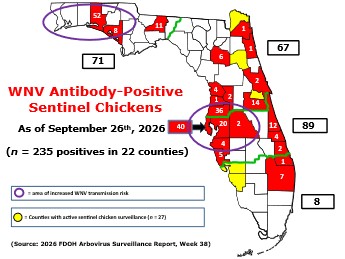
Sixty-three new WNV antibody-positive sentinel chickens were reported last week in a wide variety of Florida counties, bringing the 2026 Florida total to 235 positive sentinels (Figure 7). Two obvious WNV transmission foci were reported last week in the Tampa Bay area (Pinellas County with12 positive sentinels and Pasco County with seven seroconversions) and the western Florida Panhandle (Walton County with 17 positive sentinels.
| | Figure 7. The spatial distribution of 235 WNV antibody-positive sentinel chickens in Florida as of 9/26/26. | | |
Chikungunya Virus
Four new travel-associated cases of CHIKV were reported last week in Miami-Dade County, bringing the 2026 total to 76.
| | A summary of the observed and expected number of imported and local mosquito-borne viruses and diseases in Florida as of 9/26/26 appears in the table below. | | The 2026 Tampa Bay regional dengue epidemic may mark a watershed moment for dengue transmission in Florida. The observations and predictions of Gubler and Clark (1995) (see Suggested Readings below) are haunting as Florida appears to be approaching a dengue transmission hot zone equivalent to what is currently seen in Cuba and Puerto Rico. The only way we can avoid future seasonal dengue outbreaks in Florida is to get Aedes aegypti under control. | | |
In 1995, Duane Gubler at The National Center for Infectious Diseases, Centers for Disease Control and Prevention, Ft. Collins, CO and Gary Clark at The National Center for Infectious Diseases, Centers for Disease Control and Prevention, San Juan, PR, accurately predicted the dangerous issues we currently face with the mosquito-borne dengue virus (DENV). Their concerns were published in the Emerging Infectious Diseases article cited below.
By the mid-1990s, DENV was a rapidly expanding emerging vector-borne disease. Multiple factors were responsible for the expansion, including viral diversity (four dengue serotypes), changing patterns of urbanization, and rapidly increasing international travel leading to the introduction of new travel-associated dengue infections around the world (does this sound familiar?).
It is almost impossible to believe that in 1970 only DEN-2 had a presence in the Americas, although DEN-3 was on the doorsteps of Colombia and Puerto Rico. The relentless march of DENV into the Americas and our inability to control the primary vector, Aedes aegypti, despite a valiant effort by the Pan American Health Organization in the 1950s, has resulted in the dengue transmission conditions we are observing today.
All four dengue serotypes have been reported in Florida, placing residents and visitors at a higher risk for severe dengue infection in the future. Our inability to control Ae. aegypti increases that risk. The review article by Gubler and Clark provides an interesting insight into the dengue issues of more than thirty years ago and emphasizes the fact that our problems with severe dengue infection may be just beginning.
Suggested Readings
Gubler DJ and GG Clark. 1995.Dengue/Dengue Hemorrhagic Fever: The emergence of a global health problem. Emerging Infectious Diseases
1(2):55-57. Dengue/Dengue Hemorrhagic Fever: The Emergence of a Global Health Problem - Volume 1, Number 2—April 1995 - Emerging Infectious Diseases journal - CDC
| | |
Additional Resources
FMCA Dengue Virtual Briefing: Watch the discussion with mosquito control and public health experts on dengue activity and response efforts in Florida. Watch Here
Dengue Resources: Clarke’s Dengue PR Kit provides ready-to-use resources to help mosquito control programs communicate with their communities about dengue and prevention.
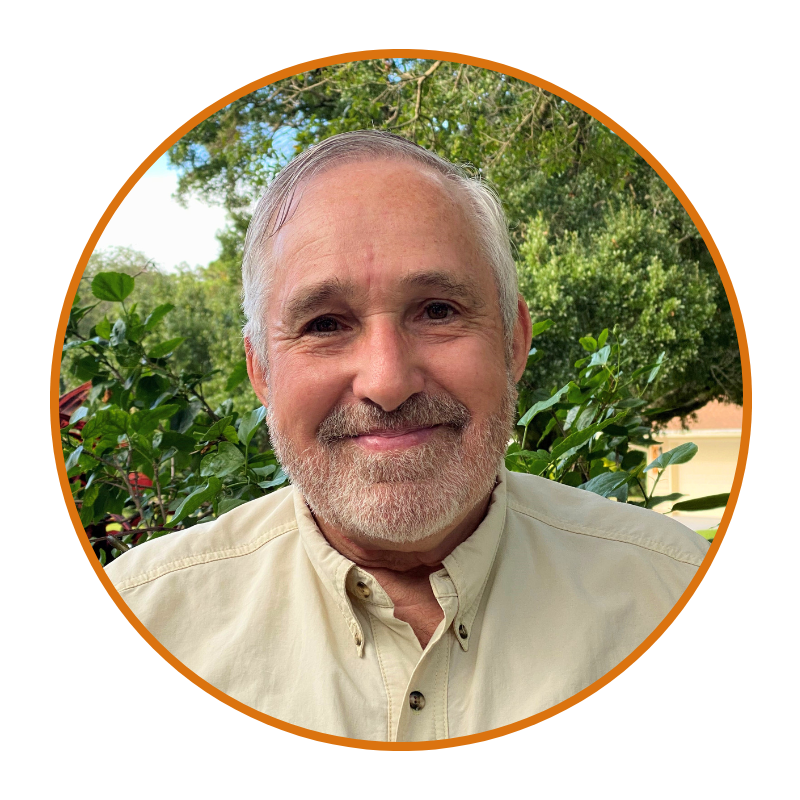
| | | | Jonathan Day, Professor Emeritus of Medical Entomology at the University of Florida and stationed at the Florida Medical Entomology Laboratory in Vero Beach is a national expert on mosquitoes and other blood-feeding arthropods that transmit diseases to humans, domestic animals, and wildlife. In collaboration with other researchers, Dr. Day has developed an effective system for monitoring and predicting epidemics of mosquito-borne diseases. | | |
Acknowledgments: This analysis would not be possible without the tireless efforts of multiple agencies across Florida. At least 27 Florida agencies collect serum samples from sentinel chickens each week and mail them to the Florida Department of Health Tampa Branch Laboratory for analysis, compilation, and reporting. Data are summarized by researchers at the Florida Department of Health in Tallahassee and reported weekly as the Florida Arbovirus Surveillance Report.
Contributors to this summary and full report include: Andrea Morrison, PhD, MSPH, Rebecca Zimler, PhD, MPH, and Olga Ospina, MPH, Florida Department of Health, Bureau of Epidemiology; Lea Heberlein, DrPH, Peter Dumoulin, PhD, MS, Maribel Castaneda, and Amanda Davis, MT (AAB) MB (ASCP), and Brittany Rowlette, BS, Florida Department of Health Bureau of Public Health Laboratories, and Dr. Joe Fisch, Florida Department of Agriculture and Consumer Services, Division of Animal Industry, Tallahassee, FL.
Daily updates of the Keetch-Byram Drought Index (KBDI) are produced by the Florida Department of Agriculture and Consumer Services, Forest Service.
The U.S. Drought Monitor is jointly produced by the National Drought Mitigation Center at the University of Nebraska-Lincoln, the United States Department of Agriculture, and the National Oceanic and Atmospheric Administration. Map courtesy of NDMC.
The Newsletter is edited and distributed by Jordan Brown.
| | |
Clarke has been helping make communities more livable, safe and comfortable since 1946.
Learn more about our work in protecting public health on clarke.com.
| | | | |