Rail Workers Weekly News Digest
Number 6 - February 11th, 2020
|
|
Below is a series of articles compiled over the previous week.
They are of interest to railroad workers.
_____________________________________________
|
|
Article 2 -
RWU IN THE NEWS
Works in Progress - The Year of the Derailment
“Every possible asset trimmed to the bone”
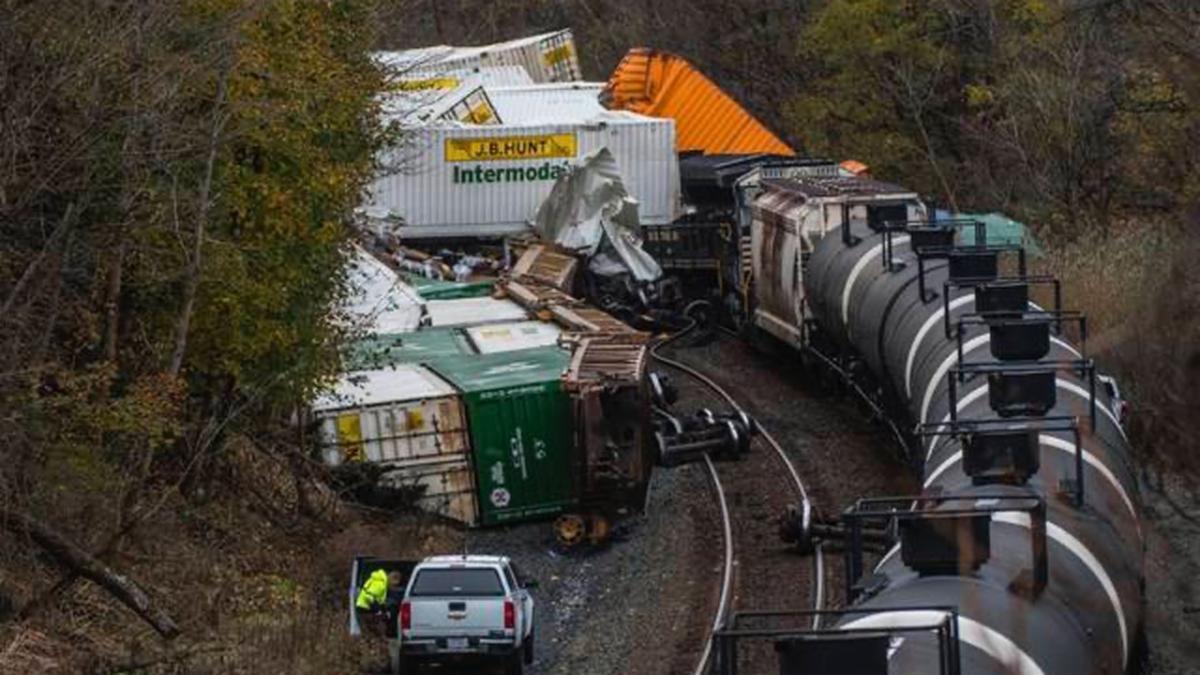
The railroad industry is largely “self-regulated” which means that there is no outside agency that monitors safety or anything else, including collecting accident data. Recently the Railroad Workers United (RWU) made a list of “major” derailments on Class One railroads—not including passenger trains—and found an average of nearly one per week. No one would imagine that derailments are so common so we’ve listed them here. The National Transportation Safety Board investigates freight accidents only when there is a fatality or substantial property damage so, in many cases the “cause” of the derailment is not specified.
However, the RWU members have an insider’s grasp about why the increasing frequency of rail accidents. One driver is “PSR” which stands for Precision Scheduled Railroading—a new way to extract more profit by working fewer people longer and fewer assets harder. Ron Kaminkow is General Secretary of the RWU, and here is how he tells it.
The ranks of rail labor have been decimated. Loco and car inspections have been cut, resulting in more faulty equipment on the mainline, which can result in derails. Track inspections have been cut, resulting in undiscovered broken rails and other faults that can lead to derailments. Train lengths have grown exponentially, increasing slack and buff forces in train, that can result in derailments.
The rail freight industry has long wanted to run trains with only one person on board, and last year the Trump Administration withdrew a rule that would have required a minimum of two. The goal is also to pre-empt states, several of whom require larger crews. Crew size has dropped from 5 in the 1970s, to 3 in the ‘80s and now to one or two.
|
|
Article 3 -
LEGAL ADVICE FOR RAILS
NOTE:
Each month, the Poolson-Oden Law Firm publishes an article in their newsletter - Right on Track - sent by RWU. See the most recent newsletter
Here
. The RWU article is on Page 2. In return, RWU features an article which they submit to the RWU Weekly Summary. See below ...
Engineer’s Suspension for Untimely Reporting of a Personal Injury is not Retaliation: Recent U.S. 8th Circuit Court of Appeals decision
A recent decision handed down by the 8th Circuit Court of Appeals on January 30, 2020, concluded that the U.S. Department of Labor wrongly decided that Canadian Pacific Railway unlawfully retaliated against its employee. Railroad engineer Mark Riley was suspended by the carrier after waiting less than 24 hours to make a formal complaint regarding an altercation with a co-worker.
In the case of Dakota, Minnesota & Eastern Railroad Corporation d/b/a/ Canadian Pacific v. U.S. Department of Labor Administrative Review Board, Canadian Pacific requested a review of the final decision of the Department of Labor Administrative Review Board [“ARB”] which ruled that Canadian Pacific violated the whistleblower retaliation provisions of the Federal Railroad Safety Act [“FRSA”]. Canadian Pacific suspended its employee, locomotive engineer Mark Riley, when he reported an altercation with his assistant locomotive engineer, John Bollman.
On June 5, 2012, a unit train consisting of three locomotives and 81 cars loaded with ethanol arrived at Canadian Pacific’s terminal in Bensenville, Illinois. Bollman was riding on the front of the locomotive to line up switches, and at one point, Riley yelled to Bollman to determine whether he was in track four or track five. Bollman did not answer, or Riley could not hear him, so Riley leaned out the window and yelled at Bollman repeatedly. According to Riley, Bollman then entered the locomotive, hit Riley in the chest with his lantern, punched him on top of his head and screamed at him. Riley and Bollman calmed down and finished yarding the train, heading to their hotel rooms at 4:25 a.m.
When Riley went to his hotel room at 4:25 a.m. he attempted to call his immediate supervisor and sent a text regarding the altercation. The next day, Riley reported the incident over the phone to his supervisor at 12:20 p.m. and then made a formal complaint at 2:38 p.m. After Riley reported the incident, CN charged both Riley and Bollman with multiple rule violations, including late reporting of the incident and engaging in physical and verbal altercations.
|
|
Article 4 -
RAIL SAFETY
Rail regulators intensify push to advance grade crossing safety
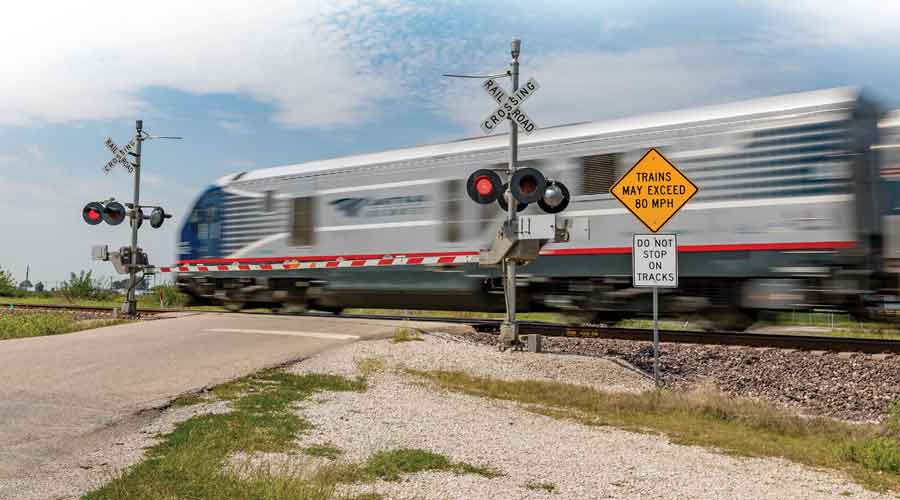
Grade crossing incidents and illegal trespassing on rail property continue to account for about 95 percent of all U.S. rail-related fatalities each year, according to the
Federal Railroad Administration
(FRA). Sadly, most of those incidents are preventable.
The FRA’s most recent data shows that in 2018, there were 2,217 collisions at public and private crossings in the United States, up from 2,123 in 2017, 2,049 in 2016 and 2,080 in 2015. While the number of fatalities resulting from collisions fell to 262 in 2018 from 271 in 2017, the deaths in 2018 outpaced the figures in 2016 (255) and 2015 (237) and tied 2014’s total.
Rail safety experts cite two factors that they believe caused the 2018 increase in collisions: a higher volume of train traffic and a greater number of distracted drivers and pedestrians.
In an effort to further drive down crossing-related incidents and deaths, U.S. Transportation Secretary Elaine Chao last month announced the
U.S. Department of Transportation
(USDOT) has “significant plans” to advance grade crossing safety around the nation. The announcement followed steps the FRA has taken over the past several years to raise crossing safety awareness.
Among the FRA’s most recent actions is a proposed rulemaking,
issued in November 2019
, that calls on states and the District of Columbia to develop action plans or update existing ones to make crossings safer. The proposed rule would require 40 states and D.C. to develop crossing action plans, and 10 states to update plans they’ve already made and report steps they’ve taken to implement their plans.
The 10 states — Alabama, California, Florida, Georgia, Illinois, Indiana, Iowa, Louisiana, Ohio and Texas — were previously required under the Rail Safety Improvement Act of 2008 to develop crossing action plans, according to FRA officials. The agency proposed the rule in response to the Fixing America’s Surface Transportation (FAST) Act mandate that the FRA promulgate a regulation requiring states to come up with ways to reduce the number of collisions, fatalities and injuries at crossings nationwide.
|
|
Article 5 -
CP WRECK UPDATE
Rail disaster video surfaces on anniversary of CP crash amid controversy over police probe
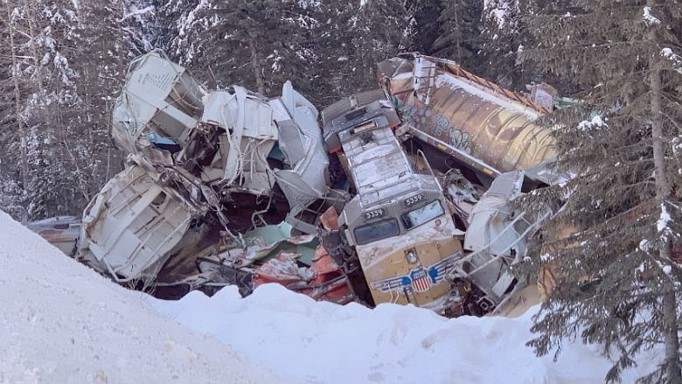
A metal CP Rail car ripped in half. An orange tarp shrouding the overturned locomotive. A dusting of snow covering the site while heavy machinery removes 99 derailed grain cars, most of them lying smashed along a mountainside.
These close-up images from video recently obtained by CBC News show the aftermath of the derailment of a Canadian Pacific Railway freight train one year ago today near Field, B.C. The video was made by CP Rail workers in the days immediately after three of their colleagues were killed on Feb. 4, 2019.
"It was a war zone … I was dumbfounded at the carnage," one railroader told CBC News, recalling driving a train through the crash zone after the runaway train derailed at the Spiral Tunnels. "The only thing I could think about was the terror that went through their heads," the railroader said, recalling that he burst into tears when he learned his friends Andrew Dockrell, Dylan Paradis and Daniel Waldenberger-Bulmer were killed in the crash.
The video has surfaced in the wake of a CBC Fifth Estate report that uncovered a string of failures at CP Rail and has sparked controversy over whether an outside police force should conduct an investigation into potential criminal negligence.
The Transportation Safety Board of Canada has demoted its lead investigator in the probe of the crash, stripping him of his title as investigator in charge, after deciding his comments to CBC News about the case were "completely inappropriate."
|
|
Article 6 -
PSR NEWS
Rail bosses slash jobs, safety in drive to maximize profits
CHICAGO — Rail bosses in North America have slashed thousands of jobs — from engineers and conductors to track maintenance and equipment repair workers — in recent months, with more cuts in the works. At the same time they brag they’re raking in soaring profits, despite a decline in freight volume. They’re imposing more stringent schedules on shippers and putting engines and other equipment out of service.
For rail workers, this means speedup, intensified work and increasingly unsafe conditions for those still on the job, while others confront the uncertainty of indefinite furloughs.
According to U.S. Labor Department figures, more than 20,000 rail jobs have been cut in the last year, nearly 10 percent of the workforce. Norfolk Southern has furloughed over 3,500 train crew, maintenance and other workers. BNSF Railway also has a growing number of workers on furlough. Union Pacific has closed several rail yards and says it plans to continue cuts through 2020.
“How do you expect to move the same freight with less people,” Travis Williams, a conductor with 18 years’ experience in Chicago, told the Militant. “They have to cut corners somewhere. We know it is going to affect safety in an industry that’s already dangerous.”
The biggest cuts have been in maintenance of equipment and stores, down 15% from a year earlier, and in train and engine crews, down 13.7%. The seven largest railroads in North America have idled nearly 30% of their locomotives over the last year, the Washington Post reported Jan. 3. It described how hundreds of mothballed engines are now parked in Norfolk Southern’s once-bustling hub in Roanoke, Virginia.
Overall, freight traffic is down compared to a year ago, but the job cuts go much deeper than the decline in trade, because of what the Post calls “an aggressive push across the railroad industry to slash costs.” Norfolk Southern chief marketing officer Alan Shaw boasted to investors in November they were able to cut “crew costs” by 13%. He said the company was “accelerating” cuts heading into the new year.
|
|
Article 7 -
RAIL INFRASTRUCTURE
Meet the group trying to electrify America’s railroads
The Backbone Campaign hopes it will reduce emissions and jump-start depressed communities.
Mary Paterson’s involvement in Solutionary Rail, a vision to electrify rail corridors spanning the U.S., began with a book review.
Paterson is a Seattle-area environmental activist, and in 2017 penned a review for Real Change after reading a book written by the solutionary rail campaign. On the surface, it might seem like the environmental movement in the Pacific Northwest is at odds with large railroad companies. It doesn’t take long to find headlines about activists blocking tracks and trying to stop trains loaded with fossil fuels from reaching refineries or ports.
Paterson said a key for environmental health and justice, creating green jobs and lowering emissions might be found in one of America’s oldest monopolies.
“This would be a role for trains that would make them part of the solution to the current problem, which is our reliance on fossil fuels, instead of their current purpose, which is to transport fossil fuels,” Paterson said. “It would give the trains a new role.”
The vision of the program is simple: move more freight, and especially long-haul freight, out of trucks and onto existing rail tracks and corridors. Ideally these would be electrified. The plan could also help rebuild passenger rail as a legitimate competitor to other forms of transportation.
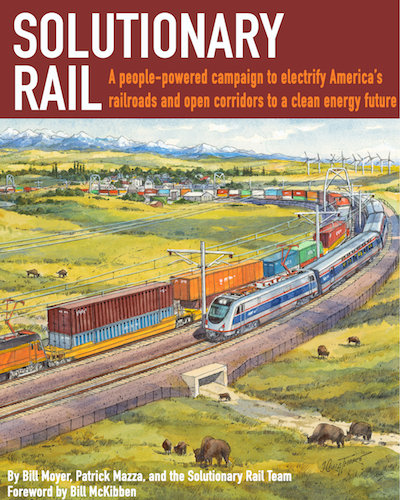
On top of this, the plan could create more stops in small communities, giving local farmers and manufacturers along the line a more affordable shipping option. But the blueprint for getting there is a little more complicated. The book, titled “Solutionary Rail: A people-powered campaign to electrify America’s railroads and open corridors to a clean energy future,” was released in 2017 by the Backbone Campaign and outlines the plan. It originally proposed modernizing and electrifying the U.S. rail system through a new public-private partnership and corresponding federal oversight.
|
|
Article 8 -
WORKER RIGHTS
Protecting the Right to Organize (PRO) Act, H.R. 2474
Right now, Congress has a critical opportunity to strengthen workers’ rights.
Lawmakers, in 2019, introduced the Protecting the Right to Organize (PRO) Act, H.R. 2474, which would give millions of America’s workers additional protections to organize and negotiate for better pay and benefits, and a voice on the job.
The U.S. House of Representatives will vote next week on this crucial piece of legislation. But greedy CEOs will do everything they can to oppose working people standing together.
It’s no secret that the right to form a union is under attack. “Right to work” laws are spreading, while wages have stagnated. More than ever, we need our lawmakers to stand up for working people’s rights—that’s where the PRO Act comes in. It would:
-- Penalize employers who violate workers’ right to organize.
-- Help workers secure a first contract.
-- Protect workers who go on strike.
-- Close loopholes that allow companies to misclassify workers as independent contractors.
Working people deserve the right to organize and demand living wages, safe workspaces and good benefits—and it’s up to our members of Congress to protect and strengthen that right. Contact your elected representatives and tell them to support the PRO Act.
|
|
|
|
|
|
|