RETIREMENT SECURITY MATTERS
A forum for retirement innovation information sharing focused on
states, supporters, and service providers.
Vol 29 | April 22, 2021
|
|
Greetings! welcome! to Retirement Security Matters – where we talk about retirement readiness innovation by states, supporters, and service providers.
|
Can you believe we are well into spring? We hope yours is awesome. In this edition we’ve got some great stuff to spice up your day:
- The inimitable Andrew Remo of the American Retirement Association on getting more employers into the retirement system
- Fresh state stats!
- Action notes from California, Illinois, New Mexico, Oregon, Virginia, Arkansas, Hawaii, Nevada and Rhode Island.
- Grant Boyken on Early Withdrawals and State Programs
-
Hot Sauce that is super hot – new research from Mingli Zhong, Amanda Umpierrez, Nancy Altman and Eric Kingson, David Morse and Angela Antonelli, NIRS, and EBRI. Plus some non-pensions stuff to enrich your day!
- And … PIX of the Week. From two countries. Just sayin.
|
|
The ARA on Coverage: Let's Get More Employers into the Retirement System
|
|
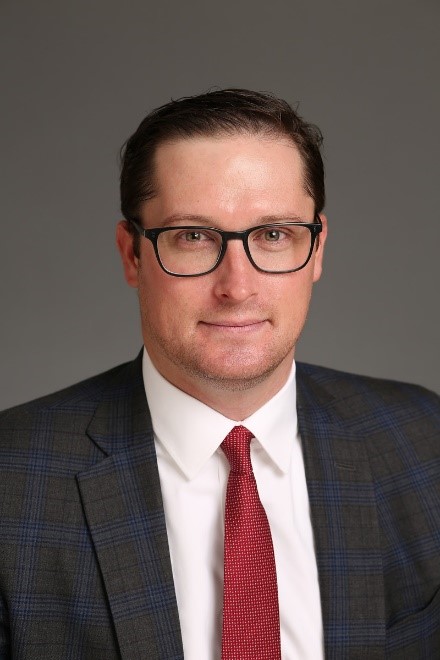
Andrew Remo,
Director of Federal & State
Legislative Affairs for the American Retirement Association
|
|
Andrew Remo has worked for the American Retirement Association’s government affairs department for more than eight years. He advocates before Congress and in the States for policies that achieve the American Retirement Association’s mission to give every working American the ability to have a comfortable retirement.
Before joining ARA, Andrew worked as a staff member for U.S. Senator Benjamin L. Cardin (D-MD) and was responsible for various policy portfolios, including tax and retirement issues. Andrew holds a Master of Arts in Government and a Master of Business Administration from the Johns Hopkins University as well as a Bachelor of Arts in Political Science from the American University.
Andy’s experience reaches back a ways. It also covers an important constituency: the advisor and provider community. We wanted to get his perspective!
|
|
Andrew – Andy -- the American retirement system is performing well in many ways, but we still see shortfalls in access and use. What could we do better?
I think the critical point is access to a retirement plan through the workplace.
The Employee Benefits Research Institute (EBRI) has produced data over the years suggesting that if moderate income earners – those who make between $30,000 and $50,000 a year -- have access to a retirement plan at work, they're 12 times more likely to save for their retirement than those who do not.
We know you've been involved in commenting on design and legislation related to some of the state auto IRA programs. What do you like and what don't you like?
The main thing we would like to improve in some states is to broaden the types of products that employers can use to meet the state requirements for employer exemption from facilitating. We like auto-enroll payroll deduction retirement savings plans offered in the private sector.
What we most like about these state programs is that they require businesses over a certain size to offer a retirement plan, which increases coverage. The employer requirement is a key principle for us. We think it’s critical to the success of these state initiatives. Because what's the point otherwise?
We feel strongly that there are already plenty of retirement plan products available that fit the needs of small businesses. Our members specialize in this market and create product offerings for small- and medium-sized businesses. The problem isn't lack of product, it's lack of employer interest, or the time and the expense to do something.
The way I like to explain the state initiatives that have the requirement for businesses to do something is that these states are essentially auto enrolling employers into the system.
That’s a new perspective!
We support these initiatives, but for them to work they need to have that requirement. I think the way these programs are structured impose as minimal a burden as possible on employers to provide access to retirement savings at work.
These state programs are largely IRA-based, do not require employer contributions, and absolve employers from any liability other than facilitating the payroll processing. And that is the sweet spot to close the coverage gap.
Let’s talk about usage. We see a respectable number of folks who have access at work who still don’t save.
Yes. A number of our members are plan advisors. As part of their role, they support employer plan sponsors by engaging with participants on a regular basis, highlighting the benefit their employer provides. They may even talk to individual employees about their financial circumstances and to help them consider participation.
Our advisor members try to lift the curtain on financial products and investments to increase understanding and confidence. These decisions can be intimidating if you are not financially experienced. Interestingly, our members also tell us that, particularly for moderate income workers, they're often the only financial professional that those folks ever interact with.
What?! We need to more about this. Check out the rest of this chat with Andy here.
Thank you so much for your fresh insights Andrew Remo! Want to connect directly with Andrew to ask him some of the questions we didn’t? You can right here. Connect with Andrew on LinkedIn. And you can follow the work of Andrew and his peers at the American Retirement Association here and here.
|
|
State Program Metrics - Auto IRAs |
|
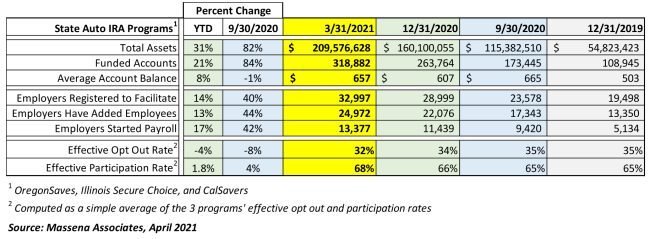
These figures reflect March 31 reporting for all three funded state Auto IRA programs.
We got you! Cheat Sheet:
Year to date: current assets are $209 million, up $10 million from our last report and up 31% since January 1. Funded accounts are flirting with the 320,000 level, up more than 20% so far this year. And, average account balances are up 8% to more than $650. A nice bridge between any saver and short term economic challenges. In the Oregon program with its longer history, average account balances are about $950, and early savers have now set aside amounts that will allow them to defer taking Social Security for several months, increasing their lifetime income.
Opt out rates are holding steady from February at about 32%, and are down both year to date and over the historical measured periods.
Nearly 33,000 employers have registered to facilitate program savings. Three-quarters of these (24,972) have added employee rosters. 40% (13,377) have started payroll deductions for their participating employees. In absolute terms this represents a 13-17% increase year to date, and a 40-44% increase over the last six months.
|
|
State Facilitated Retirement Programs - Fresh Highlights |
|
California (workforce 17.9 million) – CalSavers announced that as of March 31, the number of registered employers had reached 10,000 (see this). Two-thirds of those employers are in the smallest category (employers with 5 to 50 employees) whose registration deadline is still more than a year away. This suggests that state-facilitated auto-IRAs are serving a very real need for small businesses. CalSavers also reported that only about 70% of the estimated 8,481 employers with more than 100 employees required to register or respond by Sept. 30, 2020 had done so.
|
|
Illinois (workforce 5.7 million) – On April 14, 2021, the Senate’s State Government Committee amended SB 208, to make Illinois Secure Choice eligibility apply to employers with at least 5 employees. The original proposal would have expanded eligibility to employers with at least one employee. Under current law, the Act applies to employers with more than 25 employees.
|
|
New Mexico (workforce 1.0 million) – The New Mexico Work and Save program’s original January 1, 2022 deadline for implementing the marketplace has been extended. Governor Grisham signed SB 129 into law on April 5. The legislation sets an “on or before” deadline of July 1, 2024 for the board to implement both the marketplace and the IRA program.
|
|
Oregon (workforce 1.9 million) – In an April 16, 2021 news release, Oregon State Treasurer Tobias Read announced that OregonSaves is now available to SEIU-represented homecare workers and personal care attendants that provide home-based help and services to adults experiencing physical disabilities across the state. An April 8, 2021 news release announced that OregonSaves reached the 🍾 $100 million milestone 🙌 for dollars saved in the program as of April 2, 2021.
|
|
Virginia (workforce 3.8 million) – On April 15, 2021, Virginia’s Governor Northam signed HB 2174 which establishes the VirginiaSaves auto-IRA state-facilitated retirement savings program. The eligibility threshold for the program is employers with 25 or more employees and the implementation deadline is
July 1, 2023.
A C T I V E
|
|
Arkansas (workforce 1.4 million) – HB 1349, the Every Arkansan Retirement Plan Opportunity Act creating a Multiple Employer Plan, appears to have survived sudden death and as of April 10 is now “Recommended for study in the Interim” by the Joint Interim Committee on Public Retirement & Social Security Programs.
|
|
Hawaii (workforce 655,000) – Hawaii is working on a study bill related to retirement security in the state. On March 19 the bill passed with amendments out of the Senate committee on Labor, Culture and the Arts. On April 1, referred to the committees on Labor and Tourism, and Finance. A companion bill in the House was referred to the same committees on March 15.
|
|
Nevada (workforce 1.5 million) – on March 9 introduced a bill providing for the establishment of a retirement savings program for private sector employees. The bill was heard on April 5 and given a “Do Pass” recommendation. April 12: Read second time. Re-referred to Committee on Finance as recommended by Sen. Chris Brooks.
|
|
Rhode Island (workforce 540,000) – on March 18 introduced SB640, an Act Relating to Public Finance -- Rhode Island Secure Choice Retirement Savings Program Act. This Act establishes the Rhode Island secure choice retirement savings program. Establishes a board which is a public corporation. Allows for creation of IRA-type retirement investments managed by the board. Scheduled for hearing on April 5, but the meeting has been postponed.
|
|
Meetings on Deck.
-
Oregon (workforce 1.9 million) – The next meeting of the Oregon Saves Board is scheduled for May 4, 2021.
-
Illinois (workforce 5.7 million) – The next meeting of the Illinois Secure Choice Board is scheduled for May 13, 2021.
-
California (workforce 17.9 million) –The next meeting of the CalSavers Board is scheduled for June 22, 2021.
|
|
Grant's Go-To's: Take It or Leave It? Early Withdrawal Options in State Programs
|
|
Withdrawing funds from a retirement account prior to retirement is generally frowned upon, and with good reason. Withdrawals are a form of “leakage” that not only limit the long-term growth of account funds, but also come with potential tax penalties.
Withdrawing funds from a retirement account prior to retirement is generally frowned upon, and with good reason. Withdrawals are a form of “leakage” that not only limit the long-term growth of account funds, but also come with potential tax penalties.
While the perils of early withdrawals are real, it may make sense to keep an open mind when it comes to state-facilitated retirement programs (SFRPs) …
|
|
CalSavers, Illinois Secure Choice, and OregonSaves offer Roth IRA accounts. With Roth IRAs, there’s a 10 percent tax penalty for early distributions of investment earnings prior to age 59 ½, but original contributions can be withdrawn tax-free because taxes were already paid on the money invested. This makes Roth IRA’s a fairly flexible savings tool.
For next time, I plan to look at what impact pandemic unemployment might have played on retirement account withdrawals as a whole, and with the California, Illinois and Oregon SFRPs in particular.
Stay tuned! / Grant
|
|
Columnist and Senior Associate Grant Boyken is based in California. You’ll see his Golden State perspectives reflected here – along with 50-state insights into retirement security innovation around the country. He’s also a good sport when we mess with his head shot.
|
|
We are pleased to share this very fresh research authored by Mingli Zhong, who has worked closely with acclaimed professor Olivia Mitchell of the Wharton School (and much more) and is currently a postdoctoral fellow at the National Bureau of Economic Fellow (NBER). *warning* LOTS OF MATH AHEAD. If like us you said in high school, “I’ll never use algebra!” this paper is here to prove you wrong. But you should still take a good look at it. Ms. Zhong works to answer some very important questions: what is the optimal default savings rate in automatic enrollment retirement saving plans that don’t include an employer match; and, why does a substantial fraction of American households save so little. 💸 The answers may surprise you.
EBRI’s Spring Policy Forum is coming up! May 10, 11 and 13. Always great content and the people are awesome. Register here.
Teezer: At the end of April, the Pew Charitable Trusts will publish the third in its series of issue briefs from its survey of employers participating in OregonSaves. Details to come, but the brief will show that the vast majority of employers do not report any financial burden from being a part of OregonSaves. Oh really?!
“Instead of adding what they can afford to, they fail to add anything at all.” – check out this piece from Amanda Umpierrez for PlanSponsor. The piece focuses on the value of simple and consistent communication to participants, as it highlights some of their current challenges.
🌷 🌸 🌷 🌸 🌷
What We’re Reading: We have a treat for you! We love Yo-Yo Ma because of his peaceful philosophies, personal discipline, open curiosity about life and music, and of course for the beauty of his cellonic expression. You won't want to miss his new autobiographical piece, Yo-Yo Ma: Beginner’s Mind. It's inspirational, and a piece of art in itself. "Recognizing our shared humanity has never been more important to our survival."
Still slogging our way through Chet Arthur via The Gentleman Boss. This week as the federally appointed Collector, he's just finished plundering the Port of New York and its resources to get President Ulysses S. Grant and a series of Republicans re-elected. Sadly for him at this juncture, civil service reform is taking hold, weakening the political machine he supports, and he's found his income cut back to the level of his actual salary. #toobadforyou. Actually, we believe there are some positive twists coming up.
And, it has been a reflective week. To counterbalance the foregoing, we are re-reading The Sabbath by Abraham Heschel. If you are spiritually inclined, this is a beautiful book. Even the forward by Heschel’s daughter is beautiful.
One last tidbit, this from the world of art: a lovely story about Vincent Van Gogh’s sister-in-law, Jo Van Gogh-Bonger, and her influence in bringing his art down through the ages. You may need a NYT subscription to read this piece.
OK, let's have some fun! Pix of the Week!
|
|
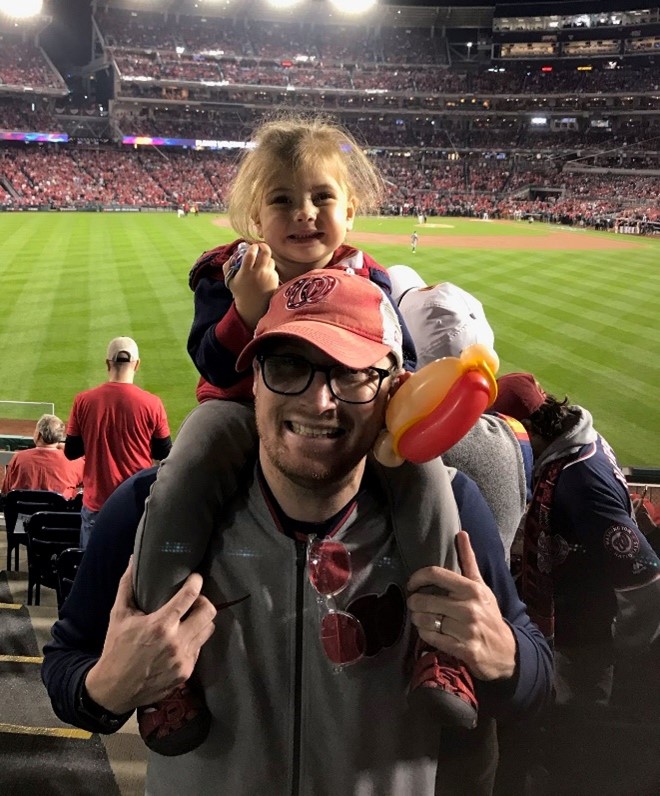
We’ve got to start with baseball, cuz it’s – baseball season! Enjoy Andrew and his daughter Eloise enjoying 2019’s first World Series in D.C. in 86 years. She looks very happy! He seems pleased too. Is that a snack in your hat, Dad?
If baseball is over, it must be Halloween. Pizza and Tacos, anyone? We’re going for the tasty little Doughnut in the back!
(🎃 Megan, Eloise, Andrew 🎃)
|
|
And of course, it wouldn’t be a full season without Santa – in a mask! Santa captures the zeitgeist in this 2020 Remo family holiday season picture. Andrew, Megan and Eloise, we hope your stockings were full to the brim and that the spring season has you once again enjoying … baseball.
Thank you Remo family, that was delightful and refreshing.
We look forward to seeing you again soon ❤.
|
|
And our closing thought for the day: if you get a chance to travel to a warm place with your mother and just enjoy her company, do it.
|
|
Thus endeth another edition of War & Peace, Retirement Style. ❤ Hug your people and change the world.
|
|
Massena Associates provides process, policy, and implementation consulting on retirement savings programs and products.
Our clientele includes states, governments, policy organizations, and private sector providers. Our specialty – efficient, targeted results. We are an active speaker on retirement security topics, including state-facilitated programs, MEPs and more.
If you’d like to explore working together, we welcome the conversation. Connect with us here, and at 339-236-0684. |
|
Looking for a great retirement savings innovation resource? Led by Dr. Alicia Munnell, the Center for Retirement Research at Boston College develops and hosts terrific content and proprietary research related to states, financial security, social security, and more.
Pew’s Retirement Savings Project studies the challenges and opportunities for increasing retirement savings and is another great resource - check out the work of John Scott and his terrific team.
|
|
|
|
|
|
|