|
2025 Kickoff & Highlights of 2024
| | |
|
Inside this issue:
- 2025: A Year of Possibility
- Highlights of 2024
- Gratitude for Katie Dively
- Spring 2025 Virtual Positive Culture Framework Training
- Featured Projects
- Connecting the Dots: Conferences and Collaborations
- Our Services
| | |
2025: A Year of Possibility | |
|
Happy New Year! As we begin 2025, I reflect on the incredible work we’ve accomplished together. Our partnerships with states, communities, and organizations across the country have been instrumental in advancing health and safety. I am grateful for your continued support and collaboration – our shared successes would not have been possible without you.
Looking forward, I am excited about the possibilities that await us. We remain committed to embracing new opportunities, fostering meaningful collaborations, and making a lasting, positive impact in the year to come. Let’s continue to make a difference together. Wishing you a joyful, safe, and healthy year ahead!
Warm regards,
Dr. Kari Finley
Director, Center for Health and Safety Culture
| |
|
In 2024, our team made strides in advancing research and community engagement:
-
Conducted 24 impactful research projects addressing critical issues in health and safety.
-
Assisted over 33 communities and clients, providing valuable guidance and support.
-
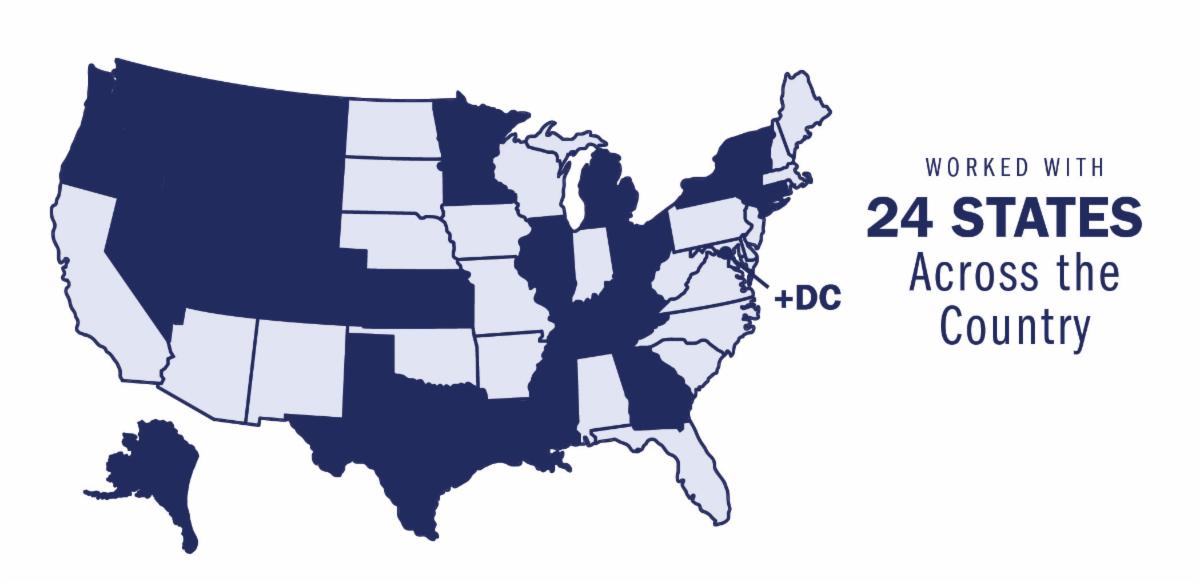
Collaborated with 24 states and the District of Columbia, expanding our reach and impact across the nation.
-
Achieved research expenditures surpassing $1.8 million, fueling innovation and progress in our work.
-
Delivered 18 in-person trainings and presentations, empowering over 1300 participants with practical knowledge and skills.
-
Hosted 10 virtual trainings and presentations, reaching over 350 attendees and fostering learning on a broader scale.
We are proud of these achievements and look forward to building on this momentum in the coming year.
| |
Gratitude for Katie Dively | |
We would like to extend our sincere appreciation to Katie Dively for her 14 years of service and dedication to the Center for Health and Safety Culture. Katie’s contributions to training and guiding communities in the Positive Culture Framework have made a lasting impact. She will be greatly missed. As Katie embraces her next adventure, we wish her all the best! | |
|
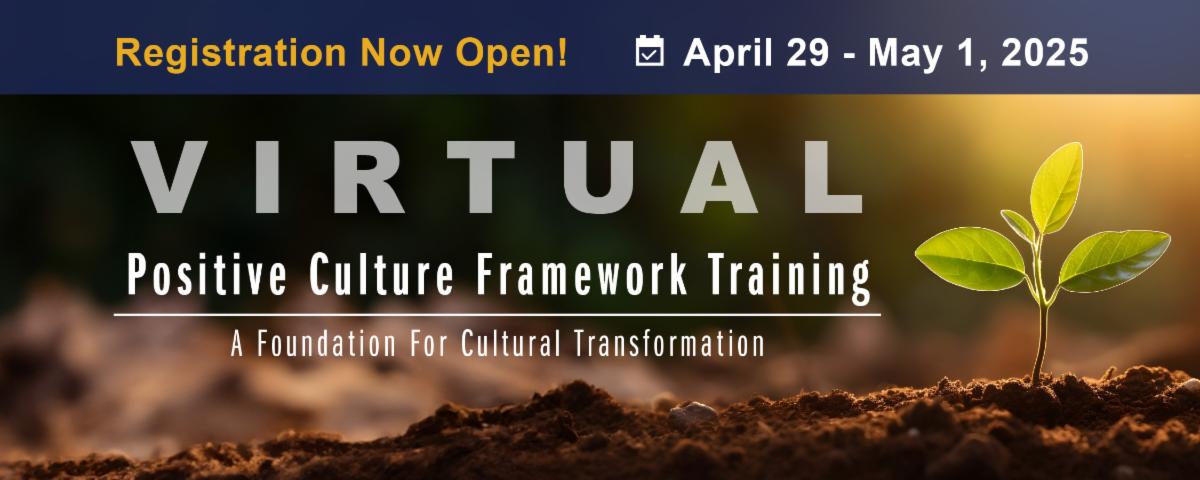
Register Now for the virtual Positive Culture Framework (PCF) Training - April 29-May 1, 2025 | |
|
We are excited to provide our popular 3-day virtual Positive Culture Framework Training. The PCF Training provides a foundation for efforts to improve health and safety that address a wide variety of complex social issues.
Training attendees will:
- Learn how culture influences behavior
- Develop and refine skills in three critical areas: leadership, communication, and the integration of effective strategies
- Gain specific next steps for transforming culture to improve health and safety
| |
|
|
The Positive Culture Framework Training is an excellent opportunity to engage with others across the country and move toward cultivating a culture that supports and sustains health and safety.
Samantha Pinzl, MPH, CHES, will be the trainer. Samantha is a Research Scientist for the Center and a knowledgeable public health educator with experience leading community prevention efforts. She helps attendees feel equipped and inspired to apply the knowledge and skills she presents.
See what past attendees have said about our virtual training:
- “This training was excellent! I am looking forward to sharing and implementing what I’ve learned.”
- “Great training. Made my master's in health promotion make more sense. Very satisfied and glad to have taken the training.”
- “This was excellent. I am so glad I participated."
- “Repetition of key points felt natural, and it felt like the course progressed logically, while many other courses I attend don’t do either of those things well.”
Who should attend?
Our training is designed for anyone working to improve health and safety including (but not limited to) substance misuse professionals, prevention specialists, violence prevention advocates, coalition members, traffic safety professionals, educators, government personnel, and law enforcement officers.
You can view the agenda and get more information here.
| |
|
The Center has completed a long-standing project aiming to increase seat belt use in rural Utah. In 2013, a significant gap was identified in the percentage of people who wear their seat belts in urban areas (85%) of Utah compared to some rural areas (55%). Since vehicle crashes are a leading cause of death and serious injury in the United States, and seat belts are a proven effective lifesaving mechanism in those crashes, the Highway Safety Office of the Utah Department of Public Safety engaged the Center for Health and Safety Culture in 2012 to look into the factors that were contributing to the sizable gap in seat belt use between urban and rural areas.
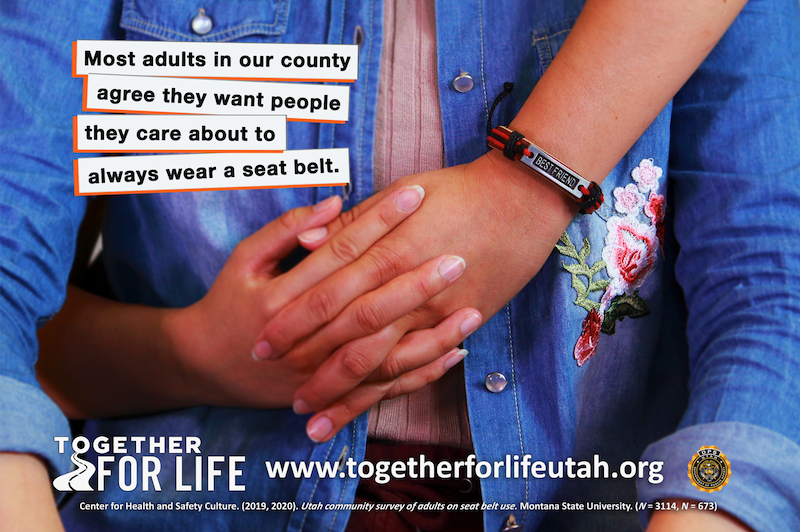
The Center worked with nine different counties in Utah between 2012 to 2024. After conducting surveys of adults to better understand beliefs about seat belt use, resources were developed for public health coordinators working in each county. The project was named “Together for Life” as it focused on growing family rules, workplace rules, and bystander engagement. After providing resources, local training, and ongoing support, the Center repeated surveys in 2019 and 2024 to assess changes in behaviors and beliefs. Between baseline and 2024, both self-reported and observed seat belt use increased in the nine participating counties. Analyses showed that adult beliefs and behaviors changed—especially among those that acknowledged they had heard or seen the “Together for Life” media. More males—both adult and high school-aged—reported wearing a seat belt, had beliefs supportive of using seat belts, and asked others to wear a seat belt (changes among females were smaller).
This project highlights the dedication of the Center to serve communities and apply our research in partnership with communities. We thank all of the partners involved in this project over the last 12 years!
View the project website here.
| |
Georgia Rural Roads: It's About Us | |
|
The Center also recently completed a project in partnership with Shepherd Center and the Georgia Governor’s Office of Highway Safety. This project aimed to increase seat belt use in rural Georgia. The CHSC works to understand beliefs and behaviors of adults regarding seat belt use by conducting and analyzing surveys. Partners in this project developed an identity for the campaign and various media including a website, video, radio, and print materials. The campaign, Georgia Rural Roads: It’s About Us, was developed to increase seat belt use in rural Georgia and decrease injuries and fatalities on rural roads. The campaign aimed to grow accurate perceptions that most adults in rural Georgia always wear a seat belt and always ask others to wear one.
View the project website here and the campaign overview here.
| |
Connecting the Dots: Conferences and Collaborations | |
American Public Health Association (APHA) Annual Meeting & Expo | |
|
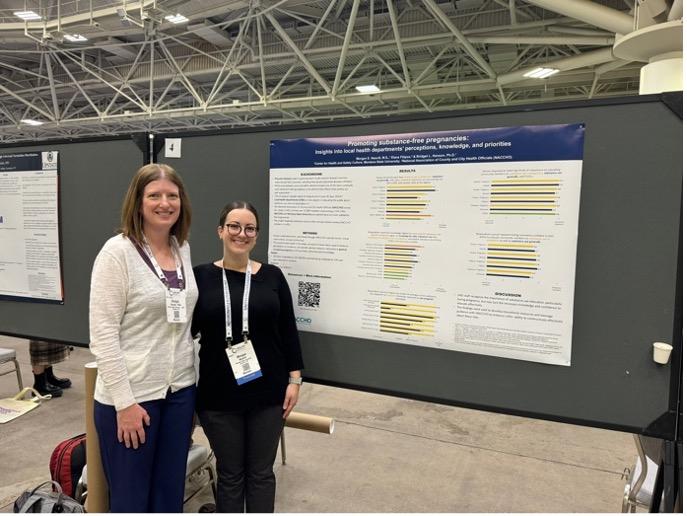
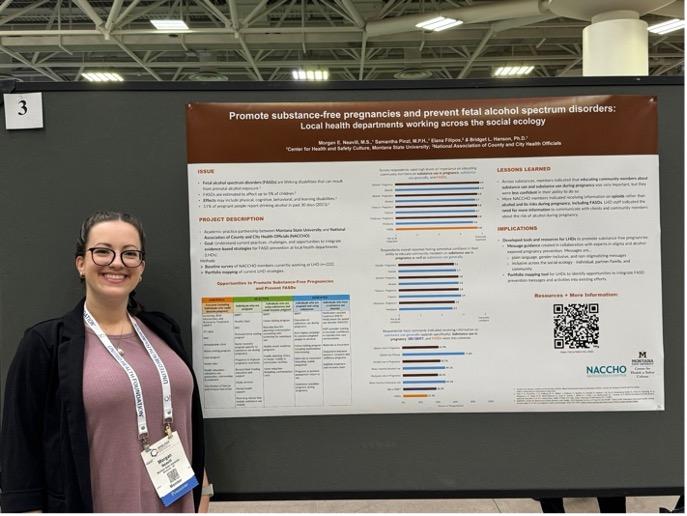
The Center is proud to work with students. Morgan Neavill, a Graduate Research Assistant at the Center and PhD student in Psychological Sciences at Montana State University, attended and presented at the American Public Health Association (APHA) annual conference with Dr. Bridget Hanson, Center Senior Research Scholar. Morgan was lead author on two posters about local health departments and substance-free pregnancies.
Morgan said, “I really enjoyed traveling to and presenting at the APHA conference in October. It was such a great experience getting to share the CHSC’s work on fetal alcohol spectrum disorders (FASDs) and getting to connect in person with colleagues. It was exciting and inspiring to see people so interested in using the FASD communication guide in their own work and communities.”
| |
Pictured left to right: Dr. Bridget Hanson and Morgan Neavill | |
Montana Department of Transportation Annual Transportation Safety Meeting | |
|
Center Director, Dr. Kari Finley, gave a keynote presentation at the Montana Department of Transportation Annual Safety Meeting in Helena, MT in October. The presentation focused on growing positive traffic safety culture and shared responsibility, an important principle of the Safe System Approach. In addition to Dr. Finley presenting and attending the meeting, Kelly Green, Research Scientist with the Center also attended the annual safety meeting. They were able to engage with multiple state partners and hear about the latest work being done in Montana to implement the Safe System Approach to improve traffic safety across the state.
Dr. Finley was featured in the Montana Department of Transportation winter newsletter (page 9). She said, "We must focus on growing protective beliefs to shift risky behaviors to change negative outcomes and consequences."
Read the full MDT newsletter here.
| |
Western Regional Commercial Vehicle Safety Summit | |
Dr. Kari Finley also spoke at the Western Regional Commercial Vehicle Safety Summit in Denver, CO in early December. The plenary session focused on state and industry coordination efforts and Dr. Finley spoke about growing positive traffic safety culture and changing beliefs to support safer behaviors. In the session, Dr. Finley highlighted two resources (click to view): | |
- Conducting, Exchanging, and Applying Research
- Cultural Assessments, Surveys, and Evaluation
- Positive Culture Framework
- Integration Skills
- Stigma Training
- Instructional Videos
- Communication & Leadership Skills
- Moving From Knowledge to Practice
| | | | |