The Pensioner: Looking Forward
|
|
Welcome to the digital MPERS newsletter! The Pensioner: Looking Forward contains news, updates, and important information for active employees of the Missouri Department of Transportation, the Missouri State Highway Patrol, and MPERS.
|
|
We look forward to serving you in the new year! |
|
In the March edition of The Pensioner: Looking Forward, the oversight formula was introduced: |
|
In the oversight formula, contributions plus investments equals benefits plus expenses. In the December edition of The Pensioner: In the Moment we explored the cost of benefits that MPERS administers. This month we will be looking at the E or the Expenses of the System. |
|
The expenses of the System can be broken down into three categories: benefit payments, investment fees/costs, and the operating budget.
Benefit payments represent by far the single largest cost to the organization – over $266 million last fiscal year. That is likely no surprise as the ultimate responsibility for MPERS is to distribute the benefits earned by covered members. The second largest cost to the System – just under $75 million for last fiscal year – comes in the form of investment fees and costs associated with the investment of funds and performance costs of the $3.0 billion trust. Finally, the operating budget covers those items pertinent to the day-to-day activities of administering the organization – $5.8 million for last fiscal year. Things like salaries, professional services, utilities, printing, building expenses, maintenance, etc., are all part of the operating budget. Each of these larger costs is managed in different ways.
|
|
As described last month, the cost of benefits is a critical function and is reliant on the effective funding of the plan. The annual actuarial valuation serves as the budget for the funding, and ultimately for the payment of benefits. The annual valuation report determines the contribution rate necessary to cover the benefit payments that have been and will be earned. For information about the valuation process, take another look back at the December newsletter. It is important to remember that earned benefits are defined by state statute. If you earn the benefit, it will be paid. |
|
Investment fees and costs are a function of MPERS’ board-approved asset allocation. The current asset allocation for MPERS has a high cost – that is, the fees for accessing a higher-return asset class are expensive (but with a payoff). The predominant factor for the high cost is the large allocation to what are called “alternative assets.” Alternative assets include such things as real estate, real assets, private equity, and commodities. Lower cost asset allocations are an option but come with considerably lower return expectations, which in turn increases the cost to MoDOT and the Patrol. Just as the cost of benefits is evaluated through the annual valuation process, the asset allocation is reviewed informally through updated capital market projections each year and more formally every three to five years through an extensive process called an asset/liability study. When the official asset allocation is set by the Boar, the corresponding cost/fee load is also established. |
|
Lastly, there is the operating budget to consider. This is a common business practice and entails an analysis of the costs necessary for the organization to function, much like creating a household budget. Relative to total costs, the operating budget represents a very small piece of the overall cost to the organization usually 2-3% in total. The operating budget is developed each year and approved by the Board before the next fiscal year begins.
|
|
Board Elections are Coming Soon! |
|
The MPERS Board of Trustees is made up of 11 members, four of which are elected by active employees and retirees of MoDOT and the Highway Patrol. The four elected members are:
- One active employee of the Highway Patrol
- One retired member of the Highway Patrol
- One active employee of MoDOT
- One retired member of MoDOT
The next election cycle is approaching quickly and will occur during the Spring of 2022. If you wish to make your voice heard by casting a vote, please make sure you have an active myMPERS Secure Member Access Account.
If you aren't sure about the status of your myMPERS account, please contact MPERS at 800-270-1271 or mpers@mpers.org.
|
|
Check Out This Month's Benefit Bite!
|
|
What is a beneficiary? It is any persons or entities entitled to or nominated by a member or retiree who may be legally entitled to receive benefits.
Below is a quick look at each plan and a beneficiary summary based on active or retired status.
|
|
Active Employees
- If an active member passes away prior to retirement and a survivor benefit is due, the survivor benefit will be paid to the spouse the member was married to on the date of death.
- If there is no eligible spouse, eligible surviving child(ren) under the age of 21 will be receive the benefit.
|
Retired Members
- Beneficiaries are determined by the payment option chosen at retirement.
- The joint and survivor payment option beneficiary is the spouse named at the time of retirement.
- The guaranteed payment option beneficiary can be any person(s) or charity and can be changed at any time.
- The $5000 death benefit beneficiary is named at retirement and can be changed at any time.
- The final payment beneficiary is named at retirement for those who chose the life income annuity or guaranteed payment options.
|
|
Active Employee
-
If an active employee passes away prior to retirement, employee contributions will be paid to the beneficiary named on the Designation of Beneficiary for Employee Contributions form.
-
If an active member passes away prior to retirement and a survivor benefit is due, the survivor benefit will be paid to the spouse the member was married to on the date of death.
- If there is no eligible spouse, eligible surviving child(ren) under the age of 21 will be receive the benefit.
|
Retired Members
- Beneficiaries are determined by the payment option chosen at retirement.
- The joint and survivor payment option beneficiary is the spouse named at the time of retirement.
- The guaranteed payment option beneficiary can be any person(s) or charity and can be changed at any time.
- The $5000 death benefit beneficiary is named at retirement and can be changed at any time.
- The final payment beneficiary is named at retirement for those who chose the life income annuity or guaranteed payment options.
|
|
MPERS FYI is Now Available!
|
|
Don't have the time or the "want to" to read all 110 pages of the Annual Comprehensive Financial Report, but are still curious? The MPERS FYI is a summary report that covers important information, in a quick and easy-to-read format. Plus, it is only 10 pages! Select the cover below to view MPERS FYI for the 2021 fiscal year.
|
|
 |
2022 Board Meeting Schedule |
Friday, February 25
Friday, April 29 (tentative)
Thursday, June 16
Thursday, September 22
Thursday, November 17
|
|
|
|
|
|
|
- 17 - Martin Luther King, Jr. Birthday - office closed
-
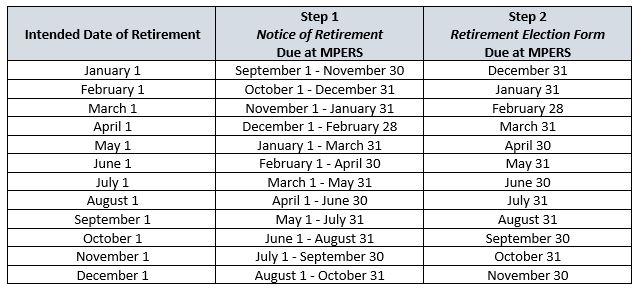
31 - Deadline to submit step 1 - Notice of Retirement for March 1 retirement
|
|
We value your feedback!
What would you like to see in The Pensioner: Looking Forward?
|
|
|
|
|
|
|