|
President's Message
Introduction to the Book of Joshua
“As I said to Moses, every place that the sole of your foot will tread upon I have given to you, from the wilderness and this Lebanon as far as the great river, the River Euphrates—all the land of the Hittites—and to the Great Sea toward the going down of the sun shall be your territory” (Joshua 1:3–4).
God’s work is not interrupted by human beings but continues on. God’s work carries on through Joshua, Moses’ attendant, even after Moses’ death. Joshua, who had been Moses’ assistant (servant), was left with the responsibility of continuing the work of his predecessor. His ministry was the fulfillment of God’s promise to Abraham, a promise that was now realized exactly as it had been confirmed to Moses. This new era, firmly established in Israel’s history, continues into the period of the monarchy. The land allotted to the twelve tribes promised to Israel was far broader than the territory actually occupied during the time of Joshua. Verse 4 refers to a region larger than the boundaries distributed to each tribe in Joshua chapters 13–19. It points to the territory of the great empire that was expanded during the reigns of David and Solomon.
Joshua, the Successor of Moses
God delivered Israel from oppression in Egypt through Moses and set them free. Now God brings them into the Promised Land through Joshua, Moses’ successor. Since Joshua stands at the center of the events recorded in the Book of Joshua, it is fitting that the book bears his name. Moses received God’s revelation at Mount Sinai and became the mediator of the covenant God made with His people. Joshua’s role, however, was more limited. His task was to lead Israel in the conquest of the land of Canaan.
God’s Presence with His People
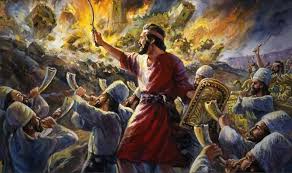
The campaign in Canaan was not merely a military operation. Throughout the entire process of conquest, it is clearly revealed that Israel did not take possession of the land because of superior military power, but because God helped them—bringing down the walls (chapter 6) and causing the inhabitants of the land to fear and tremble (2:9–11). Joshua was more than a successful military leader. Just as he himself obeyed God’s commandments, he urged the people of Israel to obey them as well.
At the climax of taking possession of and distributing the land of Canaan, Joshua exhorted the Israelites to make a clear decision about whom they would serve—God or idols—and renewed the covenant that God had made with Israel through Moses. Joshua trusted in God’s help (“God’s presence with them”), which had already been proven repeatedly throughout the history of God’s people up to that point. The command to “be strong” and “be courageous” echoes throughout Scripture. To be strong means to be bold and courageous. This decision born of faith established Joshua as a man of God and firmly secured Israel as the people of God.
God Who Fulfills His Promises
As can be seen from the statement, “Not one of all the good promises that the LORD had made to the house of Israel failed; all came to pass” (21:45), the book of Joshua was written to show that God keeps His promises. At the same time, Joshua was written with the awareness that if Israel turned away from God, they would bring upon themselves the risk of losing the land that had been given to them as a gift. As Israel conquered the land of Canaan, they inherited an agricultural way of life and at the same time learned the religious practices associated with it. Joshua describes the conquest of Canaan from the perspective of how these temptations could be uprooted.
Joshua does not recount the history of the conquest of Canaan from a purely historical standpoint. When Israel’s claim to the land of Canaan was questioned during the Babylonian exile, Joshua vividly presented, through the past events of the Canaanite conquest, the fact that God had fulfilled the promises He made to the ancestors. Each time Israel faced hardship in its history, the conviction emerged that God is the Lord of history and that He does not hand His people over as prey to other powers even now. Accordingly, the book exhorts Israel to remain faithful to this God and to place all their hope in Him alone.
Reflection
Joshua’s conquest of Canaan is the fulfillment of God’s promise, first given to Abraham, that He would give the land to his descendants. No matter how long the passage of time, God never forgets His promises. The covenant is God’s good plan for His chosen people and the rudder that determines the direction of history. Therefore, even in lives burdened by oppression like slavery or wearied by wandering in the wilderness, God’s covenant people do not lose hope or vision when they trust in the covenant.
Moses led the chosen people through the wilderness for forty years. However, at the threshold of the Promised Land, he completed his role and died, and the task of leading the people into Canaan was entrusted to Joshua. If Moses represents the Law, Joshua can be said to represent Christ. Ultimately, the Book of Joshua foreshadows one aspect of the New Testament truth: that the Law is a tutor leading us to Christ, and that only Christ can justify us and lead us into the kingdom of heaven, the inheritance of the saints.
|