|
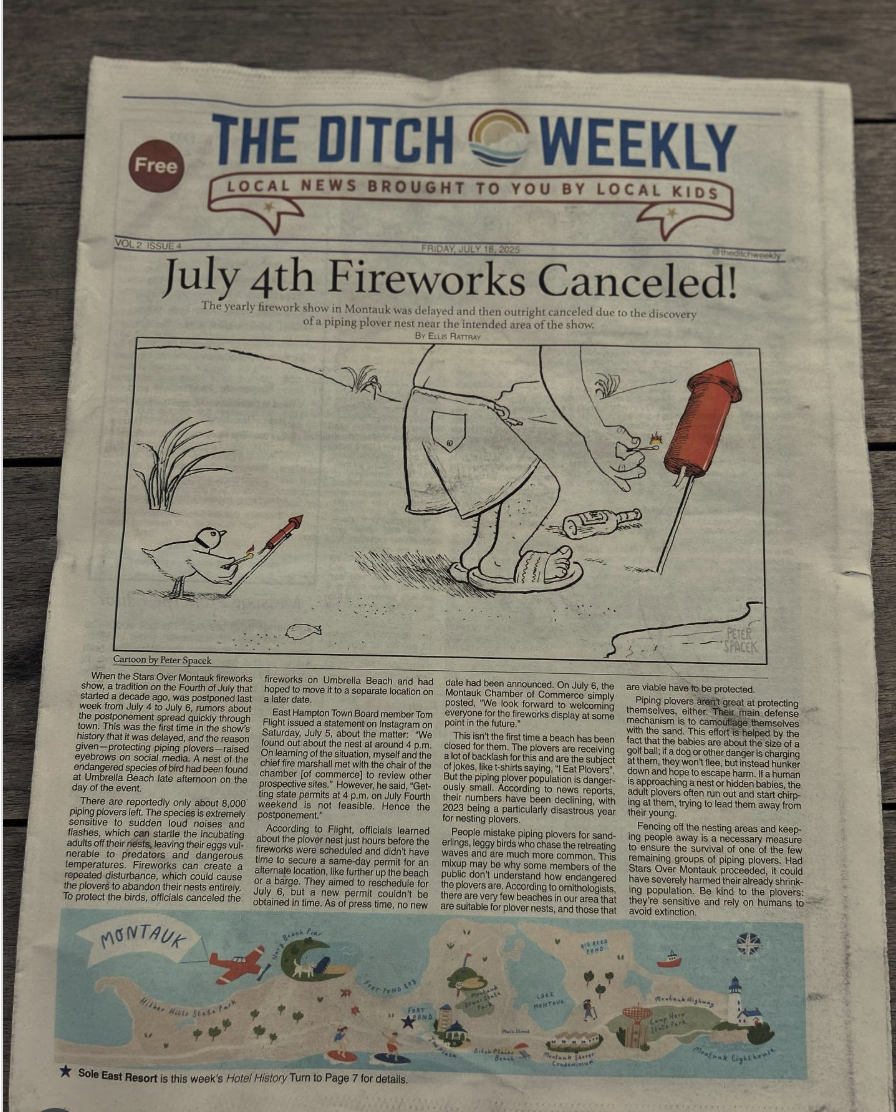
The Institute reached out to Stern find out what it took to motivate a group of teens to launch a newspaper in their small town.
This interview has been edited for length and clarity.
What got you interested in the newspaper business?
Stern: I wanted to start a business in general, something I could run during the summer. I wanted to find something that didn’t already exist in Montauk. There was no weekly newspaper specific to Montauk. So we did a little research and looked at the numbers to see if, financially, it was something that would be able to function. We saw that it was something that would definitely work as long as we could sell the ads. We started working on it in the winter of 2024 and were able to put out our first issue in May of 2024.
When people think of the Hamptons, they often think of big-time celebrities making headlines there. But you all focus on something a bit different. Tell me about your scope of coverage.
Stern: What we try to cover is just local topics that affect local people. So that could be anything from beach restorations to the building of new hospitals to even just reporting on local high school sports teams. These are topics that local people will be interested in, as well as people who are coming out here in the summer to be tourists.
Some of your staff’s parents are involved in the news business. (For example, the owner and editor of The East Hampton Star is father to one of The Ditch Weekly columnists.) How involved are your parents?
Stern: When we started the paper, we of course had pretty much no experience in newspapers or business in general. So I took some advice from my parents — and some of my partners’ parents as well — on how to manage it and how to build a team. But the actual work throughout the summer has been entirely by kids — there's no parent input. Everything is done by the staff members of The Ditch Weekly.
I get that a lot. People say, “Oh, your parents must be doing this. They must be helping you.” They’re really not. It's all kids.
How does your team generate story ideas?
Stern: Social media. We see Instagram posts about, “This organization is holding this fundraiser this weekend,” or just chatter among the community: “Oh, did you hear New York Governor Kathy Hochul is probably going to put in this new thing that's gonna build more sand at the beaches in Montauk?” So we'll hear that, we'll do some research on it, and we'll assign an article.
We get tips on certain things. People will email us with press releases and stories that we should run in the paper, and then we try to make them happen.
People have been saying “Print is dead” for years. What advice would you give to young people who are interested in the news business or, more specifically, newspapers?
Stern: I would say, if you're a kid and you want to start something like what we've done, it's very possible. You don't really need a lot of resources. If you could work hard enough and make it happen, you can do it.
About print being dead, I honestly think that's probably true. I think we live in such a digital age where it's not reasonable anymore to be able to just put out print issues of a newspaper or a magazine and expect that to just take off. I think social media is probably the way to generate more eyes on whatever you're trying to do. But if you want to put out a print publication, I think there are certain ways to do it that still work.
You have to find the right audience. You have to find the right location of where to put it out, and you have to hype it up on social media. People go on their phones for multiple hours a day, and that's how they get their information.
So, do you have plans to make a digital version of the paper?
Stern: Probably not, just because the amazing part of the paper is the fact that we are in print, that we are still able to do it. But if it comes to it, there's a chance that we will have to go digital. But if we do, the reason will probably be financial or just because we want more eyes on it.
You mentioned social media. On your Instagram page, you share behind-the-scenes content of your team out in the community doing things like spending a day on a fishing boat with a company you covered. What’s the mindset behind sharing things like that?
Stern: We want people to see that we are just kids and that we are having fun. And we also want people to see different parts of the community and what's so great about where we live. We have so many fishing boats in Montauk — they don't get featured the same way as, like, a celebrity who went to a dinner in Sag Harbor and drove his truck into a tree.
We really just want to show all the ins and outs of Montauk. I'll go on my delivery route every week, and I go to these amazing parts of our town that you never see.
What are your goals for The Ditch? And what are your personal goals in journalism or otherwise?
Stern: I really just want to keep growing it. I'm not sure entirely what we're going to do next summer, whether it's going to be a 10-issue paper or something else. But I just really want to keep pushing the name out there and build the brand. For my own goals, I would say I just want to have fun. I want to be successful. So I don't really know what I'm gonna do.
|