Instagram  LinkedIn  X  YouTube  Bluesky

NEWSLETTER November 2025

As we approach the end of 2025, we are delighted to share updates from the SIG Participatory Research in Health Promotion (PRHP). This edition highlights developments from our October leadership meeting, upcoming activities, and a warm introduction to our newest leadership team member.


New leadership team members


Introducing Janneke, as our new SIG leadership team member


Hi! I’m Janneke, a passionate participatory researcher. Last year, I completed my PhD, in which I combined co-creation with implementation science. Specifically, my PhD thesis focused on co-creating an implementation intervention for a school-based healthy sleep intervention. Soon I will continue my career as a Research Associate at the University of Leicester. In this role, I will focus on the co-creation of behaviour change interventions that aim to increase physical activity and reduce sedentary behaviour, promoting a healthy lifestyle.


Why am I passionate about participatory research?

I am passionate about participatory research because I truly enjoy working with people and I believe that community members are the best experts on their own needs for enhancing wellbeing. This is why they should be actively involved in the development, implementation, and evaluation of behaviour change interventions.


Share your imPARfections! What do you find challenging about participatory research?

I have encountered several imPARfections during my research to date. First, I employed voluntary sampling for my studies, which led to the inclusion of the most motivated participants, rather than those who may have needed the (implementation) intervention the most. Additionally, throughout the co-creation processes I have conducted, I faced time constraints. Despite thorough preparation, things often unfolded differently than planned. As a result, these time constraints impacted the participatory aspect of the research.


SIG PRHP coffee break series ☕ 

We are excited to launch the Participatory Research Coffee Break Series, short, informal opportunities to connect, share experiences, and strengthen our community.

Next session

📅 3 December

⏰ 09:00 UTC

🎙 Theme: Ethical applications in participatory research

Join us for a short introduction on navigating ethical approvals within participatory projects, followed by open discussion.

💬 A chance to meet others working with participatory research and learn from each other in an informal, supportive setting.

☕ Bring your coffee (or tea) and join us to connect, reflect, and learn together.

What to expect

  • A 5-minute opener
  • Shared experiences from researchers
  • Light, supportive conversation
  • Breakout discussions (if needed)
  • Opportunity to submit questions in advance

Registration

https://us02web.zoom.us/meeting/register/vNwkKNS8R0iUdXP5hveL_Q


Upcoming 2026 sessions

  • 10 March, 09:00 UTC – Co-adaptation in participatory research
  • 7 May, 09:00 UTC – Theme selected by participants


Participatory Research Expertise Map

We encourage all members to add their details to the expertise map to support visibility, collaboration, and shared learning across the SIG.

https://docs.google.com/forms/d/e/1FAIpQLScrNSYAthDVZsjRZDyTNYg31bWhH-RRG32LWakgLLoAm8bqnw/viewform?usp=sharing&ouid=116213889453341328546


Research Spotlight


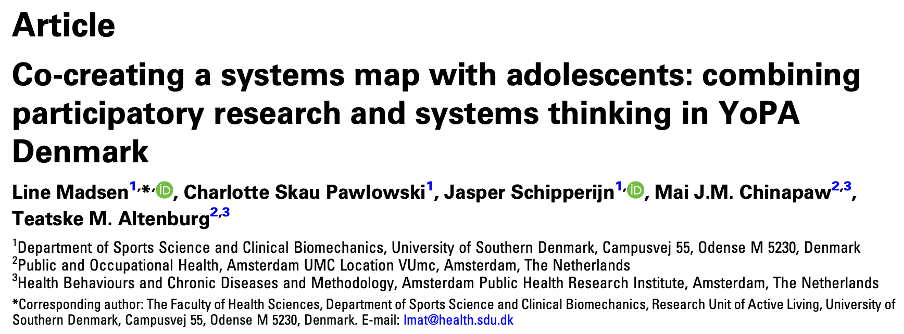
This paper illustrates how participatory action research (PAR) and systems thinking can be combined to meaningfully engage adolescents in understanding and improving their own physical activity environments. Using the Danish arm of the Youth-Centered Participatory Action (YoPA) project as a case example, the authors worked with adolescents from two underserved youth clubs to co-create a systems map of the factors influencing outdoor physical activity.


Across an eight-session participatory process, drawing on photovoice, community mapping, interviews, and collaborative storytelling, adolescents acted as co-researchers, shaping the data and analysis through their lived experiences. The resulting map identified five key drivers of outdoor physical activity:

  1. Sense of belonging,
  2. Maintenance of outdoor spaces,
  3. Peer influence,
  4. Accessible and attractive spaces, and
  5. The role of youth club staff as organisers and role models.


The study demonstrates the added value of integrating youths’ own perspectives when addressing complex public health challenges. The authors highlight that combining PAR with systems thinking not only produces more context-relevant insights but also builds young people’s confidence, agency, and capacity to engage in local decision-making. The systems map will now guide the co-development of local interventions to support adolescent physical activity in underserved communities.


Looking Ahead to 2026

  • Greater SIG visibility at ISBNPA 2026
  • Cross-SIG collaboration opportunities
  • Exploration of more interactive webinars
  • Continued work on strengthening participatory research communities
  • Website update anticipated by end of December


Thank you from the leadership team

We appreciate your engagement throughout the year and look forward to building an even stronger participatory research community in 2026.

If you have items you’d like included in future newsletters, please get in touch.


Instagram  LinkedIn  X  YouTube  Bluesky

Be updated on all ISBNPA news

Stay tuned at