Hello Sue,

Monthly News & Updates

February 2025 Issue

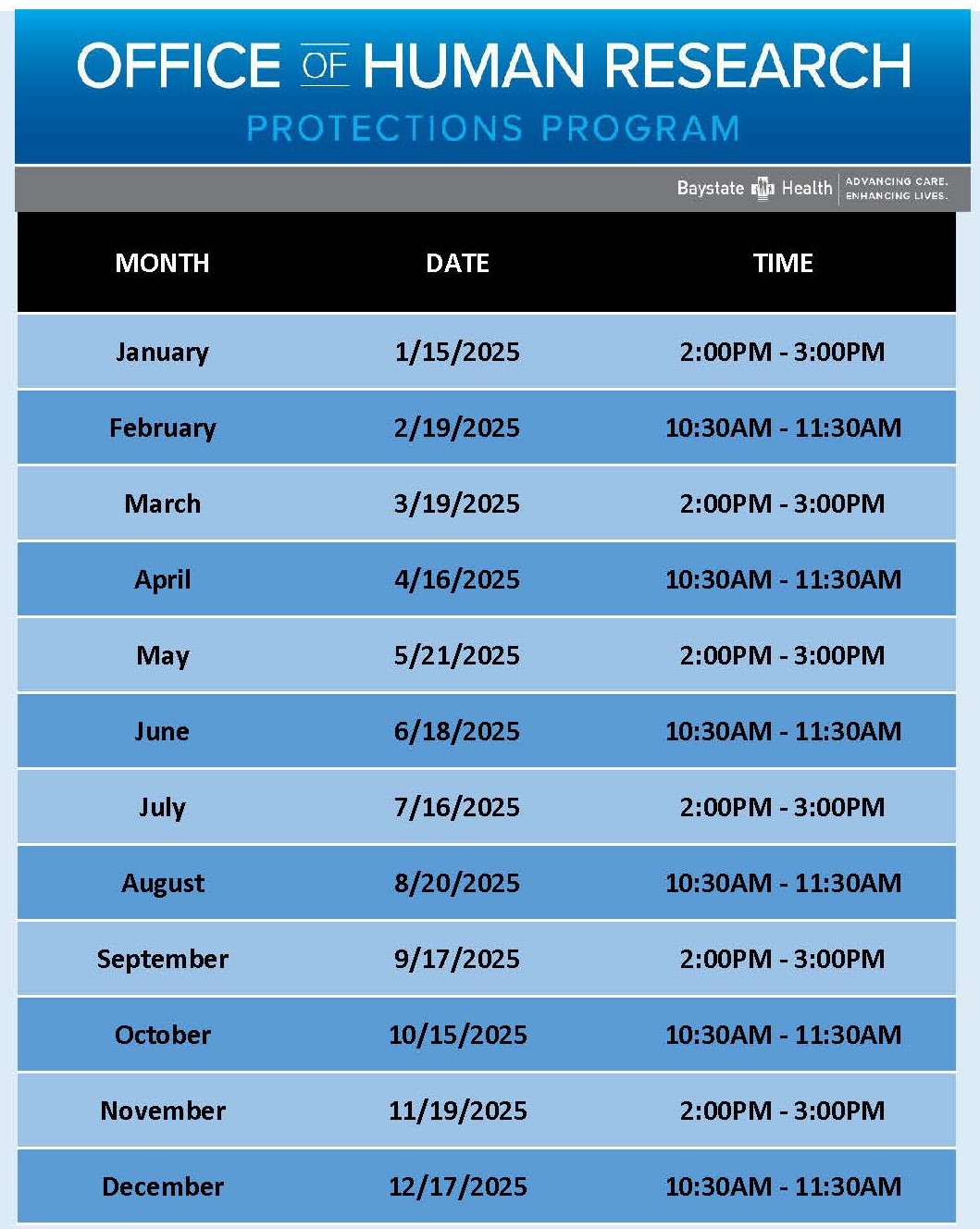
2025 Research Community Meeting Schedule

Visit our Website

Please visit the HRPP Website to watch the February 19, 2025 Research Community Meeting and past meetings.


The next Research Community Meeting will be held on Wednesday, March 19, 2025, from 2:00 PM - 3:00 PM ET.

Zoom Link


Monthly Education - Research Community Meetings


Starting with our March session, we will begin a monthly education series as part of the Research Community Meetings.


The topic for our March 19, 2025 meeting will be:

The history of human subjects research and foundations for regulations.


Please refer to the link below for the full schedule. Continuing education credit will be available for the March session and future sessions.


If you do not already have an EthosCE account, please go the the Continuing Education website to create your account.

Link to the Schedule
Instructions for Using EthosCE
 

Policy Updates


In the February Research Community Meeting, Jennifer Pacheco, MPH, CHRC, CIM, CIP, provided updates to two Baystate policies:


  • BC 10.155 - Participant Payments for Sponsored Awards
  • The policy goal is to ensure that all payments are conducted ethically, in compliance with legal requirements and are in alignment with institutional policies.


  • BC 10.125 - Translations and Use of Interpreters in Research
  • To ensure that non-English speaking, limited English proficiency, deaf, hard of hearing and deaf-blind individuals have an equal opportunity to obtain any potential direct benefits that may only be available within the context of the research.


The updated policies will be uploaded to Scribble on The Hub soon. The full PowerPoint presentation can be viewed below.

View the PowerPoint
 

Registeries and Repositories


In the February Research Community Meeting, L. Cliff Rhodes, MBA, CIP, presented on registeries and respositories.


A registry is a tool that identifies and tracks groups of people with similar characteristics, such as disease, genetic makeup, health behaviors, and surgical procedures. Registries can be used to provide investigators with potential study volunteers.


A repository is a tool that collects and stores data from individual patients for analysis purposes. Repositories can contain biological specimens.


The full PowerPoint presentation can be viewed below.

View the PowerPoint
 

Florence eBinders


On January 22nd, our EQA team gave a presentation on Florence eBinders. This presentation was recorded and can be found here.


Decedent Research


According to federal policy, research involving deceased individuals is not considered human subjects research and therefore does not require IRB oversight unless the research study includes both living and deceased individuals. Except, there’s a catch. You see, the HIPAA Privacy Rule has to be considered. It gets more complicated if the study involves both living and deceased records.


The Common Rule (45 CFR 46.102(e)(1)) defines a human subject as “a living individual about whom an investigator (whether profession or student) conducting research (1) obtains information or biospecimens through intervention or interaction with the individual, and uses, studies, or analyzes the information or biospecimens; or (2) obtains, uses, analyzes, or generates identifiable private information or identifiable biospecimens.”


The FDA regulations similarly imply that subjects are living, as they define a "human subject" as a person involved in research, either receiving a test article or serving as a control. (21 CFR 56.102 (e) and 21 CFR 812.3(p)


While IRB oversight may not apply to decedent-only research per the Common Rule or FDA, other regulations like the HIPAA Privacy Rule and institutional requirements for Material or Data Transfer Agreements still apply. The Privacy Rule requires researchers and covered entities like Baystate, to ensure they can meet the requirements of Privacy Rule Accounting of Disclosures, obtain attestations for assurances that the protected health information (PHI) is the necessary for the research and that researchers can produce documentation of death, if requested.  As with all PHI any data or specimen to be shared outside of the covered entity may require a written agreement. At Baystate, these research determinations and attestations are done by the IRB which functions as the research privacy board.


All researchers should also note, if a study involves both living and deceased individuals, IRB review and oversight is likely required.


Researchers intending to utilize decedent records for scholarly activity should consult the IRB office for guidance.

Link to the Deceased Individuals Attestation Form
 

Baystate Physician Addresses Concerns Following TB Outbreak in Kansas


Public health officials in Kansas City are sounding the alarm about a tuberculosis outbreak. Tuberculosis is one of the world’s leading infectious-disease killers. It’s spread in the air from person-to-person. “TB spreads through the air when a person with active TB coughs or speaks or sings and patient in close contact because it can linger in the air for quite some time. It can be really infectious,” said Dr. Armando Paez, chief of the Division of Infectious Disease at Baystate Health. Read the full story via the link below.

Link to Story
 

Community Members Needed for IRB


Unaffiliated community members of the Institutional Review Board (IRB) are individuals

whose primary concerns reflect those of the

population where research participants are

coming from. They bring fresh insights and

perspective about how to best protect research

participants. Unaffiliated community members

review from the point of view of sharing community and cultural awareness in the context of the research. No experience is necessary. Baystate's IRB is looking for individuals who can fill this role. If you know of anyone that may be interested in being a part of our IRB as a community member, please email Michael Boland at michael.boland@baystatehealth.org.


In Other News...


The most recent newsletter from the Tufts Clinical and Translational Science Institute has several articles and upcoming events that may be of interest.

Link to the Newsletter
 

Recipe of the Month


Red Velvet Brownies


Inspired by the beloved cake, these red velvet brownies are dense, fudgy, and topped with a tangy cream cheese frosting for an eye-catching dessert that will shake up your usual baking routine.

Make this colorful twist on chocolate brownies for a festive touch at your next party, as an after-school snack, or to just keep in the freezer to have on hand for drop-in guests. The snowy-white cream cheese frosting adds a delicious contrast to the bars, but you can also top them with your favorite chocolate frosting if preferred.

View the Recipe
 

February Humor


Q. Why did George Washington have trouble sleeping on his birthday?

A. Because he couldn’t lie!

Q. What do you do at the end of the last day of February?

A. You March on!

Q. How are corny dad jokes like Groundhog Day jokes? 

A. You always keep hearing the same puns over and over again!

Q. Why should you order a burger on Fat Tuesday in New Orleans?

A. They serve the best French Quarter pounders!


Reminders


Have your trial listed on the Office of Research website. The Office of Research website has a page dedicated to clinical trials information for patients and families. Increase your enrollment by listing your trial here. Link to the Form


Don't forget to use ServiceNow for all requests going to the HRPP Education and Quality Assurance Program (EQA). Link to ServiceNow.

Email Michael Boland at michael.boland@baystatehealth.org if you have something that you would like included in a future newsletter.